
Gardening, Home and Nature Thread, April 18
—K.T.

From Don in Kansas, end of February:
The weather can always double-cross you - - this is Kansas, after all - - but it looks like spring is early this year. I snapped these pictures earlier today.
Continue reading









Freedom of Thought and Religion
—K.T.
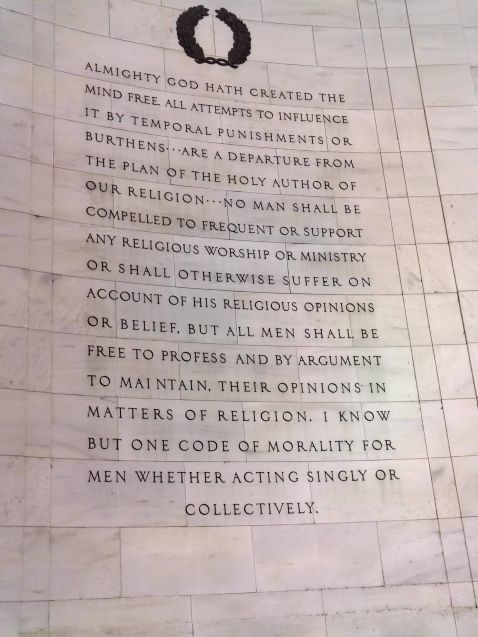
Family friends recently returned from a visit to D.C., where the photo above was taken.
Thomas Jefferson Memorial Inscriptions
Northwest Portico"Almighty God hath created the mind free. All attempts to influence it by temporal punishments or burthens . . . are a departure from the plan of the holy Author of our religion . . . No man shall be compelled to frequent or support religious worship or ministry or shall otherwise suffer on account of his religious opinions or belief, but all men shall be free to profess and by argument to maintain, their opinions in matters of religion. I know but one code of morality for men whether acting singly or collectively."
-Excerpted from A Bill for Establishing Religious Freedom, drafted in 1777. First introduced in the Virginia General Assembly in 1779, after he had become Governor. Passed by the Virginia Assembly in 1786, while Jefferson was serving as Minister to France. The last sentence is excerpted from a letter to James Madison, August 28, 1789, as he was returning to America to assume his position as Secretary of State.

Continue reading

The Classical Saturday Morning Coffee Break & Prayer Revival
—Misanthropic Humanitarian

[H/T Sharon(Willow's Apprentice). I see there is another Misanthrope in the building]
Good morning boys and girls and everything in between. Before we enter the Prayer Revival just a few housekeeping matters to go over. (Rulz for those of you in Baldwin)
1) This is an open thread. Feel free to lurk, opine and/or bloviate.
2) Be kind, be nice. Or else.
3) Running with sharp objects should be done during the Movie Thread.
4) Have a great weekend!
Continue reading
Daily Tech News 18 April 2026
—Pixy Misa
Top Story- Intel's new Core Series 3 is its answer to the MacBook Neo. (PC World)
The A18 CPU used in the MacBook Neo uses 6W maximum, and typically throttles down to 4W since the laptop is passively cooled.
All models in the Core Series 3 range use 35W maximum and a base of 15W, which is rather more than that. So while it may be Intel's answer, it is not necessarily a good answer.
The first laptop announced with the Core Series 3 is Honor's Magicbook 14. That costs around $1000, but on the other hand it comes with 32GB of RAM and 1TB of SSD, which is more than is even possible in the MacBook Neo.
- Meanwhile AMD's legendary 5800X3D may be making a return. (Tom's Hardware)
AMD has officially made non-committal noises about this. The chip was taken off the market allegedly because it was too competitive with the newer 7800X3D. But with DDR5 prices in cislunar orbit, and the slower 5700X3D and 5600X3D also retired from the market, it would be a very welcome sign.
But it's allegedly a 10th anniversary special edition, and Ryzen's 10th anniversary is in December, counting from the announcement, or next March counting from retail availability. Hope we're not going to have to wait that long.
I mean, it's not like I have 384GB of DDR4 RAM lying around, but if I did I might be interested.
Continue reading
After FANG FANG, He Stuck His WANG WANG Into Someone Else's THANG THANG. She Said Wait A DANG DANG Minute And Went To The DA And SANG SANG ONT.*
—WeirdDave
Welcome to Friday Night! Let's start with a little advice for Eric Swalwell
Continue reading








Carnivorous Pig Attack Cafe
—Disinformation Expert Ace

Kyoto
Puppy mocks a poor turtle. Bad puppy.
Ah the weekend.
Puppy keeps his habits throughout his life.
Baby wants to make sure mom keeps it fair.
Baby lamb tries to make friends with the piglets.
Brought you this stick with a nice shiny wasps' nest on it, hope you like it...
Kitten from the top rope.
Timid rescue dog afraid of everything finds an understanding friend.
Continue reading
Blowin' Up Stuff Real Good Agin Open Thread
—Disinformation Expert Ace
No this is a new one.
This is interesting if you're into guns: The slow-motion guys fire a teeny-tiny pin gun at the back of a bullet to see if they can ignite the second bullet by hitting its primer with its teeny-tiny bullet. I say it's interesting because it turns out, without a barrel, and without a closed hammer at the back of the barrel to force all gas forwards, a bullet that's been sparked off by a hit on its butt isn't much of a projectile. One could say it's a damp squid.
Okay that was a teeny-tiny round. Here are some bigger ones.
.50 caliber fired into a ballistic head. BTW, a lot of these cause actual fire/light upon impact just due to the energy of impact.
I did link this a while back -- firing the .577 Tyrannosaur elephant gun at blocks of ballistic gel.
And he tests whether the .577 Tyrannosaur could stop an actual Tyrannosaurus Rex, firing it at a balilstic head in the shape of a Tyrannosaurus's.
A nock volley gun is a multi-barrel rifle designed to shoot an entire volley of bullets with one shot. This particular volley gun is called "The Kraken," and has seven barrels each firing a .61 caliber round. Apparently it's based on a gun used in shipboard combat-- you'd fire it from the crow's nest down to the decks.
It's a big gun with a lot of recoil.
A howitzer shell fired at a ballistic torso. And then, that tank shell fired at a ballistic head.
A tank shell fired at a ballistic torso.
In this clip, they fire an RPG-7 (rocket propelled grenade, which isn't really what it stood for, but that has been made up as a retronym to explain the Russian initials) at a ballistic torso. In the first hit, the grenade doesn't detonate, because it passes through the torso quickly enough that its detonation mechanism doesn't detect it as an actual stop/hit. So they put some cinderblocks behind the torso, and make the detonator more sensitive, and blow it up real good.
Continue reading
The Week In Woke
—Disinformation Expert Ace
The Party of Plunder:

Chris Pratt's wife posted a short video praising her husband for building a dollhouse for their daughter, and the bitter loneley wallflower alcoholic wine-aunt AWFULs attacked her for it.
Katherine Schwarzenegger sparked a debate with fans after she praised her husband, Chris Pratt, for building a dollhouse for their daughters.The "Kat and Brandy" author recently took to Instagram to share a video of the actor getting his hands dirty while working on the homemade project.
"I'll never understand when women say, 'I don't need my husband' when I very much in fact do need my husband because who else would build our daughters a dollhouse?" she wrote over the clip set to Olivia Dean's "Man I Need."
Schwarzenegger, 36, also gushed over Pratt, 46, in the caption, writing, "When you have a golden retriever husband >>>."While the New York Times best-selling author was merely showing appreciation for the Marvel star, her remarks rubbed some critics the wrong way.
"Wives and women can build doll houses, too," one person wrote, as another added, "Women can do that. We can buy our own homes and vote, too! 😉."
Others echoed the same remarks, with a third chiming in, "How nice that he [built it], but it's either tone deaf or passive aggressive to say you'll 'never understand.'"
Others attacked her as a "child of privilege." Which is a true fact, but... what motivates this?
Malicious envy. Once you see it, you can't stop seeing that every single feeling a leftist has is just resentful, spiteful envy. Everyone has those kind of flaws -- but they have adopted an ideology that tells them these are not flaws and evil thoughts to be contained, but instead "empowerment" and "enlightenment" to be nurtured and wielded as a weapon.
AWFULs are the most maliciously envious, spiteful, hateful, and useless people the world has ever produced
Dr. Oz and Stephanie Carlton write about California's no-child-left-untransitioned psychopathy.
California was horribly wrong about gender and kids California's classroom policies put children on a path to irreversible medical interventions with no proven benefits...
Until recently, this debate was dominated by radical gender ideologues, who insist on affirmation at any cost.
...
In California, the pipeline to these drastic interventions begins in the classroom, where state law requires teachers to hide kids' gender confusion from parents, even if that means sitting across from them in parent-teacher conferences and lying by omission to the very people most responsible for those children's care and wellbeing.
Socially transitioning children at school puts them on a collision course with sex-rejecting medical interventions that cause lower bone density, infertility, cardiovascular problems and other painful, costly health issues.
There is no off-ramp. California's ban on "conversion therapy" applies not just to the abusive practices most people associate with that term, but to any counseling that might reduce children's gender distress without transitioning them. (Multiple states have similarly broad bans on their books, though the Supreme Court just struck down Colorado's.)
Those policies are rooted in academic "queer theory" rather than science, but after a long campaign of infiltration and intimidation, activists managed to align the medical profession with their ideology. Just a few years ago, they could claim that "[e]very major medical association" considered sex-rejecting interventions for trans-identifying youth to be "safe and lifesaving."
But that confidence was never matched by strong evidence.
Thankfully, the tide has turned. There's a growing international consensus that the gender activists were wrong. Scientific reviews in Sweden and Finland, as well as the U.K.'s rigorous Cass report helped convince those countries to dramatically scale back sex-rejecting interventions for children and adolescents.
Last fall, the U.S. Department of Health and Human Services (HHS) published a comprehensive review titled "Treatment for Pediatric Gender Dysphoria: Review of Evidence and Best Practices," which arrived at the same conclusion: that medically transitioning minors conveys no proven benefits.
The choice between "a trans son or a dead daughter" convinced thousands of parents to approve interventions that irreparably damaged their children. It turned out to be a false dichotomy.
Socially transitioning children at school puts them on a collision course with sex-rejecting medical interventions that cause lower bone density, infertility, cardiovascular problems and other painful, costly health issues.Evidence also increasingly suggests that trans-identifying kids were not simply "born in the wrong body" but may instead be struggling with deeper issues.
The recent spike in youth gender dysphoria coincided with a massive decline in teen mental health (likely driven by smartphones and social media). Both trends were more pronounced among girls.
One influential study found that 63% of adolescents presenting with gender distress have at least one co-occurring neurodevelopmental disability or mental health disorder.
These kids don't need puberty blockers and hormones. They need psychotherapy, family counseling, thorough clinical evaluation and perhaps treatment for anxiety or depression -- not a rush toward irreversible medical interventions.
People continue fleeing the Shitholes controlled by the left.
EXCLUSIVE: 5.4 Million People Have Migrated To Pro-Trump Counties Since 2020 As The Great Divorce Continues
The past five years have seen a massive migration of Americans out of heavily Democratic counties and into ones where Donald Trump won majorities in each of the past three elections. That's according to an exclusive analysis by Issues & Insights of the latest Census Bureau and election data.Most analyses of internal migration patterns look only at state-level data. And what they show is that blue states are losing population to red states, and have been for many years.
I&I wanted to go deeper, so we used the latest Census data on migration between counties, and compared that with how these counties voted in the past three presidential elections.
What we found was that millions aren't just moving out of blue states, but are moving out of blue counties within states.
Trump won 2,589 counties in each of the past three elections. From 2020 to 2025, those counties gained 5.4 million people due to net migration -- which measures how many people move into and out of an area. The 433 counties where Hillary Clinton, Joe Biden, and Kamala Harris carried the day saw a net loss of 5.43 million people.
And the 121 counties in which Trump won at least one of the past three elections saw a net gain of 29,000 people over those years.
I&I has been tracking these migration trends for years. In 2023, we found that Biden-voting counties had lost 2.6 million people from 2020 to 2022. We did the analysis again in 2024, and the number had swelled to 3.7 million. The exodus clearly has continued.
...
The 10 counties with the biggest loss of population from 2020 to 2025 were all heavily Democratic -- they voted for Hillary Clinton, Biden, and Harris. (Miami-Dade flipped into the Trump camp in 2024.)
Even if you go further down the list, the pattern remains.
Of the 50 counties with the biggest net gain of population, all but four voted for Trump in the past three elections. Of the 50 counties with the biggest losses due to net migration, all but five are solid blue.
...
Millions of Americans would rather live among Trump supporters than those voting for the likes of Kamala Harris.
A professor was denied emeritus status because he cited long-known and uncontested facts about men having more extreme IQs -- more men are mentally retarded than women, and more men are super-geniuses than women.
I can't stress how uncontested this fact is.
But you're not allowed to say it, because these political extremists are all about TheScience (TM).
Eric Rasmusen, a well-known professor of economics at Indiana University, recently said he was denied his application for emeritus status.Rasmusen retired in 2021, but decided not to apply for emeritus status until last year when the university stopped offering free access to online journal subscriptions for faculty who were retired but not emeritus, Rasmusen wrote recently on his substack.
"If I continue to be denied access, I will accept that," he told The College Fix in a recent interview. "It isn't fair, but I can ask friends at Indiana University and elsewhere to look up scholarly articles if I need them."
Typically, professors who retire in good status are awarded the title "emeritus," but Rasmusen said he was not. He believes the answer to this question goes back to 2019 and a controversial social media post about men and IQ.
...
Meanwhile, National Association of Scholars President Peter Wood told The Fix that denial of emeritus status is uncommon because "conferring such status on a retiring professor is essentially costless."Wood said in a recent email that "the only reason to deny it" would be "the danger of reputational damage" such as "credible accusations of plagiarism, research fraud, rape, or other criminal felonies ..."
...
Rasmusen, however, has not faced such accusations nor, as he pointed out, is he lacking in academic prowess.
...
When asked about discrimination against conservative professors in higher education, Wood told The Fix that a conservative professor "may well encounter discrimination during tenure review, promotion, teaching assignments, and a host of other ways. The Rasmusen case, however, is the only one I have heard of in which a conservative professor, having survived all those sorts of attacks, has been denied emeritus status."
Wood told The College Fix that "Rasmusen's account of that denial is highly credible."
Meanwhile, Rasmusen, who is conservative and a Christian, said he believes the emeritus status issue is linked to a controversy over his social media posts.
On Nov. 7, 2019, Rasmusen tweeted a quote from an article titled "Are Women Destroying Academia? Probably." The quote read, "Geniuses are overwhelmingly male because they combine outlier high IQ with moderately low Agreeableness and moderately low Conscientiousness."
...
To the label of "racist, sexist, and homophobic," Rasmusen responded: "I oppose admitting people to universities based on their race; I open doors for ladies; I say that sodomy is a sin. I suppose that's enough to qualify me for those insults under the Provost's personal definitions."...
To the statement that "he believes that black students are generally unqualified for attendance at elite institutions," Rasmusen clarified his belief that it "is clear is that *some* students are admitted because of their race -- which means that others are denied because of their race ... Affirmative action may be right; it may be wrong; but that's what it is."
The observation that men are psychologically less "Agreeable" -- and hence more willing to buck conventional wisdom, prevailing hierarchies, and accept the punishment that rules-enforcing mediocrities inflict -- is also uncontested.
As for affirmative action resulting in people being admitted or promoted due to race -- that's the entire point of it. But, again, you're not allowed to say it.
They love TheScience (TM), though. Just ask them!
Continue reading
Hollywood: Shit or Garbarge?
—Disinformation Expert Ace
Even The Hollywood Reporter is admitting this.
Fantasy Authors Are Not Playing: Creators Increasingly Call Out "Unfaithful" AdaptationsFrom 'House of the Dragon' to 'God of War' to 'The Witcher,' shows are getting smacked by creators for seeming to stray from source material. And there are reasons it's happening now.
Amazon Studios has to be at least a little thankful that J.R.R. Tolkien is no longer around.First, the studio came under fire by best-selling fantasy author Brandon Sanderson for its Wheel of Time adaptation ("I had my problems with the show," Sanderson said last year. "I won't miss being largely ignored; they wanted my name on it for legitimacy ... it had a fan base that deserved better"). Then last month, the creator of the God of War video game, David Jaffe, savaged a first-look photo (above) from Prime Video's upcoming big-budget adaptation ("It is so bad in so many ways," Jaffe said in a YouTube rant. "Neither of these characters look very interesting or appealing. If this was God of War: Dumb and Dumber edition, this is what you would expect").
To be fair, Jaffe has been a critic of other God of War spinoff efforts since his involvement with the game ended nearly two decades ago, and he added that he trusts the Prime Video show's producer Ronald D. Moore to deliver. But given all the fandom debate that surrounded Amazon's first two seasons of its The Lord of the Rings prequel series, The Rings of Power, not having Tolkien rage-tweeting about the show's Harfoots has to be a blessing.
Prime Video is not alone in having a fantasy creator target its adaptation. The Witcher author Andrzej Sapkowski has repeatedly thrown passive barbs at Netflix's troubled series, saying things like the streamer "never listened to me" and "I cannot praise the show, it wouldn't be decent" (The Witcher also famously lost its star Henry Cavill amid still-murky circumstances, with the actor having hinted that fidelity to the source material was a core issue for him).
George R.R. Martin -- after years of dutifully holding his tongue over some things about Game of Thrones he wasn't thrilled with -- unleashed a dracarys on prequel House of the Dragon for its deviations from his book, Fire & Blood, amid a falling out with showrunner Ryan Condal. ("We got into season two, and [Condal] basically stopped listening to me," Martin said. "I would give notes, and nothing would happen." Yet Martin has sung the praises of new series A Knight of the Seven Kingdoms, saying the show is "as faithful as an adaptation as a reasonable man could hope for" and playfully quipped, "and you all know how incredibly reasonable I am on that particular subject").
HBO recently had a slightly similar issue with an acclaimed Green Lantern comic-book writer Grant Morrison, who aligned with outraged fans taking issue with the showrunner of the upcoming Lanterns series joking "green is stupid." Morrison wrote, "What is this jockish dismissal of superhero conventions intended to prove anyway?" The showrunner, Damon Lindelof (who surely had to be amused at being called a "jock") drafted a sincere apology.
Why are authors just now beginning to call out Hollywood Shit or Garbage hacks for crap they've done forever?
The combination of audience fragmentation (where studios no longer need to draw the largest possible viewership on every show) and streaming services collectively serving up hundreds of longform titles a year now allows these stories to be adapted with a level of specificity and loyalty to the source material that wasn't realistic before.
I think they mean that since even a "hit" is only going to get a 2.8 rating -- where hits 40 years ago would get a 15 rating -- then you can afford to give the hardcore audience what they want, and they will no longer accept excuses that you had to water down the material to appeal to a mass audience. The "mass audience" is a dead concept.
"...
But streamers are trying to balance making wide-appeal content and pleasing a vocal hardcore fandom that can often have an almost religious view of "canon" -- and now have authors potentially breaking ranks to join fans in their criticisms as well.
Hollywood is creatively bankrupt and will only greenlight movies based on names and IPs people remember, even if they don't remember them fondly.
The ultimate proof of this: They've rebooted the Faces of Death video nasties. This "movie," if you can call it that, seems to be about some creeps on the internet recreating gory deaths from the original Faces of Deaths videos, and the question is: Are they real or fake deaths?
Rebooting Faces of Death. What a world.
Speaking of dead franchises with only the glimmer of name recognition:
The budget for Marvel's last-chance movie, Doomsday, is said to be $400 million, with $100-200 just going to Robert Downey Jr. (Though I suspect that might be for both this film and the next one, Secret Wars.) The marketing budget is projected to be $300 million.
$700 million for a movie that most people don't even care about.
"The word is that Doomsday's budget is around $400 million which makes it one of if not the most expensive film ever made," Campea said. "I heard a little birdie told me, you guys will remember that Avengers Endgame was the first movie ever to spend $200 million on a marketing campaign, which was unheard of at the time. I've heard their marketing budget for Doomsday is just a little north of $300 million. Now, here's where it's interesting. If Doomsday is about a $400 million budget and if they are spending about $300 million on marketing, Doomsday will be the first film in history that will need to join the billion dollar club in order to break even."
Even worse, this movie that no one wanted opens on December 18th -- the same day as Dune: Messiah. (Or is it just called Dune Part III?)
Marvel is playing tough-guy and pretending they won't move off that release date. But of course they will. They have to do everything possible to give this piece-of-shit the best possible chance to make money. Warner Bros. doesn't really have to move Dune -- this is the third time they've milked this teat. They can afford to take a bit of a hit in the box office. (And to be honest, it doesn't sound like a crowd-pleaser, anyway: It's about Paul being responsible for literal billions of deaths as he's conned people into fighting his Space Jihad for him for ten years. Interesting way to go, but I don't know if that's going to wow the public. (Then again, I also didn't think the other two would wow the public but apparently they did.))
But if Doomsday fails -- and I think it will - that's the end of the MCU. At least it'll have to be let fallow for five or six years and only brought back as a full DC-style reboot.
Breaking: Disney will not have IMAX screens for Doomsday, because Warner Bros. already locked those down by contract for Dune Part 3. So that's a big hit right there.
So Disney is attempting to destroy the reputation of IMAX, so they can say "Who cares about IMAX? See our crap movie on a normal screen, you're not missing anything." Specifically, they've made up a new standard they're calling "Infinity Vision," and are saying that only 75 screens throughout the country meet that standard. And they're rolling this official new made-up bullshit standard on December 18, 2026-- when both Doomsday and Dune open.
They're basically trying to sabotage Dune to scare Dune away and make it move its release. But in doing so, they're burning goodwill with theaters by labeling almost all of their premium screens "Not up to Disney/Marvel standards."
This is the most arrogant, entitled entertainment company in history. And it should be of no surprise that they churn out almost nothing but substandard slop. Because absurd arrogance goes along with poor performance -- Dunning-Kruger. The incompetent are so incompetent and so unfamiliar with the standards of competency that they don't even realize they're incompetent.
More bad news for Disney:
Based on surveys of 7,000+ moviegoers conducted by Fandango, the summer of 2026 is heavily dominated by major franchises, sequels, and high-profile intellectual property (IP).Here are the top ten most anticipated movies of Summer 2026:
Toy Story 5 (Disney/Pixar): Voted as the #1 most anticipated film, promising a new chapter for the beloved animated toys.
Spider-Man: Brand New Day (Sony Pictures): A new live-action installment in the Spider-Man franchise, highly anticipated by fans.
The Devil Wears Prada 2 (Disney/20th Century Studios): A sequel to the iconic fashion-industry comedy.
The Odyssey (Universal Pictures): Directed by Christopher Nolan, this is one of the few non-sequel films to break the top of the list.
Scary Movie (2026) (Paramount Pictures): A reboot or new installment of the popular horror-comedy parody franchise.
Moana (2026) (Disney): The live-action reimagining of the animated hit, featuring the return of Dwayne Johnson as Maui.
Minions & Monsters (Universal Pictures): The latest installment in the globally successful Despicable Me spinoff franchise.
Mortal Kombat 2 (Warner Bros.): The sequel to the 2021 live-action video game adaptation.
Supergirl: Woman of Tomorrow (Warner Bros./DC Studios): A key entry in the new DC Universe (DCU) focusing on Kara Zor-El.
Insidious: The Bleeding World (Sony/Blumhouse): The latest entry in the long-running, successful horror franchise.
Notice anything missing? The Star Wars tv-show-turned-into-movie the Mandalorian and Grogu is missing from the list. It's beaten out by Scary Movie 6, for crying out loud. No shade to Scary Movie 6. But...for crying out loud, Star Wars used to be a bigger franchise than Scary Movie!
Would you like to see the fourth entry of a franchise that produced exactly one movie worth watching, 20 years ago?
Would you like to watch a movie featuring decrepit caveman retard Bobby "the Brain" DeNiro phoning in his 700th performance in a row?
How about a haggard and aged Ben Stiller, who hasn't been funny since Zoolander, whose face is now thin as cracked paper due to rigorous intermittent fasting and AIDS?
And how about notorious anxiety-ridden neurotic weirdo and donut licker Adrianna Grande?
Then boy, do I have the movie for you: Focker-In-Law. I dare you to watch this. It is without a single smile, let alone laugh.
A few weeks ago I mentioned the Malcolm in the Middle reboot. Given that it's Current Year and the show is produced by Disney -- and the producer himself has three gay children (out of four -- almost a clean sweep!) and thinks he needs to stuff more "representation" into a show formerly about straight people -- he's made some slight adjustments to the characters we thought we knew.
* A fifth sibling has been added to the mix. And They is a Non-Binary who lectures the dad when he gets Them's pronouns wrong.
* Stevie, Malcolm's black, wheel-chairbound, girl-crazy boob-obsessed pal, is now gay and married to a dude. I guess he was really good at faking.
* Malcolm's three nerdy male friends from school are now in an "asexual throuple."
Doesn't that just make you want to sign up for Disney Minus right now?
Please vote on whether you think these projects are Shit or Garbage? I'm compiling the data.
Here are two possibly decent projects:
Continue reading
Communist Zohran Mamdani Is Taxing All Luxury Part-Time Homes in NYC
—Disinformation Expert Ace
Filthy Terrorist Theater Kid is imposing a so-called pied-a-terre tax on millionaire's apartments, if they only live there part of the year. In other words, if they're a pied-a-terre, a little place in the city to take your mistresses to. A foot on the ground, the term means, approximately. A little place in the city you can visit when you're bored of your country estate.
He's bragging about this and grinning like a chimp.
In other words, he's directly taxing his bicoastal/bisexual celebrity supporters.
Do I even object to this? I think this makes me happy.
The worse the better, as bitter old communists say -- the worse this corrupt system gets, the better for all of mankind, because it will hasten the revolution.
Let them turn their cities into dust and then tell us "Real socialism has never been tried!!1!"
New York City Mayor Zohran Mamdani touted Gov. Kathy Hochul's proposal on April 15 to tax expensive second homes as a sign of a progressive tide to tax the rich, but it will only apply to absentee owners.The pied-à-terre tax puts an annual surcharge on homes valued above $5 million when there is no resident who lives primarily in New York City. The tax, which would need to be passed in the state's delayed budget, would generate some $500 million in revenue annually, according to Hochul's office.
"If you can afford a $5 million second home that sits empty most of the year, you can afford to contribute like every other New Yorker," Hochul said in a statement. Non-resident owners do not pay New York City's income taxes. To avoid taxation, property owners could make the home their primary residence or rent it out someone else who does so.
Hochul, a moderate Democrat up for re-election in November, has been hesitant to raise taxes, which the city cannot do without the state government's permission. Mamdani, a democratic socialist, ran for mayor on a platform of free buses, universal childcare and city-run grocery stores paid for in part by levying higher taxes on the rich.
Continue reading
Is "Girlboss Feminism" Dead? If It Is Dead, How Come the Rest of Us Are Still Forced by the Government to Subsidize These "Independent" Girlbosses?
—Disinformation Expert Ace
You may remember Lindy West. Barely. She was one of those 2010's loudmouthed Fat n' Proud feminists that shrieked constantly at Jezebel or the Guardian.
Apparently she's written a memoir -- kind of like Lena Dunham -- and it's inspired a couple of viral articles about "Millennial Feminism" or "2010s girlboss bog feminism."
Helen Lewis writes about Lindy West being pressured to allow her "boyfriend" to date another woman. Which she accepts, because it's the "progressive," "sex positive," "feminist" thing to do.
Isn't it?
Actually she writes about various bits of Millennial Feminism nonsense but I'm going to focus on that one part.
The Death of Millennial Feminism Lindy West has unwittingly written the obituary for an era.
...That background is what makes the publication of her new memoir, Adult Braces, such a cultural moment. Adult Braces is many things: a paean to the varied landscapes of America, an advert for #vanlife, a reminder to be grateful that your partner hasn't talked you into a throuple with a much thinner woman. It is also the tombstone for Millennial Feminism--that swirling brew of Media Twitter, blog snark, the Great Awokening, whaling on Lena Dunham, fat positivity, and boring straight people identifying as queer through accounting tricks. To read Lindy West is to gaze backwards in time, to an era when it was acceptable to write "welp!" in copy.
...
Her fatness wasn't only a joyful expression of her appetites; instead she has now realized that "I am at my biggest when I am at my saddest."
Even her relationship wasn't all that it seemed. In her 2019 essay collection, The Witches Are Coming, she had written that she and Oluo--her "best friend" and a "once in a generation" musical talent--had a "dawn ritual" where they lay in bed talking for hours. In Adult Braces, she adds that "what I omitted was that we'd only developed that 'ritual' to mitigate a toxic pattern we'd been stuck in for years: I'd wake up anxious, I'd vomit my anxiety on Aham, he'd snap at me for triggering his anxiety, I'd feel alone and unsupported, I'd stare at him with tears in my eyes until he had a panic attack, he'd zone out for the rest of the day and not listen to a word I said."
As it offers a revisionist history of West's 2010s, Adult Braces makes another grand claim: that West is now polyamorous and lovin' it. Yes, she might have been upset when a fan texted her with the news that Oluo was out in public kissing another woman. (Even then, she admits halfway through the book, that wasn't the whole truth: "I told you Aham was secretly seeing one woman in 2019. He was actually seeing two.") But really, she absolutely adores her and Oluo's now-mutual girlfriend, Roya, to the extent that through sheer force of will, she has become bisexual. It only took driving a van from Seattle to the Florida Keys and back, while also undergoing cosmetic dentistry, to realize this.
When I read Adult Braces, my instinctive reaction was: I don't believe you.
To me, it seemed obvious that Oluo, who is mixed race, had successfully used West's desire to be progressive against her: "He believed that monogamy was, at its root, a system of ownership. I had to admit that perhaps I didn't feel it as keenly, as a white person." Oluo had also rebranded himself as a "non-binary he/they," perhaps to shrug off any suggestion that he was acting like every harem-patrolling patriarch in history.
Now, I know plenty of people who have come to a different understanding of their sexuality as adults--mostly Later-Life Lesbians, or LLLs--but it seems an unlikely coincidence that the first woman West has ever been attracted to was already her husband's girlfriend. Not least when the book includes this line: "Being cool about polyamory felt like a growing imperative in progressive circles."
Lindy West has sniffed that her life choices are none your business.
This might be true, although I would say again that if you don't want people picking over your personal life, avoid writing a memoir.
...
This is why so many women who considered themselves left-wing--myself included--eventually parted ways with Millennial Feminism. At the beginning, the movement felt intoxicating and liberating, but it soon became clear that sticking with Millennial Feminism would have required submitting ourselves to a voluntary lobotomy. After all, Lindy West essentially did.
...
Of course, it's one thing to set rigid and unforgiving rules of human conduct. It's quite another to expect anyone to live by them. What killed Millennial Feminism was the gap between what its high priestesses demanded and what they were able to endure themselves. If you insist that accepting polyamory is the price of being a good person, and then write a book about your throuple where the front cover shows you with mascara-streaked tears running down your face, people will spot the dissonance.
For a long time I've been saying that the Democrat Daddy Government is the Husband of Last Resort for bitter sexless husband-less AWFULs. What I meant -- I guess I didn't explain it -- was that AWFULs pretend to be "independent" from their daddies and from husbands but they're still mostly dependent on other people to support them. No, they don't have to answer to or please a husband to provide them with economic support. Rather, they just demand that the federal government provide the support that husbands traditionally did. They get the monetary benefit of marriage without actually having to find or please a mate.
Inez Stepman wrote a real corker of a piece on this subject. I don't mean she cribbed from me, I just mean she questions how "independent" the "independent girlboss" really is, given that she's so incredibly dependent on subsidies provided by taxpayers, quite against their will.
Is the independent girlboss dead? Maybe she never existed to begin with.The release of Lindy West's latest cringeworthy memoir, Adult Braces--about how her husband out-woked her into becoming the side chick in her own marriage--has prompted an intra-leftist firing squad about who bears responsibility for the girlboss's dimming appeal to younger women.
...
The image of the working woman, the girlboss, remains the sine qua non of independence. After all, she pays her own bills using money she earned herself, or so it seems. But dig into the details and one learns she is propped up from every angle by laws, taxpayer dollars, and the ability to externalize the costs of her lifestyle onto others. In other words, the girlboss is often as much a dependent as Betty Draper, but her dependence is less honest, laundered through public policy.
President Barack Obama ran an infamous 2012 campaign ad, mocked by conservatives, about the "Life of Julia," a woman dependent on government at every turn. That model could be renamed for Millennial girlbosses as the "Life of Jessica": a cycle of dependence on institutions and structures that allegedly liberate women from the patriarchal boot but instead merely redistribute and conceal their dependence.
She points out that Democrat open borders policies provide these "girlbosses" with incredibly cheap and exploitable foreign labor which increases their own economic power. Read the whole essay for that.
...
Then there are the girlboss jobs themselves. While millions of women create real value in the economy and deserve their paychecks, it's impossible not to notice the wild proliferation of "email jobs" and administrative compliance positions that don't add to the company bottom line (David Graeber famously called them "bullshit jobs" in his bestselling book of the same title), jobs disproportionately filled by the fairer sex.In 1991, reforms to the Civil Rights Act ensured that lawsuits over (often spurious) sexual harassment claims in the workplace became a major cash cow for litigants. Companies responded by bending the knee to the most easily offended, kicking off the era of "political correctness" and spawning an enormous industry that trains employees not to harass one another. These reforms also raised the stakes for employers to prove they were not discriminating on the basis of sex or race in their hiring and promotion practices, pushing them well beyond meritocracy into de facto affirmative action for women and minorities.
Even more pernicious is the proliferation of Soviet commissar-style jobs, both in the nonprofit and for-profit sectors, that exist primarily to enforce political agendas rather than to produce value. In the U.S., the number of human resources jobs, three-quarters of which are filled by women, has exploded, roughly doubling from 2014 to 2024. It's unlikely that managing a payroll has become commensurately burdensome in the past ten years; those additional roles exist to enforce diversity laws. The entire DEI complex is a giant subsidy for make-work positions staffed by women and racial minorities.
...
Earlier in the life of the girlboss resides an even more obvious source of her dependency: universities. Higher education is disproportionately attended and staffed by women. It is also funded in large part by the taxpayer, with an output that adds to cultural revolution more than to the wealth of nations.
Female students earn just under 60 percent of bachelor's degrees, and similar proportions of master's and PhDs. Given that women more often choose lower-paid majors such as gender studies and communications, as opposed to structural engineering and computer science, it's little surprise that the student debt crisis is itself a disproportionately female phenomenon. Women hold two-thirds of outstanding student debt, nearly all of which has been financed by the federal government. Unless serious policy changes are made to defuse this debt bomb, the high default rates will ultimately fall on the taxpayer, through whom the government already owns 93 percent of student loans.
As I said, read the whole thing. The "independent" girlboss is an illusion; they've merely forced all the rest of us to become their daddies and husbands.
I got this from Based Camp, who have called the phenomenon of women who are almost entirely subsidized by the taxpayers -- and usually paid by taxpayers to act as agitators and disruptors against the lives and lifestyles of the taxpayers themselves -- "Nuns of the State." Rather than being supported by the Church to teach Church doctrine, they're paid by the Deep State -- using money the Deep State stole from taxpayers -- to disrupt society and make taxpayers' lives a living hell.
That's another good term for it.
Continue reading
Anna Paulina Luna: A Woman Is Coming Forward With Lawyers to Make a Complaint Against Ruben Gallego of a Violation That is "Sexual In Nature" and Also Human Trafficking
Plus: FBI to Investigate Deaths and Disappearances of 10 Top-Secret Clearance Scien
—Disinformation Expert Ace
Now, we have seen fakers and grifters come forward to make false claims in the wake of a high-profile accusation. A bunch of psychopaths and schizophrenics made up claims against Brett Kavanaugh after Hysterical Hippocampus made her false claims WITHOUT EVIDENCE.
On the other hand, Anna Paulina Luna is hot enough to roast a dolphin.
Rep. Anna Paulina Luna @RepLunaIt's seems like the Senate has its own trash to take out. @LeaderJohnThune. You need to look into the allegations against one of your Senators, it's very disturbing. My chief will be contacting your chief.
Republican Rep. Anna Paulina Luna of Florida accused Democratic Sen. Ruben Gallego of misconduct on Thursday, which Gallego denied.Luna told CBS News' "The Takeout with Major Garrett" that the Arizona Democrat was the previously unnamed senator whom she said was facing "very disturbing" allegations in a cryptic social media post earlier this week.
...
Luna did not give much detail about the allegations, but she said some of them are "sexual in nature" and some of them involve alleged campaign finance violations. She also said Senate Majority Leader John Thune's office confirmed to her that the matter is under investigation.
...
Luna said "there is a woman that allegedly is coming forward with attorneys [and] wants to go on-record about an incident that occurred between the two of them at the same time, and the event was sexual in nature, allegedly."
Pressed for further details, Luna added that "I think any time that you are knowingly engaging in purchasing someone for sex, that that is something that should be taken seriously."
She also says the case involves "trafficking." I don't know what this means. She might be taking the broadest possible view of "trafficking" and claiming that any woman in the business of prostitution, as this prostitute Gallego paid is, is "trafficked."
Or she might mean that this specific woman was, in fact, trafficked. Did Gallego know that or have reason to suspect?
Seems a little flimsy but we'll see.
Gallego has strongly denied wrongdoing in recent days. He told reporters earlier this week he has never engaged in any sexual misconduct or other inappropriate behavior with staff or women outside of his marriage.
Insane. He divorced his wife, pregnant in the ninth month, to marry a 25-year-old staffer. He's claiming that there was no affair prior to the divorce?
It's spectacularly dishonest. What "news organization" could print this lie without providing the factual context which demonstrates it's a lie?
Oh -- CBS "News." That checks out.
Gallego -- who was friends with Swalwell but later called for his expulsion from Congress -- acknowledged earlier this week that he was aware of rumors of Swalwell acting "flirty." But he later said that he'd "never heard actual accusations of harassment of staff or predatory behavior toward staff." Gallego also said he "fell for the lies."
...
Luna has been outspoken about the need to crack down on allegations of misconduct, telling CBS News earlier this week that she expects other lawmakers to face similar pressure.
She's also campaigning to release the Congressional Sex Slush Fund Files.
Rep. Anna Paulina Luna @RepLunaApr 15
A friendly reminder that House Oversight subpoenaed the records of the congressional sexual harassment slush fund and we will be releasing them. Maybe we'll see more resignations, you never know. #trashday
Before the guy comes in to say "John Thune will do nothing" -- let me beat you to the punch. John Thune will do nothing. He's a Democrat who exists to do favors for his rich corporate donors and get paid off for doing them.
Continue reading
Iran Claims They Have Completely Opened the Strait of America, Claims They're Ready to Turn Over All Uranium and Give Up Their Nuclear Ambitions
—Disinformation Expert Ace
I believe neither of these things. I do believe they've said these things, but I think they're lying.
But this nevertheless newsworthy because it shows that Iran is scared and desperate. They are always pretending that they're in the cat-bird seat and #winning the war, somehow, even as they're all hiding inside mosques. To even speak these lies shows their weakness: Strong men have no need of lying. They can speak the truth and dar you to object to it.
LeMonde: Iran agrees to give up their enriched uranium, insists their nuclear program is "peaceful."
Except that during the talks before Epic Fury, they boasted they could make 11 nuclear bombs within a week if they chose to.
You can share an article by clicking on the share icons at the top right of it. The total or partial reproduction of an article, without the prior written authorization of Le Monde, is strictly forbidden. For more information, see our Terms and Conditions. For all authorization requests, contact syndication@lemonde.fr.https://www.lemonde.fr/en/international/article/2026/04/17/trump-says-iran-has-agreed-to-hand-over-enriched-uranium_6752515_4.html
US President Donald Trump said on Thursday, April 16, that Washington and Tehran were "very close" to a peace deal and insisted that Iran had agreed to hand over its enriched uranium, a key sticking point in negotiations. The United States had earlier threatened to resume airstrikes on the Islamic Republic and maintain a naval blockade of its ports if Tehran refused to accept a deal to solve the conflict that broke out on February 28.
At the same time, a 10-day ceasefire came into effect between Israel and Lebanon with Trump saying he expected the two countries' leaders to be at the White House within "four or five days." Hezbollah has not said if it recognizes the ceasefire, but a senior figure said it would respect it if Israeli attacks on the militants stopped.
But Israel's army said it was striking Hezbollah rocket launchers after fire from Lebanon shortly before the ceasefire was due to begin. The prime ministers of both countries welcomed the ceasefire, which came days after the US and Iran agreed to a separate truce and as Pakistan pursued diplomatic efforts to arrange a new round of talks between foes Washington and Tehran.
CNN: Iran declares Strait of America "completely open."
Strait of Hormuz: Iran announced the vital trade chokepoint open to all commercial vessels for the remainder of the ceasefire. US President Donald Trump said Iran committed to never closing the waterway again, but that a US naval blockade will continue until a deal with Iran is "100% complete."
They're also threatening to re-close the Strait if America continues its blockade of Iranian ports:
If the US continues its naval blockade, Iran will consider it a ceasefire violation and close the Strait of Hormuz, Iranian state media Fars reported on Friday.
That's weird, the leftwing propaganda media, including CNN, insisted that America's counter-blockade wasn't working at all.
And yet here's Iran begging for an end to the blockade. Almost as if it's crippling them.
As Rachel Zegler would say: Weird, weird!
I don't believe that any agreement these monsters sign is worth anything. The only way we will achieve our objectives is through regime change.
So this is very hopeful news: Iranian patriots are TCOB themselves. As a hippie would say: Be the Regime Change You Want to See in the World.
M.A. Rothman
@MichaelARothman𝐓𝐇𝐑𝐄𝐄 𝐌𝐎𝐑𝐄 𝐒𝐄𝐍𝐈𝐎𝐑 𝐈𝐑𝐆𝐂 𝐎𝐏𝐄𝐑𝐀𝐓𝐈𝐕𝐄𝐒 𝐄𝐋𝐈𝐌𝐈𝐍𝐀𝐓𝐄𝐃 𝐁𝐘 𝐈𝐑𝐀𝐍𝐈𝐀𝐍 𝐑𝐄𝐒𝐈𝐒𝐓𝐀𝐍𝐂𝐄 𝐅𝐈𝐆𝐇𝐓𝐄𝐑𝐒 𝐀𝐒 𝐑𝐄𝐆𝐈𝐌𝐄 𝐂𝐑𝐔𝐌𝐁𝐋𝐄𝐒 𝐅𝐑𝐎𝐌 𝐖𝐈𝐓𝐇𝐈𝐍
"𝘈𝘭𝘭 𝘰𝘧 𝘵𝘩𝘦𝘮 𝘩𝘢𝘷𝘦 𝘯𝘰𝘸 𝘣𝘦𝘦𝘯 𝘵𝘢𝘬𝘦𝘯 𝘰𝘶𝘵 𝘣𝘺 𝘵𝘩𝘦 𝘢𝘳𝘮𝘦𝘥 𝘳𝘦𝘴𝘪𝘴𝘵𝘢𝘯𝘤𝘦 𝘨𝘳𝘰𝘶𝘱𝘴 𝘪𝘯𝘴𝘪𝘥𝘦 𝘐𝘳𝘢𝘯 𝘢𝘨𝘢𝘪𝘯𝘴𝘵 𝘵𝘩𝘦 𝘐𝘴𝘭𝘢𝘮𝘪𝘤 𝘰𝘤𝘤𝘶𝘱𝘢𝘵𝘪𝘰𝘯 𝘧𝘰𝘳𝘤𝘦𝘴."
The IRGC is dying from both ends. While American bombers and Israeli jets hit from above, 𝐭𝐡𝐞 𝐈𝐫𝐚𝐧𝐢𝐚𝐧 𝐩𝐞𝐨𝐩𝐥𝐞 𝐚𝐫𝐞 𝐡𝐢𝐭𝐭𝐢𝐧𝐠 𝐟𝐫𝐨𝐦 𝐛𝐞𝐥𝐨𝐰.
Three more senior IRGC operatives have been confirmed eliminated in 𝐒𝐚𝐫𝐚𝐯𝐚𝐧:
-- Second Lieutenant 𝐌𝐚𝐡𝐝𝐢 𝐍𝐚𝐬𝐢𝐫𝐢 𝐒𝐚𝐝𝐞𝐡
-- First Sergeant 𝐀𝐡𝐦𝐞𝐝 𝐒𝐡𝐞𝐢𝐤𝐡𝐢
-- First Sergeant 𝐌𝐨𝐡𝐚𝐦𝐦𝐚𝐝 𝐑𝐞𝐳𝐚 𝐒𝐡𝐚𝐡𝐨𝐨𝐳𝐚𝐢
These are new assassinations. These took place in Saravan, near the Pakistani border, while the car-bombs and assassination-by-stabbings I mentioned earlier this week took place in Tehran.
And these are just the ones that have been confirmed. With the 𝐢𝐧𝐭𝐞𝐫𝐧𝐞𝐭 𝐛𝐥𝐚𝐜𝐤𝐨𝐮𝐭 across Iran, it is taking days to verify identities -- meaning the real body count is almost certainly 𝐬𝐢𝐠𝐧𝐢𝐟𝐢𝐜𝐚𝐧𝐭𝐥𝐲 𝐡𝐢𝐠𝐡𝐞𝐫.
"𝘛𝘩𝘦𝘳𝘦 𝘢𝘳𝘦 𝘮𝘰𝘳𝘦 𝘵𝘩𝘢𝘵 𝘩𝘢𝘷𝘦 𝘣𝘦𝘦𝘯 𝘵𝘢𝘬𝘦𝘯 𝘰𝘶𝘵. 𝘈 𝘭𝘰𝘵 𝘰𝘧 𝘵𝘩𝘦𝘮, 𝘰𝘣𝘷𝘪𝘰𝘶𝘴𝘭𝘺, 𝘵𝘩𝘦𝘳𝘦'𝘴 𝘴𝘵𝘪𝘭𝘭 𝘢𝘯 𝘪𝘴𝘴𝘶𝘦 𝘸𝘪𝘵𝘩 𝘵𝘩𝘦 𝘪𝘯𝘵𝘦𝘳𝘯𝘦𝘵 𝘪𝘯 𝘐𝘳𝘢𝘯. 𝘛𝘩𝘦 𝘐𝘙𝘎𝘊 𝘵𝘢𝘬𝘦𝘴 𝘴𝘰𝘮𝘦 𝘵𝘪𝘮𝘦 𝘵𝘰 𝘦𝘷𝘦𝘯 𝘢𝘥𝘮𝘪𝘵 𝘵𝘩𝘢𝘵 𝘵𝘩𝘦𝘺'𝘷𝘦 𝘭𝘰𝘴𝘵 𝘮𝘰𝘳𝘦 𝘱𝘦𝘳𝘴𝘰𝘯𝘯𝘦𝘭."
This is the part of the war the legacy media refuses to cover: 𝐭𝐡𝐞 𝐢𝐧𝐭𝐞𝐫𝐧𝐚𝐥 𝐜𝐨𝐥𝐥𝐚𝐩𝐬𝐞 𝐨𝐟 𝐭𝐡𝐞 𝐈𝐑𝐆𝐂. These are not American strikes. These are not Israeli operations. These are 𝐈𝐫𝐚𝐧𝐢𝐚𝐧 𝐜𝐢𝐭𝐢𝐳𝐞𝐧𝐬, 𝐚𝐫𝐦𝐞𝐝 𝐫𝐞𝐬𝐢𝐬𝐭𝐚𝐧𝐜𝐞 𝐠𝐫𝐨𝐮𝐩𝐬, 𝐡𝐮𝐧𝐭𝐢𝐧𝐠 𝐝𝐨𝐰𝐧 𝐭𝐡𝐞 𝐑𝐞𝐯𝐨𝐥𝐮𝐭𝐢𝐨𝐧𝐚𝐫𝐲 𝐆𝐮𝐚𝐫𝐝 𝐢𝐧 𝐭𝐡𝐞𝐢𝐫 𝐨𝐰𝐧 𝐬𝐭𝐫𝐞𝐞𝐭𝐬.
For 46 years the mullahs told the world the Iranian people loved the revolution. 𝐓𝐡𝐞 𝐈𝐫𝐚𝐧𝐢𝐚𝐧 𝐩𝐞𝐨𝐩𝐥𝐞 𝐚𝐫𝐞 𝐚𝐧𝐬𝐰𝐞𝐫𝐢𝐧𝐠 𝐰𝐢𝐭𝐡 𝐛𝐮𝐥𝐥𝐞𝐭𝐬.
𝐓𝐡𝐞 𝐫𝐞𝐠𝐢𝐦𝐞 𝐢𝐬 𝐝𝐲𝐢𝐧𝐠 𝐟𝐫𝐨𝐦 𝐰𝐢𝐭𝐡𝐨𝐮𝐭 𝐀𝐍𝐃 𝐟𝐫𝐨𝐦 𝐰𝐢𝐭𝐡𝐢𝐧. 𝐓𝐡𝐞𝐫𝐞 𝐢𝐬 𝐧𝐨 𝐜𝐨𝐦𝐢𝐧𝐠 𝐛𝐚𝐜𝐤 𝐟𝐫𝐨𝐦 𝐭𝐡𝐢𝐬.
Continue reading


MORNING RANT: The EV De-Transition Accelerates as Volkswagen Permanently Cancels EV Production in the U.S.
—Buck Throckmorton

It was exactly five years ago this week that I published my first anti-EV piece at the Ace of Spades blog. I mocked Volkswagen for putting out a press release to celebrate its new ID.4 electric vehicle being able to drive from New York to Sacramento in just 18 days. I wrote, “Phileas Fogg of ‘Around The World In 80 Days’ might be impressed. I’m not. This isn’t 1872. Heck, the Pony Express was able to get mail from Missouri to Sacramento in only 10 days. In 1860. On horseback. But Volkswagen is very excited about their electric cars. With 21st Century technology they are able to make what was once a 4-day drive with quick and easily-available refueling, into a multi-week ordeal where you must obsess about fuel availability.”
I’ve followed Volkswagen’s EV debacle from a front-row seat here in Tennessee. VW, along with Ford, took the bait as hard as any legacy auto manufacturer during peak-EV hype. Both announced all-new Tennessee EV plants to much fanfare in the late ‘teens and early ‘20s. Both of them built costly new plants, with much Tennessee taxpayer assistance. And both are now left with big, empty plants that do not produce EVs.
Ford officially killed its flagship EV, the F150 Conflagration Lightning pickup truck, a few months ago. And now, Volkswagen just followed suit, killing off U.S. production of its flagship ID.4. Volkswagen fully expected this to be its new mass-market vehicle in the tradition of the Beetle and the Golf. By the time the ID.4 was killed off, it was the slowest selling car in the United States. ID.4 sales are averaging about 100 units per month right now. VW anticipated initial demand of 7,000 units per month, and only growing from there.
Five years ago, an all-EV future was not even considered a hypothesis by most journalists and politicians (including too many Republicans.) They considered it a fait accompli. Their religious fervor in service to the Church of Climate, along with their zeal to stamp out personal liberty, had many people thinking the only question was the timeline to 100% EVs. But some of us chose to fight back, and conservative media played a huge role. But most importantly, conservative consumers came to understand that not buying an EV was an important political act, no matter how much an EV might be subsidized by tax dollars or discounted by the auto manufacturer.
I’m going to make a quick Civil War analogy to the war we have fought against the “EV transition.” The defunding of EV mandates in the One Big Beautiful Bill Act along with the removal of emissions penalties by Lee Zeldin’s EPA were like Gettysburg and Vicksburg. Momentum was reversed, and the new task for the EV army was defensive - to hold out and hold on until the tide turned again. The tide never turned back. When first Ford threw in the towel on EVs, and then Volkswagen followed, it was like the fall of Atlanta and Richmond. Team EV is in a state of total collapse. Perhaps Rivian’s impending cessation of operations will be Appomattox for electric vehicles.
I often hear it said that legacy auto manufacturers had no choice but to try to go all-EV due to government mandates. That is not true. While Joe Biden and his EPA were certainly trying to use the coercive power of government to steer auto manufacturers in that direction, Ford and VW announced their grand EV strategies well before Biden tried to tighten the screws further on gas vehicles. But several mass-market manufacturers resisted. Honda and Toyota received blistering criticism from the left-wing auto media for going slow with EVs, continuing instead to focus on traditional internal combustion vehicles and gas-hybrids instead. The CEOs of Ford and VW, by contrast, were worshipful disciples of Klaus Schwab. They wanted to lead the EV transition. In 2019, VW’s CEO, Herbert Diess, promised an all-electric future for VW, but having nearly destroyed the company in service to his eco-leftist belief system, he was forced out in 2022. Inexplicably, Ford’s destructor, Jim Farley, is still its CEO.
One way I can tell that the morale of Team EV is in shambles is that my hate mail from EV fanboys has evaporated. I’m starting to miss those diatribes instructing me to “educate yourself” on the superiority of EVs, and advising me that they’ll be laughing when I have no choice but to buy an EV.
Another criticism I often hear is that those of us fighting to defeat the EV transition are going to cost a lot of jobs throughout the “electric vehicle belt” in Tennessee, Georgia, and North Carolina. I don’t care. Those were always make-believe jobs in service to a socialist economic model. It required that money be redistributed from taxpayers to government-favored corporations whose business models rely on government subsidization. In addition, the jobs to be created at new EV plants were to be offset by killing-off jobs at legacy auto manufacturers. It was at best a zero-sum game.
But I’ll go even further and state that if a manufacturer is engaged in an evil enterprise, those jobs should not exist. If Volkswagen announced that it was building a new foundry in my town to produce slave shackles, I would oppose it. Once built, I would advocate for it to fail, even though it might cost some people their jobs. The government-funded EV transition was the flagship project to deny people their basic liberties, including freedom of movement. It was also part of a plan to kill off the jobs and wealth-creation of the petroleum industry. Given a trade-off between a job at a Rivian plant or a job in the oil patch, I’ll side with keeping the roughneck employed.
The failure of Ford’s and Volkswagen’s electric vehicle ventures is something to celebrate. Ideally, they’ll both successfully repurpose their EV factories now to build vehicles that real-world consumers want to buy.
[buck.throckmorton at protonmail dot com]

The Morning Report - 4/ 17/26
—J.J. Sefton

Good morning kids, first up President Trump looks to be racking up, if not wins, then for sure some solid "gains" on the Iranian and related Middle Eastern fronts:
Trump said on Truth Social that Israeli Prime Minister Benjamin Netanyahu and Lebanese President Joseph Aoun agreed to a temporary ceasefire that would begin at 5:00 p.m. EDT on Thursday. Ambassadors for the two countries met for the first time in more than 34 years on Tuesday for negotiations mediated by Rubio in Washington, D.C.
That said, President Trump is crowing about the latest developments vis a vis negotiations.
He said Iran’s current posture reflects a shift from before the U.S.-Israel campaign, when Tehran had resisted those terms. “They’re willing to do things today that they weren’t willing to do two months ago,” Trump said.
Again, as I and others have been saying all along, the President is stuck in an art of the deal mindset in which he thinks he thinks he is dealing with opponents who are of a similar mindset, as opposed to Dark Age savages who for close to 1500 years have longed for armageddon as the path to global domination, and who view deception and lying as acceptable and effective tools to bring the aforementioned about. Whether President Trump understands the true nature of Islam and is merely playing for time and or giving lip service to the Mullahs and world opinion and engaging himself in 11 dimensional taqqiya, or is gulping down another taqqiya sunrise is the question.
Closer to home we have the utterly useless and worse collaborationist GOP still to contend with:
Ten GOP House members voted in favor of extending Temporary Protected Status (TPS) for Haitians ahead of a potential Supreme Court ruling on the matter. The Thursday vote to effectively grant amnesty and block deportation of roughly 350,000 Haitian migrants passed the House 220-207. Notably, the final vote was preceded by the adoption of a resolution to bring the bill to the floor, which saw seven Republican defectors join House Democrats.
What more can be said that has not already been written about these bastards. The GOP, insofar as the traitors, flunkies and criminal conspirators who aid and abet the destruction of the Republic so long as they can wet their beaks at the public trough must be utterly and ruthlessly purged. I had hoped and still hope that Trump's descent from the Trump Tower escalator almost 11 years ago now was the opening salvo in that crusade, and not a mere fluke.
Concern Grows Over 10 Missing or Deceased NASA, Nuclear, and Defense Researchers Trump: “Well, I hope it’s random, but we’re going to know in the next week and a half. I just left a meeting on that subject. So, pretty serious stuff.”
China? Russia? Iran or all of the above? or have they been "Mangioni'ed by our own homegrown brownshirts?
On that note,
Have a great weekend!
Good morning kids.
Have a great day!
And lastly, a quick shout-out and a huge thank you for your continued support in hitting our tip jar. It truly is appreciated more than you can know.
- ABOVE THE FOLD, BREAKING, NOTEWORTHY LINKS
- U.S. homicide patterns reflect a stark racial disparity, with violent crime disproportionately affecting white victims in black-on-white cases.
March 2026: America’s Anti-White Holocaust Rolls On: Twenty-Seven Black-on-White Homicides vs. Only Five White-on-Black
- The Supreme Court ignored legislative intent, which would have settled the matter against birthright citizenship, and mucked about with unnecessary common law.
What’s Wrong With Wong Kim Ark?
Continue reading
Daily Tech News 17 April 2026
—Pixy Misa
Top Story- Scheduling service Cal.com has gone closed source in part due to AI security threats. (Cal.com)
Cal.diy will remain as an open-source self-hosted solution for individual users. It has most of the same features except for support for teams and enterprise authentication methods.
- Here's why that won't work. (Twitter)
If your code is out there - even as a binary - AI tools can decompile it efficiently.
If your API is out there, AI tools can and will scan it.
It's an understandable move to avoid short-term risks, but the best approach is to use the same AI tools to scan for security issues yourself.
Continue reading
Thursday Overnight Open Thread - April 16,2026 [scampydog]
—Open Blogger

1972 Detomaso Pantera owned by Jim Farley - CEO of Ford listed this car on Bring A Trailer. A lot of fun pictures of records, equipment, and of course the car. Update: Sold for $293,000
This 1972 DeTomaso Pantera was delivered new to the Aeronutronic division of Ford Aerospace for use as a pool vehicle before being registered to a private owner in Ventura, California, in July 1974. Chassis THPNMD04013 subsequently spent 18 years on display at the Yankee Candle Car Museum in South Deerfield, Massachusetts, prior to being offered on BaT in October 2018 and was subsequently repainted in its factory yellow finish that same year. The car was acquired by the current owner—President and Chief Executive Officer of the Ford Motor Company Jim Farley—on BaT in June 2024.
Your normal regular Thursday host, Doof asked if I had a hankering to do an ONT. Sounded like fun, so here we are. Very irreverent this evening. Let's get to it.
Continue reading







I'm Catman Cafe
—Disinformation Expert Ace

"I am Chaos"
Hugging dinner. She is cute, though.
A sea turtle swims on the sand.
Two different styles of headbutting.
Nightmarish imagery.
Communism doesn't work.
Daily reminder to take a break from scrolling.
Class photo day for military dogs. Try to look nice and don't make a stupid face for once.
Continue reading
Quick Hits
—Disinformation Expert Ace
Eric Daugherty @EricLDaugh2h
🚨 HOLY CRAP. Soros linked Hennepin County DA Mary Moriarity just filed ARREST WARRANTS for ICE agents
She's claiming they can be arrested anywhere nationwide
This must be IMMEDIATELY deemed null and void and she should be removed from power! TRAITOR.
Video here.
When she's not batting clean-up for the Soros Softball Team, she's letting out Somali rapists without prison time so that they can rape again. The feds had to charge this repeat rapist to keep him from committing further rapes.
Federal prosecutors on Thursday charged a Minneapolis man in connection with a string of sexual assaults including of a 15-year-old girl. In two of the cases, Abdimahat Bille Mohamed, 28, avoided prison as part of a recent plea deal with the Hennepin County Attorney's Office and allegedly raped his latest victim in September while on probation.In a statement, U.S. Attorney General Pam Bondi blamed Minnesota's "left-wing soft-on-crime policies" for putting innocent people at risk from a "Somali national." In response, Hennepin County Attorney Mary Moriarty said the Justice Department news release is a "clear attempt to politicize a sexual assault prosecution to inflict further harm on our entire Somali community."
On May 30, 2024, Minneapolis police arrested Mohamed at his home near downtown for the rape of a woman he met on Snapchat. The victim's sister, who was also in the apartment, had called 911. The victim told paramedics that Mohamed had raped and strangled her and threatened to kill her sister.Hennepin County prosecutors charged Mohamed the next day. Several months later, the Minnesota Bureau of Criminal Apprehension linked Mohamed's DNA to the 2017 kidnapping and sexual assault of a 15-year-old girl in Minneapolis. In October 2024, the Hennepin County Attorney's Office charged Mohamed separately in the earlier case.
In April, Mohamed pleaded guilty to felony charges of criminal sexual conduct in both cases, but he did not go to prison.
Following the terms of Mohamed's plea deal, Judge Juan Hoyos gave Mohamed five years of probation for the rape of the 15-year-old and a stayed sentence of 14 months in the other case. Hennepin County prosecutors agreed not to charge Mohamed in a May 2018 sexual assault of which he was suspected.
The case came to the attention of the Minnesota U.S. Attorney's Office after Hennepin County prosecutors charged Mohamed on Monday in connection with a third sexual assault.
While on probation for the rape of the 15-year-old girl, Mohamed met a Mankato woman on Snapchat in mid-September and picked her up at her home. According to court documents, he allegedly took her to a hotel in Bloomington, where he held her against her will for six days and repeatedly raped her.
Unfortunately 2032 is a lifetime away:
Eric Daugherty @EricLDaugh2m
🚨 MASSIVE: Democrats are staring down a devastating Electoral College loss of possibly 14 NET SEATS in the coming 2030 Census
This will SEVERELY constrain their ability to win the House and Presidency
FL: +2
TX: +3
ID: +1
UT: +1CA: -3
NY: -1
IL: -2
RI: -1Don't count illegal aliens in this! Make it EVEN WORSE.
"Why is everyone so horny here?"
Mass shooting cash-in grifter David Hogg remains fake and gay.
Overton @overton_news · 14h Scott Jennings just left 26-year-old left-wing activist David Hogg stumbling in his dust live on CNN.Hogg tried to claim anyone with an "elementary school understanding" of foreign policy could have predicted the Strait of Hormuz closure.
Jennings left him speechless with one simple question.
HOGG: "Anybody with an elementary school understanding of foreign policy could have told you the Strait of Hormuz was going to get shut down, and that is exactly what happened."
JENNINGS: "And who controls it right now?"
[Silence]
"Who controls strait right now?"
HOGG: "How high are...why are gas prices so high then?"
JENNINGS: "Why were they high during Biden's administration? Did you like that?"
[Jennings laughs in his face]
"You're using last week's talking points David, WE control the strait!"
"We are in charge of this conflict right now."
Eric Daugherty @EricLDaugh3h
🚨 GREAT NEWS: Tennessee Gov. Bill Lee signs a resolution telling Pride Month to SCREW OFF, instead declaring June as "NUCLEAR FAMILY MONTH"
The left is LOSING IT!
"The nuclear family, consisting of one husband, one wife, and any biological, adopted, or fostered children, is God's design for familial structure and has been the bedrock of society since the creation of the world," the resolution says
Amazing decision.
SO CLOSE TO PRIDE MONTH?!!
SO CLOSE TO PRIDE MONTH?!!?
Continue reading