Ace: aceofspadeshq at gee mail.com
Buck: buck.throckmorton at protonmail.com
CBD: cbd at cutjibnewsletter.com
Doof: doof2112 at proton.me
joe mannix: mannix2024 at proton.me
MisHum: petmorons at gee mail.com
J.J. Sefton: sefton at cutjibnewsletter.com
A site for members of the Horde to post their stories seeking beta readers, editing help, brainstorming, and story ideas. Also to share links to potential publishing outlets, writing help sites, and videos posting tips to get published.
Contact OrangeEnt for info: maildrop62 at proton dot me
Sunday Morning Book Thread - 11-29-2026 ["Perfessor" Squirrel]
—Open Blogger
(Library Book Sale Day 1)
(Library Book Sale Day 2)
Welcome to the prestigious, internationally acclaimed, stately, and illustrious Sunday Morning Book Thread! The place where all readers are welcome, regardless of whatever guilty pleasure we feel like reading. Here is where we can discuss, argue, bicker, quibble, consider, debate, confabulate, converse, and jaw about our latest fancy in reading material. As always, pants are required, unless you are wearing these pants*...
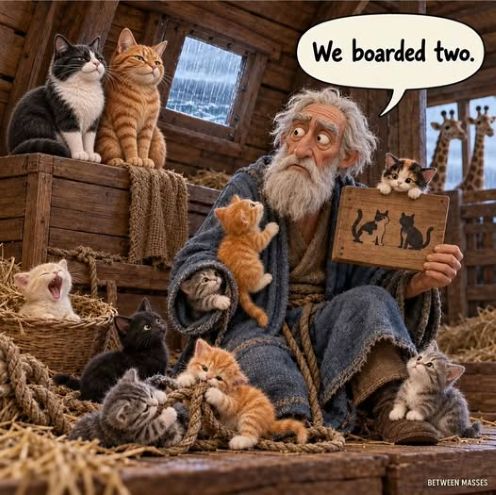
So relax, find yourself a warm kitty (or warm puppy--I won't judge) to curl up in your lap, wake up from your tryptophan-induced coma, and crack open a new book. What are YOU reading this fine morning?
The local public library book sale happened the week before Thanksgiving. Did I limit myself to just going to "Friends of the Library" night on Thursday? No, of course not. I went back for a second round Friday morning. Sigh. When am I going to learn my lesson, if there is a lesson to be learned?
For the past few times I've gone I've run into a former colleague who used to work at the same university where I currently work. She was in a different department, but I often collaborated with her. She's retired now, but it's nice to see her now and again (almost always at the library book sales). I also ran into an interesting gentleman this last time who enjoyed sharing his love of literature with us. Don't know his name, but he loves books.
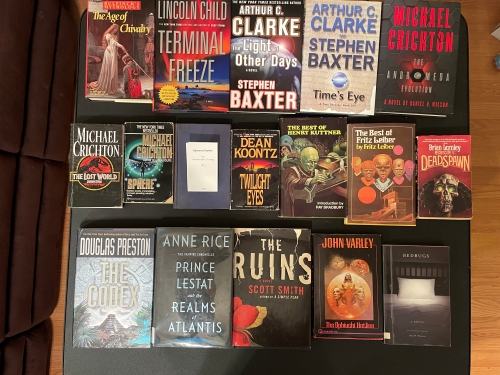
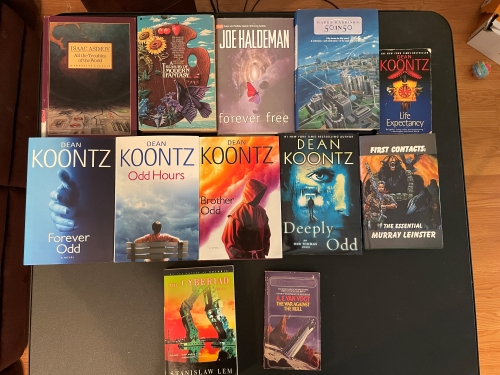
So here's a list of what I picked up in case you can't tell from the images above...
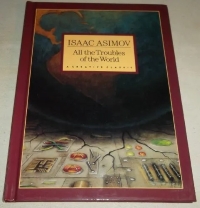
All the Troubles of the World by Isaac Asimov -- This is more of a short story bound in hardcover, with some illustrations accompanying the story.
Bullfinch's Mythology -- Age of Chivalry and Legends of Charlemagne -- This is basically a collection of classic Arthurian legends along with some other stories related to French chivalric traditions.
A Treasury of Modern Fantasy edited by Terry Carr and Martin H. Greenberg -- "Modern" in this context is somewhat relative as this anthology was published in 1981. The first story in the anthology was published in 1924 ("The Rats in the Walls" by H. P. Lovecraft). Lots of great authors. Admittedly, I probably have most of the stories in other various anthologies.
Terminal Freeze by Lincoln Child -- He's always good for an entertaining thrill ride. This is a classic tale of scientists waking up *something* that should have stayed buried deep in the Artic ice...
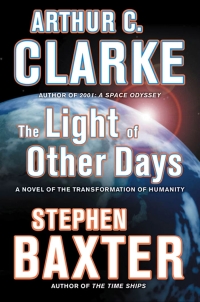
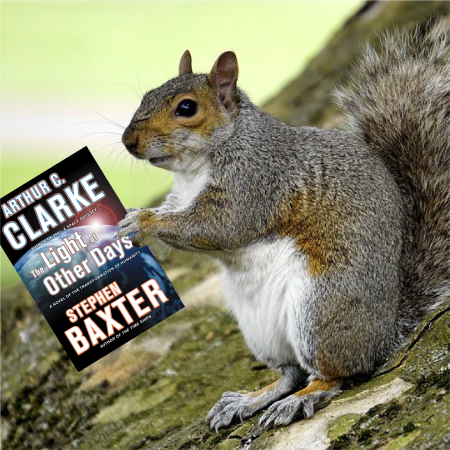
The Light of Other Days by Arthur C. Clarke and Stephen Baxter -- They've collaborated on a few novels. I could swear the plot for this book sounds like it was based on a short story I've read, but I can't quite place who wrote it.
A Time Odyssey Book One: Time's Eye by Arthur C. Clarke and Stephen Baxter -- Just from the book blurb, I can tell this is going to be a wild ride as famous figures from history (and the future) collide with one another...
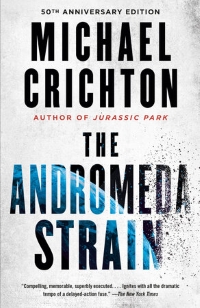
The Andromeda Evolution by Michael Crichton and Daniel H. Wilson -- This is the sequel to Crichton's famous novel, The Andromeda Strain. Wilson wrote most of the story, but it sounds like it might be based on Crichton's notes that he may have written before he passed away. Not sure. Either way, I'm looking forward to reading it, though I haven't read the first book (yet).
The Lost World by Michael Crichton -- The sequel to Jurassic Park.
Sphere by Michael Crichton -- I used to have this book a long time ago, but I gave it away or sold it or something. Now I have it again. I remember watching the movie, but wasn't too impressed with the movie. I think the book will be better on a re-read (I hope).
Edward Dantes by Alexander Dumas -- The sequel to The Count of Monte Cristo, which I should probably get around to reading sometime. I hear that's highly recommended by the Moron Horde. Anyone read this one?
Forever Free by Joe Haldeman -- The sequel to The Forever War. When you live your life traveling at relativistic speeds, you'll find that the universe will leave you behind. How do you adjust to the new world when you stop traveling?
50 in 50 by Harry Harrison -- A collection of 50 of Harry Harrison's short stories, one for each year in which it was published. I thought that was a cool idea for a collection of an author's short stories.
Forever Odd by Dean Koontz -- This was part of a four-book bundle of Odd Thomas books. Turns out I already owned two of the books, but I was able to get two books I don't have for less than the cost of the two books individually. Still a good deal!
Brother Odd by Dean Koontz -- (Already own this one!)
Odd Hours by Dean Koontz
Deeply Odd by Dean Koontz -- (Already own this one!)
Life Expectancy by Dean Koontz
Twilight Eyes by Dean Koontz
The Best of Henry Kuttner by Henry Kuttner -- Turns out I already own this one under a different title (The Last Mimsy), which I bought shortly after the movie based on one his stories was released. Oh, well. Now I have a hard cover Book Club edition.
The Best of Fritz Leiber by Fritz Leiber -- A collection of short stories from the creator of the sword-and-thievery duo of Fafhrd and the Grey Mouser
First Contacts: The Essential Murray Leinster by Murray Leinster -- Leinster was thinking about artificial intelligence and the internet decades before any of us had even heard of those things...
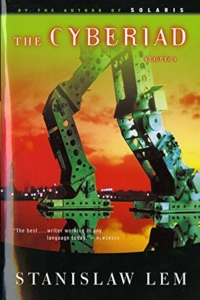
The Cyberiad by Stanislaw Lem -- I've heard of Lem, but have never read any of his works. Now is my chance to rectify that problem.
Necroscope V: Deadspawn by Brian Lumley -- Part of Lumley's long-running Necroscope series, where Harry Keogh communicates with the dead and battle vampiric beings from alternate dimensions...
The Codex by Douglas Preston -- Like Lincoln Child, Preston can hold his own as a solo author with a thrillng and entertaining story
Prince Lestat and the Realms of Atlantis by Anne Rice -- I have not read much Anne Rice, but this one sounded mildly interesting. It's part of her long-running Vampire Chronicles.
The Ruins by Scott Smith -- The novel upon which the movie by the same name is based. The movie has a fair amount of body horror, which is unpleasant. I'm not as squeamish about that in novel form...
The War against the Rull by A. E. Van Vogt -- Another classic science fiction author I've heard of, but have never read. It should be a short, fast read.
The Ophiuchi Hotline by John Varley -- His first published novel. It should be a quick read, as it's also quite short.
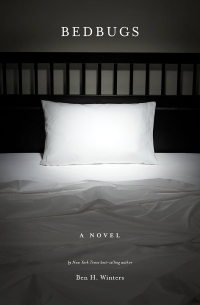
Bedbugs by Ben H. Winters -- Nothing like reading about bedbugs from hell right before you crawl into bed! Sleep tight! Dont let THESE bedbugs bite!
MAINTAINING A SENSE OF WONDER
Tristan points out that reading is about maintaining our sense of wonder even into adulthood. Now, I know that many folks around here aren't into reading fantasy/science fiction, but that doesn't mean you can't experience wonder when reading histories, biographies, scientific books, and so forth. If anything, that sense of wonder should be enhanced as you read TRUE stories about things that ACTUALLY happened, often in very funny and surprising ways that no one at the time could have predicted. Truth can often be stranger than fiction, after all, and writers often use historical events as inspiration for their more fantastical ideas. The more I've learned about physics, the more in awe I am at the incredible cosmos that God created for us. I'm also very impressed at the extraordinary cleverness of us hairless apes as we develop new and improved technologies. No single person on planet Earth can fully grasp the scope and complexity of the world that surrounds us every moment of every day.
One of the points Tristan makes through his quotation of J.M. Barrie's Peter Pan is that each of us carries around with us our own personal "Neverland," an imaginary world populated by the people, places and things that capture our own imagination. Other authors encourage us to do the same. For instance, in The Voyage of the Dawn Treader by C. S. Lewis, Eustace Scrubb is frequently described as reading the wrong sort of books that make him a terrible traveling companion to Edmund and Lucy, since Eustace effectively has no imagination when he begins his adventure. He learns by the end, though, and thus becomes the main protagonist in The Silver Chair as an experienced Narnian traveller when Jill Pole is brought along for the ride. Michael Ende's realm of Fantastica in The Neverending Story is the land where ALL stories become true, and it's growing all the time because humans are always telling new stories to one another, which is the only way that Fantastica can grow. When humans lose their sense of wonder, it becomes a literal existential threat to Fantastica--the Nothing comes along to wipe out Fantastica forever.
So always be wondering, always be dreaming, and never, ever stop imagining!
++++++++++
++++++++++
IRON LAW OF BOOK SHELVES
I don't know about y'all, but I may have discovered a hidden law of the universe. Whenever my bookshelves start overflowing I go out and buy some more shelves. OK, easy enough. I then have a little bit of wriggle room for more books. However, within a very short period of time, I find that I've suddenly filled up my bookshelves again. How did that happen so quickly?
Now I'm at the point where I have to make some tough decisions. My house has NO MORE ROOM for books. I have shelves in my dining area full of books. My living room is full of bookshelves. My library room is full of bookshelves. My bedroom has bookshelves that are completely full. Same with my office. I don't know where I could squeeze in any more books.
At some point I expect I will reach critical mass of books and either spontaneous fusion will begin, or I'll go beyond that and my house will collapse into a black hole.
Author Terry Pratchett famously developed a theory of "L-Space." L-Space is formed when the density of knowledge and information is so great that you can tear holes in spacetime, creating wormholes to any other similar location. Thus, all libraries and bookstores are connected through L-Space. A knowledgeable Librarian can make use of these passageways behind reality to travel to the past, though they have to be careful not to encounter themselves, as that leads to a variety of spatiotemporal problems.
I don't think my library will ever achieve that level of knowledge density, but who knows? Don't be too surprised if I show in your own library some day, looking for a good book to read!
MORON RECOMMENDATIONS
Last Days by Brian Evenson in preparation for the follow-up, Phantom Limb.
Last Days is a horror-detective novel concerning an apocalyptic amputation cult.
I would consider it to be a great novel with horror in the Kafka, Borges, Gogol tradition. Not to mention violence in the hardboiled detective novel tradition.
It's a book that does something I like. It's a very smart book in which the author does not pop-up to give you his opinion from on high but rather presents interesting ideas as a consequence of the action, plot, and some dialogue.
Great stuff...if you enjoy creepy horror.
Posted by: naturalfake at November 22, 2026 09:20 AM (YSUhf)
Comment: There is a form of body dysmorphia where people do voluntary seek to have their limbs amputated. It's a very disturbing mental illness, no doubt related to the transperson epidemic we see these days. The idea of an apocalyptic cult that glorifies the practice is definitely one of those things that should fill us with horror. Believe it or not, Brian Evenson is NOT the only author that describes this idea. F. Paul Wilson's Secret History of the World features a Japanese cult that also engages in ritual amputation towards an apocalyptic end. The more senior members of the cult are nothing more than heads and torsos. They even blind themselves so they can focus all their attention inwards. Very dark stuff.
Just finished John McManus' trilogy of the Army in the Pacific War (last one titled "To The End of the Earth").
Highly recommended. Writing style that draws you effortlessly through the story, and a nice balance of Big Picture and Big Name details with individual accounts from letters, diaries, and memoirs.
McManus is a dedicated Army historian and one mission with this trilogy was to fill out/correct understanding of the Pacific War, specifically that the Army was a major, in fact larger, player than the Marine Corps, which generally is the central player in the popular understanding.
One thing I like about his approach is his inclusion of logistics in recounting major operations. The story of US logistics in WWII deserves books of its own, especially if they covered the incredible industrial mobilization underlying it all.
Posted by: rhomboid at November 22, 2026 11:23 AM (U/Byj)
Comment: It's fairly common knowledge that an army marches on its stomach. In other words, logistics is the key to winning a war (assuming the goal IS to win). For every soldier in the front lines, there are dozens of people working behind the scenes to provide the front-line units with logistical support. Hauling all that stuff across entire oceans is truly an incredible feat of planning and execution. Now we expect it as a matter of course thanks to companies like Amazon, which has mastered the art of logistics to an absurd degree. With Musk's rocket technology, we can even make regular deliveries to the International Space Station on a routine basis. We truly live in an age of wonders.
In addition to the books I picked up at a library book sale, I also ordered three books based on some of the books I acquired above. As I've mentioned before, I'm a "completionist," meaning I tend to acquire all the books that are part of a series. I guess it's a compulsion...
Time Odyssey Book 2 - Sunstorm by Arthur C. Clarke and Stephen Baxter
Time Odyssen Book 3 - Firstborn by Arthur C. Clarke and Stephen Baxter
The Andromeda Strain by Michael Crichton -- One of the classics of science fiction dealing with an alien virus that crashlands on Earth, wiping out an entire American town...
WHAT I'VE BEEN READING RECENTLY
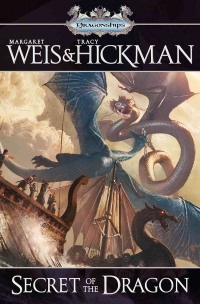
Dragonships Book 2 - Secret of the Dragon by Margaret Weis and Tracy Hickman
As I expected Weis and Hickman are able to show Skylan's character development. In the first book he was a complete idiot, borderline retarded. However, due to the setbacks he experienced at the end of that book, he's discovered he has to start *thinking* before he acts, which leads to him making slightly more rational decisions in the second book. He and his shipmates are enslaved and carried off to a foreign land (Rome, basically), where they are expected to compete in a strategy/gladiatorial game for the pleasure of their captors. Meanwhile, one of their captors is strategizing his way into becoming even more powerful, but needs the help of Skylan and his allies.
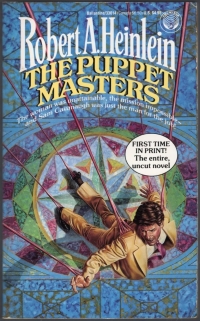
The Puppet Masters by Robert A. Heinlein
I first read this as a teenager and really enjoyed it. Now that I'm much older, I gave it a re-read based on a recent Moron Recommendation. Although I still thought it was entertaining, it really doesn't hold up very well. It takes place in the year 2007, but certain technologies are quite lacking, while others are much more advanced. For instance, there are no communication satellites. All radio broadcast transmissions are point-to-point along the surface of the Earth. But they have flying vehicles that are self-driving and can cruise at hundreds of miles per hour. Makes for very odd experience when you realize that the technology of 2007 would no doubt have resolved many of the main problems of the story, but also would have led to others. It's also unclear exactly HOW the "puppet masters" are able to travel through space. They can control other species, but who developed space travel in the first place? Anyway, the story tends to fall apart a bit when you ask too many questions.
All the Troubles in the World by Isaac Asimov
This is a short story that is published in a large hardcover format, with accompanying illustrations. The basic premise is that mankind has created the ultimate AI--Multivac (featured in many of Asimov's short stories). It can answer any question and is smart enough to anticipate crimes before they occur. But what happens when you feed a sentient machine ALL your problems?
Sphere by Michael Crichton
In typical Crichton fashion, this is a technothriller that has a couple of different layers to it. A ship laying network cable in the ocean stumbles across an artifact that defies explanation. A massive aircraft/spacecraft crashed into the South Pacific--at least 300 years before humans developed spaceflight. It appears to be manmade. However, the cargo it picked up is definitely NOT manmade (probably). A scientific team is dispatched to investigate it, of course, and they discover truths about our future, themselves, and things that probably should never be discovered.
Like many of Crichton's stories, Sphere was made into a movie. I remember watching it, but it's largely forgettable. The book, as usual, is better.
The Light of Other Days by Arthur C. Clarke and Stephen Baxter
Although the premise of this book is quite interesting, both Clarke and Baxter can't help themselves about inserting their own militant atheism into the story, which I found quite annoying. The premise is that a tech billionaire discovers how to leverage quantum mechanics to spy on everyone, everywhere, at all times. The technology floods the world and now EVERYONE can see EVERYTHING whenever they want to. No more secrets. Flock cameras on ultimate steroids.
A side effect of this is that people can also peer backwards through time. So they do. And one of the most interesting things to view is the life and death of Jesus Christ, of course. This is where Clarke and Baxter let their inner militant atheism shine, as they "prove" that the storie of Moses (Judaism) and Jesus (Christianity) are based on "lies." Like most militant atheists, they are abject cowards about confronting Mohammad's story, lumping it under "other religions" that have to readjust once people can peer backwards through time.
Overall, it's an interesting story, but they really should NOT have delved into religion...
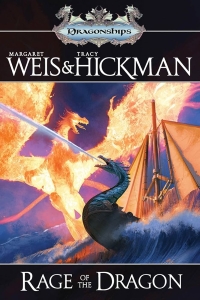
Dragonships Book 3 - Rage of the Dragon by Margaret Weis and Tracy Hickman
Skylan continues his arc of character development. He's still quite a bit dumb in certain situations, especially when he and his companions are captured by a matriarchical society where gender roles are mostly flipped. He doesn't deal with that very well, as he's a stereotypical Norseman, where MEN should be dominant and women submissive (which they really aren't even in his own society--but he's too thick to recognize that). However, he does learn to control himself enough to gain their trust and they provide assistance to him and his companions while they figure out how they can find the rest of the dragon bones they will need to save their people and the world at large.
Bedbugs by Ben H. Winters
Bedbugs. Tiny little bloodsuckers that live in the cracks of our houses, coming out at night to feast on us. Very difficult to eradicate. Now Winters gives us a horror story where they are the main antagonists. This is actually a tightly-constructed tale of treachery, betrayal, infidelity, and murder, where the bedbugs are only the manifestation of something much darker--the hidden desires of human depravity.
The Andromeda Strain by Michael Crichton
This is Michael Crichton's classic story of a strange alien bug/germ/virus/bacteria that falls to Earth and wipes out a small town in Arizona. Crichton presents this as a "documentary" of sorts, as though these events actually happened and have just now been declassified by the government.
The truth is that the so-called Andromeda Strain defies our human understanding, as it's neither completely alive nor completely autonomous, exhibiting a will and purpose of its own. It's very clear that it is inimical to life on Earth and our entire civilization if it's left to its own devices. Even nuclear weapons can't defeat it.
The Andromeda Evolution by Michael Crichton and Daniel H. Wilson
Daniel H. Wilson collaborated with Michael Crichton's estate to write an authorized sequel to one of Crichton's most famous books. Suppose the Andromeda Strain spent the past fifty years or so hiding on Earth, just biding its time until someone clever enough was able to crack the code and force the Andromeda Strain to move to a new stage in its development. Deep in the Amazon basin, *something* is starting to grow into a massive structure. A team of scientists are dispatched to investigate the "anomaly" and make horrifying discoveries along the way.
This story presents one of the possible solutions to the Fermi Paradox, in a way that has massive implications for the future of the human race.
The Cyberiad by Stanislaw Lem
This is a VERY silly book. In all the best ways. Stanislaw Lem is a master of ludicrous prose. Lewis Carroll would be in awe. The Cyberiad is a collection of short stories about the adventures of two "constructors" (i.e., mad scientists) named Trurl and Klapaucius. Trurl is usually the main protagonist, building ridiculous contraptions to make his frenemy jealous of Trurl's capabilities. Trurl construction of an electronic poet nearly destroyed the universe. Though the adding machine he build insisted that 2 + 2 = SEVEN!
Quite an entertaining read if you are in the mood for less serious fare. It's hard to call this "science fiction." Let's just say it's satire with a science fiction veneer.
50 in 50: A Collection of Short Stories - One for Each of Fifty Years by Harry Harrison
Harry Harrison had a long and distinguished career as a science fiction author. To celebrate his first fifty years as an author he collected short stories he'd published over the decades and selected ONE from each of his first fify years as an author. I thought this was a pretty neat concept.
To make things even more interesting he didn't simply arrange the stories in chronological order. Instead he went for a thematic approach, grouping stories by key ideas, such as as alien, inventions, psychological stories, robots, etc.
This is a generally good collection. Several of the stories seem familiar to me, but that's probably because I've encountered them in other anthologies.
Tips, suggestions, recommendations, etc., can all be directed to perfessor -dot- squirrel -at- gmail -dot- com.
The world was doomed, but it kept running anyway.
(Yeah, I know I've used this caption before, but it's oddly appropriate here...)
Disclaimer: Sponsored by His Royal Highness Protuberon Asteristicus, sovereign ruler of the sister globes of Aphelion and Perihelion, hereditary monarch of Aneuria, emperor of all the Monodamites, Biproxicans and Tripartisans, and Grand Duke of Anamandorinth, Glorgonzigor, and Esquacciaccaturbia, Count of the Euscalipii, the Algorissimo, and the Flora del Fortan, Paladin Escutcheoned, Begudgeoned and of the Highest Dudgeon, Baron of Bhm, Wrph, and Clarafoncasterbrackningen, as well as anointed excarch of Ida, Pida, and Adinfinida.
* I'm now contractually obligated to inform you that rickb223 is the sole recipient of a lifetime exemption from the pants rule on the Sunday Morning Book Thread. May God have mercy on us all...
No discussion, no opt-out for solo developers who work from home. And no PO boxes.
A Google spokesbeast told Engadget:
We take privacy seriously and are committed to protecting developer and user data. At the same time, fuck you.
It appears the feeling is mutual.
The Australian state of Victoria's Labor Party, in government for twelve miserable years, during which they oversaw the world's longest and least effective Bat Flu lockdown, has been reduced in one night to minor party status. Not only did they not win, they performed so poorly they didn't even lose.
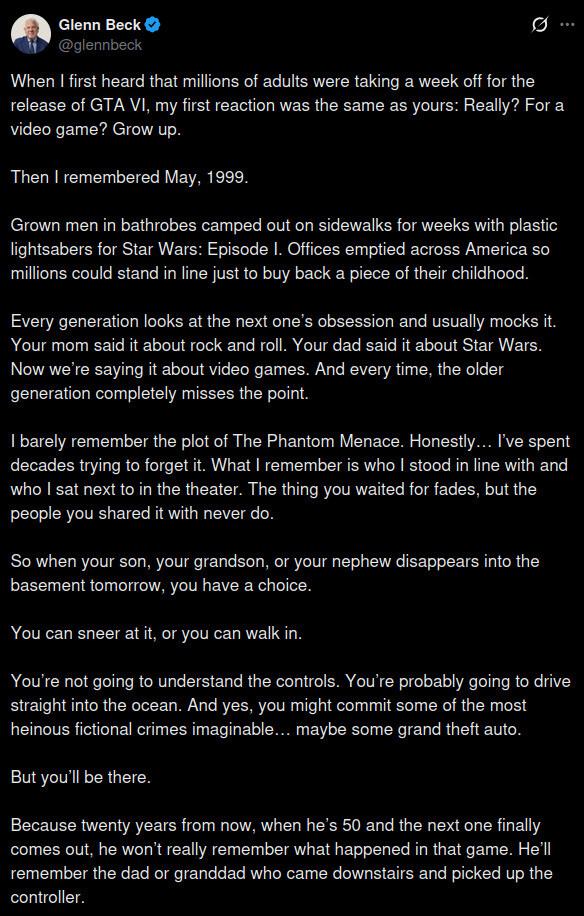
It's a crime game, in which you do crime. If you do crime, it goes on your in-game social score, so even if you pull off a perfect heist with no witnesses the in-game police will show up at your next outing with helicopters and anti-tank weapons.
I exaggerate slightly, but only slightly. They took the system from earlier game Red Dead Redemption 2 which as the title suggests is a redemption story, where GTA is about stealing cars, and, now, being miserable.
Saturday Night Club ONT - November 28, 2026 [The 3 D's]
—Open Blogger
Andy's Bar & Liquor Store in Homestead, Florida in 1939
(H/T - Hour of the Wolf)
Welcome to Club ONT - a whelming collaboration of The Disco, The Dino, and a guest appearance by The Doggo.
Club Housekeeping: Thanksgiving is in the books. The leftovers are dwindling, the family is departing, and Disco Doof continues to Horde-source Christmas songs. We have unimportant things to accomoplish this Saturday night. Important things can wait.
Open thread - bar is open, too. Come in in, grab a drink or 2. Or 3. Keep it light and friendly. Jerks need not enter. Trolls also. The Moose out Front has taken up an elevated, tactically superior position. He has brought some extra muscle to cover his flanks this evening.
Through her tears, she replied, "The pharmacist insulted me on the phone this morning! I had to call several times before he even answered."
Furious, the husband stormed down to the pharmacy, ready to demand an apology.
Before he could get more than a word out, the pharmacist said, "Now, hold on. Let me tell you my side of the story.
"This morning, my alarm didn't go off. I woke up late, skipped breakfast, and rushed out the door, only to realize I'd locked both my house and car keys inside.
"I had to break a window to get them. Then I sped off and got a ticket. Three streets from the shop, I got a flat tire.
"When I finally arrived, customers were already impatiently waiting. I opened up, started serving, and the phone would not stop ringing. Ring, ring, ring!
"Then I opened a roll of coins for change, and they went everywhere. I'm down on my hands and knees picking them up, with the phone still ringing.
"I finally stood up, smashed my head on the cash drawer, staggered backward into a shelf of expensive perfume, and sent half of it crashing to the floor.
"And still, the phone keeps ringing.
"I finally answer it.
"It was your wife.
"She wanted to know how to use a rectal thermometer.
"And believe me, sir, as God is my witness, all I did was tell her how to use it!"
-----
A sweet grandmother telephoned St. Joseph's Hospital.
She timidly asked, "Is it possible to speak to someone who can tell me how a patient is doing?"
The operator replied, "I'd be glad to help, dear. What's the patient's name and room number?"
In a weak, trembling voice, the grandmother said, "Norma Findlay, Room 302."
"Let me put you on hold while I check with the nurses' station," the operator replied.
A few minutes later, the operator returned and said, "I have good news! Norma's nurse just told me she's doing well. Her blood pressure is fine, her blood work came back normal, and her physician, Dr. Cohen, has scheduled her for discharge tomorrow."
The grandmother exclaimed, "Thank you! That's wonderful. I was so worried. God bless you for the good news."
The operator replied, "You're more than welcome. Is Norma your daughter?"
The grandmother answered: "No, I'm Norma Findlay in Room 302. No one tells me shit!"
*****
Drink of the Night
As we make the transition into the Silly Season, enter the Painkiller.
A twist on the Piña Colada, the Painkiller is a rich and fruity cocktail that stays true to its name: It will cure what ails you. Made with dark rum, pineapple juice, orange juice and cream of coconut, the drink was created in the 1970s at the Soggy Dollar Bar in the British Virgin Islands (BVI), where the confluence of warm temperatures and vacation vibes necessitated cold, refreshing libations. And where, with no dock, dollars were bound to get wet as patrons swam ashore.
Ingredients
2 ounces Pusser’s rum
4 ounces pineapple juice
1 ounce orange juice, freshly squeezed
1 ounce cream of coconut
Garnish
Nutmeg, freshly grated
Pineapple wedge
Directions
Add the rum, pineapple juice, orange juice and cream of coconut to a shaker with cubed ice and shake vigorously but briefly to combine.
Strain into a hurricane glass or snifter over crushed ice.
Garnish with freshly grated nutmeg and a pineapple wedge.
Serve with a straw.
*****
Club ONT Department of Seasonal Preparedness
The humble snow shovel deserves more respect than it receives. It delivers much more than spontaneous heart problems. Every Moron should have at least one shovel for every able-bodied person residing in the home. Sadly, the days of affordable child labor are behind some of us and those children are building their own snow shovel collections. Or the smart ones are drinking Pain Killers in the Carribean.
A good run lasts all of 15 seconds, ending when the racer collides spectacularly with a protective wall of inner tubes.
***
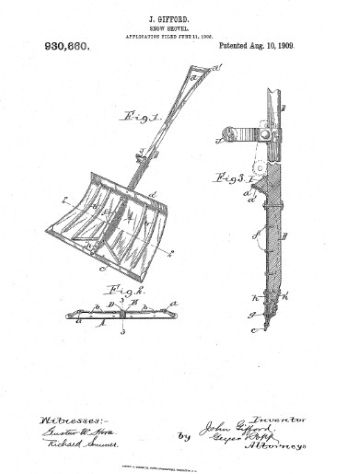
1909 snow shovel patent. It has been the subject of serious engineering for quite some time. Yet, more than a century later, we're still out there moving snow around by hand.
The object of my invention is to improve the construction of the shovel so that a straight or unbent handle can be employed, thus preserving the strength of the handle.
*****
Club ONT Department of Random Amusement
Dr. Seuss may have given us one the the best words in the English language: Nerd. His book If I Ran the Zoo contains what is generally accepted as the earliest known printed appearance of the word.
An incredibly amusing and petty feud between two artists with oversized opinions of themselves. One claims exclusive rights to the world's blackest black. The other responds by creating the world's pinkest pink and making sure the first guy can't buy it.
With little forethought and a lot of tongue shoved into his cheek, Semple answered: “I’m going to release my pink, but not allow Anish Kapoor to use it.”
Semple had made, for himself, an ultra-fluorescent pink paint. “No one has ever seen a pinker pink,” he says. So in December 2016 he put “Pinkest Pink” on sale on his website Culturehustle. £3.99 (about $5) for 1.8 ounces. He included a legalistic warning:
By adding this product to your cart you confirm that you are not Anish Kapoor, you are in no way affiliated to Anish Kapoor, you are not purchasing this item on behalf of Anish Kapoor or an associate of Anish Kapoor. To the best of your knowledge, information and belief this paint will not make its way into that hands of Anish Kapoor.
*****
Club ONT Department of Completely Unnescessary Controversy
The Club needs to settle this once and for all. Our discerning Morons know how to dintinguish bad advice, Pollyanna advice, and idle chit-chat from actual wisdom. What's the most useless advice people give?
- Just be yourself (Have you met myself?)
- The customer is always right (They are as full of crap as anyone)
- There are no stupid questions (This person has never attended a company meeting)
- Everything in moderation (Obviously not a bacon eater)
- Let it go (I am still working on something from the summer of '87)
- Communication is key (So is knowing when to shut up)
Paul Kedrosky, Investor at SK Ventures
"You can’t push on a rope. A fourth-year engineering school professor told me that most of engineering could be reduced to two things: F=ma, and you can’t push on a rope.
The former, while important, is computational and self-explanatory; the latter, however, is weirdly helpful even when you don’t have a calculator around. Because you can’t push on ropes, whether physical, relational or metaphorical."
*****
Club ONT Jukebox
*****
Comments of the Week
If you are lurking in the shadows of shame and waiting for a sign to jump into the comments and join the discussion, here you go:
*****
Club ONT is brought to you by: Kiss our Tail Feathers.
*****
Disclaimer: Your hosts are not responsible for decisions made under the influence of happiness, enthusiasm, poor judgment, or a generous pour. No conclusions reached after midnight shall be considered binding without and independent review of your peers - in the daylight.
Saturday Evening Movie Post [moviegique]: I Play Rocky
—Open Blogger
I was rather cool on I Play Rocky, as I wasn't sure if it was some sort of Son of Rambow-like riff or just a regular biopic, which I avoid fairly assiduously. I thought the title was stupid. But Armond White likes it, and he's the Mikey of cinema, so off The Boy and I went. (Kids? "Mikey"? "He hates everything!")
I have to say, I'm inordinately pleased about what a great, relevant title it actually is. Like, who cares, really; it's just a title! As it turns out, me. I care.
Because the point of the movie is Sylvester Stallone's quest to become an actor, and his desire to write a role for himself since he could not get hired easily. Hence his insistence:
And, boy, let me tell you, this is the crux of the matter. A lot of directors in history have started out as writers. I've been rewatching the classics with my mother. Recently we screened Midnight, directed by Mitchell Leisen, who ticked off Billy Wilder and Charles Brackett so much they became director and producer, respectively, so as to never have their work butchered again. And then Remember The Night, also directed by Leisen, which pissed off Preston Sturges so much he became a director.
Lots of writers become directors. John Carpenter. Kasdan, Ephron, Tarantino, Shane Black. Prior to Stallone, actors who wrote their way on to the screen were rare. Orson Welles, who finagled his way into total control on the basis of a radio broadcast of "War of the Worlds"—well, even he was an established radio entity.
Stallone was a nobody. A few bit parts here and there. He'd been on a kind of traditional starving artist trajectory before Rocky. Then, bang! instant star, and people are looking to capitalize on his past work, which was largely The Lords of Flatbush, Death Race 2000 and ultimately The Party at Kitty and Stud's (later retitled The Italian Stallion).
But that was reality and what we have here is a movie that does what good movies do: Take the bits of reality that work to create a good story, then add edit patch as needed. Like, we see Stallone's one soft-core venture, a part taken out of desperation after literally sleeping on the street. Or, he moves from Philly to Los Angeles, and a buddy recommends him to some producers, but we never see him get any other roles prior to Rocky. We only learn about them later on.
Which is fine. It's not a Wikipedia entry. It is a movie full of interesting characters, and largely devoid of serious villains.
"No, I'm totally fiiiine with you passing up $300K+!"
While on the street, Sly finds himself a dog owner. The dog, "Butkus" plays an important role. He woos Sasha, and she becomes the dutiful, supportive wife, from whom he hides the insanely good offers he's getting from a studio wanting to buy the script. His abusive father is also very supportive. ("He's from an older time," Stallone explains after a discussion on child abuse.) The producers, Winkler and Chartoff, are practically heroic, trying to deal with this intractable Italian meatball turning down hundreds of thousands of dollars.
Even the Big Studio Evil Producer Guy who would like to see the production fail because then he gets the script for cheap ultimately is won over. The union boss who comes to shut them down is pretty scary, granted.
The point, though, is that every scene does something: It fleshes out a character, it develops a plot point, it makes you laugh. There's a running gag about actors lying to get jobs, and nobody being able to do anything of the things they claim they can. This is the most humanizing portrayal of actors I've seen in a long time. They really seem like what they are (or at least were): Hustling working folk trying to score that next job.
It's also patriotic. Transitively, because Rocky was patriotic, though we sometimes forget how cynically patriotism was portrayed in that film, but also because Stallone is a real-life American success story.
Unlikely heroes who get more heroic as the movies goes on.
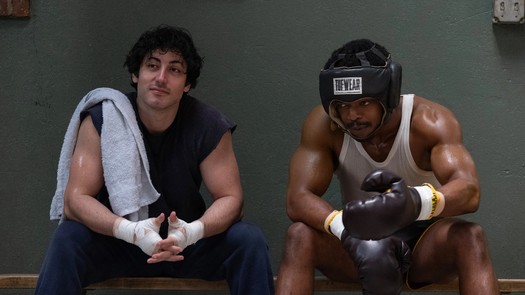
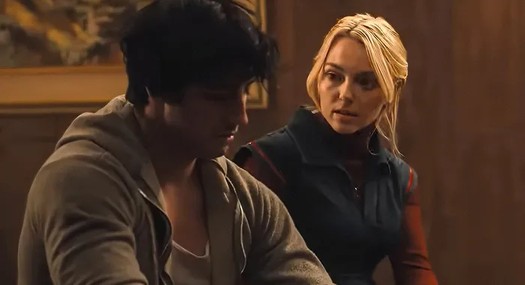
The acting is flawless. Anthony Ippolito vanishes into the role of Sylvester. At points, I wasn't sure they hadn't pulled out shots from the original movie. AnnaSophia Robb is compelling and "trad" as Sasha. This kind of "young couple in love struggles to make good" type story is one I haven't seen in years. And it's good.
P. J. Byrne and Toby Kebbell play off each other smoothly as Winkler and Chartoff. Matt Dillon as Papa Stallone—best role I've seen him in, which is something I tend to say about him the older he gets. (I never liked him as a young actor.) House favorite Jay Duplass (Backrooms, The One I Love, Safety Not Guaranteed, Jeff, Who Lives At Home, Baghead) gives a terrific performance as the no-nonsense John Avildsen, who is both budget-conscious, fast and very in tuned to what makes a great movie. Stephan James, Kiki Seto and Robert Morgan have small roles as Carl Weathers, Talia Shire and Burgess Meredith, but they make the most out of them.
The music plays on the original Bill Conti theme, which Winkler and Chartoff debate while filming. "Too military!" It's one of those things that is both funny in retrospect but also perfectly understandable in a boxing movie made in 1976. It plays on it but never straight up gives us that, which is interesting.
The boy and I often talk about tone, where a movie is either serious, or comedic, or horrific or whimsical. Tone is not something modern American movies switch easily. But there's another overlooked element in modern movies that's played beautifully here: Pitch. Related to tone, pitch is more the intensity levels you're playing with. Pitch, even more than tone, is what brings down Marvel movies when they try to be funny.
I Play Rocky deals with issues that are very important to the people involved, and virtually no one else—except that Rocky is an iconic film and one of the most influential films of the past 50 years. But if it hadn't gotten made, or if they had used, God help us, Ryan O'Neal (who would go on to make The Main Event with Barbra Streisand), nobody would've given it a second thought. Nobody would've known there was a loss, in other words.
I had to keep looking at Kiki Seto during this scene to make sure they hadn't slipped in the actual scene from "Rocky".
In a lot of modern moviemaking, dramas like this tend to go with the "Well, no, none of it matters, but look at all this amazing ACTING!" And the acting will be either scenery chewing or dead-affect-nothing-matters. I Play Rocky goes for about the pitch you'd see in real life. Sasha gets upset when Sly holds out on her. They fight a little, they make up. Sly's on the street. He's not happy about it, but he's not rending his clothes. Even the repeated beat "I play rocky," is delivered with a kind of low-level anxiety. We all know what's at stake. We don't need a lot of big musical cues or tears or ACTING.
Pitch-perfect, basically. We're not hammered with emotional beats, it's not assumed our interest is intellectual detachment. A nice touch all around from Director Peter Farrelly, who won two Oscars for 2018's Green Book, but is probably best and forever known for his is gross-out comedies made with his brother (Dumb and Dumber, There's Something About Mary, Shallow Hal, etc.).
The Boy and I agreed that it was very likely the best of 2026. The closest contender I can think of is Obsession, which shares many of the same characteristics of this film despite being a completely different genre.
Welcome hobbyists! Pull up a chair and sit a spell with the Horde in this little corner of the interweb. This is the mighty, mighty officially sanctioned Ace of Spades Hobby Thread. For this week, the Wheel of Hobbies (TM) rolled into a billiards and pool theme for this Hobby Thread.
Billiards and pool? Read on, fellow hobbyists...
[Top photo: Springs Downtown Bar and Grill, Glenwood Springs, Colorado - Gates Frontiers Fund Colorado Collection within the Carol M. Highsmith Archive, Library of Congress]
"Billiards" is the umbrella term for cue sports played with a cue stick and balls on a cloth-covered table. It includes pool, snooker, carom billiards, English billiards, and others.
"Pool" (also called "pocket billiards") is the version played on a table with six pockets. The goal is to sink balls into those pockets. The most common games are 8-ball and 9-ball, using a cue ball plus 15 numbered object balls.
It began as an outdoor lawn game similar to croquet (sometimes called ground billiards) in northern Europe, especially France, in the 15th century. It moved indoors onto a wooden table covered with green cloth to imitate grass. Early players pushed the balls with a mace (a stick with a large head) rather than striking them.
The word "billiard" likely comes from French terms for the stick (billart) or ball (bille). Pockets were added as the game developed. The modern cue stick emerged in the late 1600s - players flipped the mace and used the handle (French "queue," meaning "tail") when the ball was near a rail. By the 17th century the game was known among European nobility.
"Pool" originally referred to a collective stake or bet. In 19th-century America, horse-racing betting parlors were called "poolrooms." Owners installed billiard tables so patrons could pass time between races, and the name stuck to the pocket version of the game.
Billiards reached North America with early colonists. In the 19th century, the game spread widely. Key equipment advances included slate beds (more stable than wood), leather cue tips (allowing spin, known as "English" in the U.S.), and vulcanized rubber cushions (mid-1800s), which gave consistent rebounds.
In the 1870s, Fifteen-Ball Pool (or 61-Pool) was played. Fifteen numbered balls were used and points equaled the number on the ball pocketed. First to 61 won.
Around 1888, it was replaced as the championship game by Continuous Pool (scoring by number of balls pocketed rather than their face value. The player who cleared a rack broke the next one and scores carried over).
Straight pool (aka 14.1 Continuous) was invented in 1910 and became the main tournament game for decades.
Eight-ball developed around 1900 in the U.S. from earlier pyramid-style games: players take solids or stripes and must pocket the 8-ball last. It became the classic casual and bar game.
Nine-ball appeared around 1920. It later became the primary professional tournament format because it is faster and more spectator-friendly.
Who among the Horde is a pool shark? Your dino host has small arms and historical records of prior pool hall experience have been sealed for reasons, so need help in the comments for this theme.
***
What are you hobbying? Jump in with your hobbying, interests, stories and questions.
Anything (legal) you are hobbying is welcome. If not, offer something else relating to hobbying or just check in and say hello.
As per usual Hobby Thread etiquette, keep this thread limited to hobbying. Leave politics and religion to threads elsewhere (unless your hobby is building or restoring churches). Pants? Nope. As always, puns are welcome and encouraged.
Play nice and do not be rude. Do not be a troll and do not feed the trolls.
Give the content a chance before you judge and bail out. There's gotta be something that resonates with you. At a minimum, entertain the Horde with pool hall stories from your misspent youth (or adulthood).
***
Good history (the voiceover is AI, but the content is not):
***
Manufacturing process for a cue:
***
Time for science!
***
Basic to expert shots:
***
Did you know that most pool (and more broadly, billiard/snooker/carom) balls are made in Belgium. The Belgian company Saluc (in the village of Callenelle) produces them under the Aramith brand and has long claimed a global market share of roughly 80-85%. Who knew there were different types of balls? More here in the form of a comparison:
***
Pool versus snooker?
***
This seems like it covers most pool table maintenance needs:
***
Well done video to answer "can you build your own pool table on a budget?"
***
Never seen a glass pool table before (but I like seeing the ball return tracks):
***
Pool in the movies:
***
Never realized this song was about a pool hall tough guy:
Bonus pool hall music:
***
Nothing like Japanese television.
***
Non-theme content:
For a guy that started by woodworking with scrap pallets, Jesper has come a long way. This piece is very well designed, written, presented, filmed, etc. If you're not already wise in the ways of Jesper, this is a good place to start:
Really. Go watch it.
***
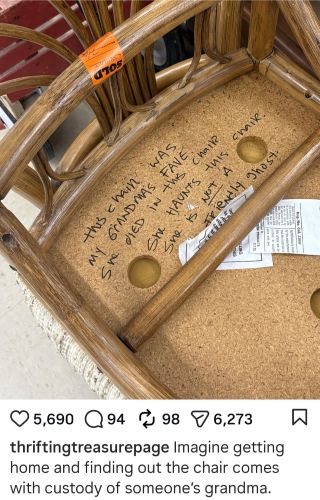
Top tip when buying second hand furniture: always read notes on the underside.
"This chair was my Grandma's fave. She died in this chair. She haunts this chair. She is not a friendly ghost."
Truth in advertising?
***
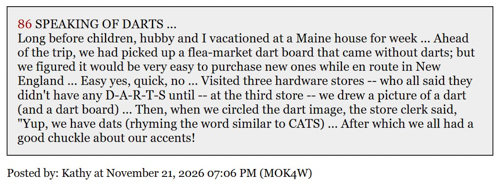
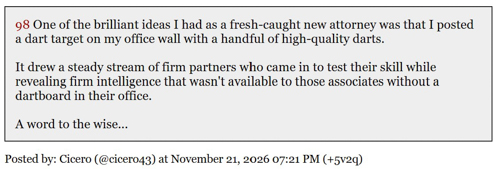
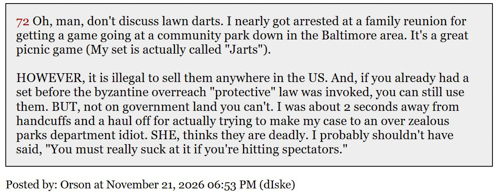
Did you miss the Hobby Thread last week? We did a darts theme. The comments may be closed, but you can re-live the content.
Notable comments from last week:
***
Words of wisdom:
"Because despite all our troubles, when things are grim out in that wide round world of ours, that's when it's really important to have a good hobby." Posted by: tankascribe at June 22, 2024 07:41 PM (HWxAD).
***
Reminder: if you put links in the comments, use a URL shortener and describe what you're linking to. Failing to do either or both makes you barrel-eligible. Don't make people click to find out what you're linking.
Send thoughts, suggestions and photos of your hobbying to moronhobbies at protonmail dot com. Or just email to say hello. Do mighty things.
New York’s subway requires dogs to be carried in a bag, and New Yorkers have found some incredibly creative ways to follow the rule https://t.co/8224sGbBoZ
Some members of The Horde are turning their attention to indoor gardening:
My grocery store Phalaenopsis is still doing well, it bloomed again in early fall. So I’ve tried another one supposedly an easy one. This is an Oncidium hybrid, “Sherry Baby”. I received it in spike in early May and by mid June it had started blooming. It hasn’t stopped, in fact it’s sent up a second spike.
Honey Crisp apples keep coming up in recommendations for baking apples, especially if you don't want to thicken your filling. Other recent recommendations include Pink Lady. Granny Smith is falling down a bit in some recommendations, with Golden Delicious noted as good for baking if your recipe can take thickening and a more tender apple. You may want to mix it with a tarter, firmer apple. Especially in pies.
Here's a good recipe for Apple Crumble. Unlike Apple Crisp in that it does not include oatmeal in the topping.
Still no freeze here, but I cut my irises as planned for a Thanksgiving bouquet. Here they are Thanksgiving morning. Just about all the buds were open by dinnertime and my hostess really liked them.
I can see why your hostess liked them!
That's pretty much it for outdoor blooms in my yard. But the holiday cactus I inherited from my Mom is blooming and should take me thru the Advent season. African violets like the dappled sunlight in my window even though it faces south, and I hope they'll bloom until spring.
If you look at the shelf below them you'll glimpse 2 moth orchids. They're an experiment and I hope my pseudo-greenhouse with a pebble tray will keep them happy during the winter heating season. They're both growing new roots, which seems like a good sign.
Merry Christmas and a Happy New Year to everyone.
badgerwx
Lovely! East and South windows are valuable for growing plants, especially in winter.
*
Hope everyone has a nice weekend.
If you would like to send photos, stories, links, etc. for the Saturday Gardening Thread, the address is:
ktinthegarden at g mail dot com
Remember to include the nic or name by which you wish to be known at AoSHQ, or let us know if you want to remain a lurker.
ON THIS DAY in 1991, (Which was Thanksgiving Day) Charlie sang his song, "Little Folks," as he rode on Tom Turkey in the 65th @Macys
Thanksgiving Day Parade in New York City. - TeamCDB
Macy's Thanksgiving Day Parade starts late for the first time in 100 years
Saw a lot of comments like this:
Shoutout to @nbc. My kids were so excited for the parade. We are now 22 minutes into the broadcast. Have had 3 commercial breaks, 1 song, and 1 balloon viewed. Now my kids are not interested anymore.
Just give us the @Macys parade. We don’t need all this other.
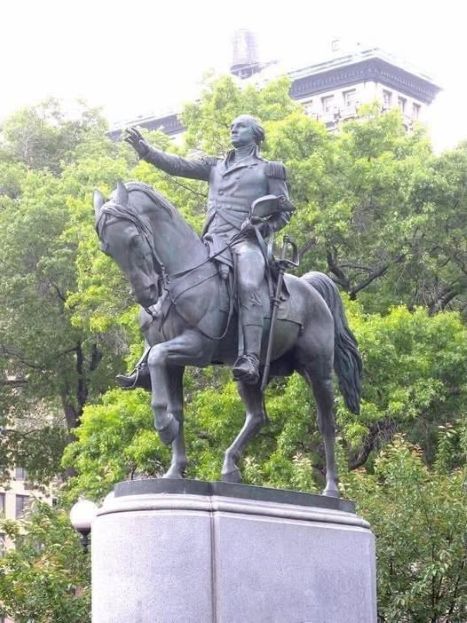
ON THIS DAY November 25, 243 years ago, in 1783, the British withdrew from New York City. It was their last military stronghold in the United States during the Revolutionary War.
November 25 was celebrated for well over 100 years in New York City, and was known as Evacuation Day. Rivaling the Fourth of July, this holiday celebrated military heroism and the ideals of the Revolution through fireworks, public banquets, military drills, parades, and patriotic plays. During the early 1800s, at the height of its popularity schools were even closed.
Over time popularity waned and the last official Evacuation Day was seen in 1916 - commemorated by 60 veterans and a ceremonial flag raising at the Battery. Most likely the United States’ alliance with Britain in World War I led to the ceasing of celebrations.
It was no easy feat for America to gain its freedom from Britain and that fight for freedom deserves to be remembered.
This statue of George Washington sculpted by Henry Kirke Brown, was dedicated in 1856. It is located at Union Square, and was the first public sculpture erected in New York City since the equestrian statue of George III in 1770. This impressive statue was the first American equestrian sculpture cast in bronze. The historic moment depicted is Evacuation Day, November 25, 1783, when General Washington triumphantly led his troops back into the city as the British left the city after their loss of the American Revolutionary War.
*
Statues and the people they salute
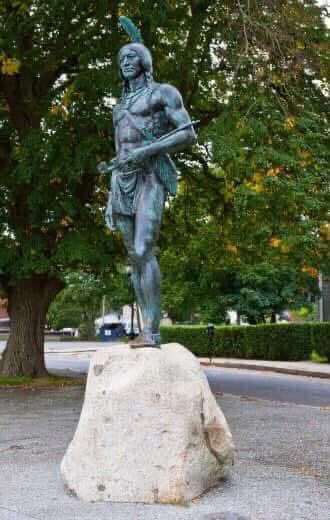
NAME the leader of the Wampanoag who met with Plymouth Colony Governor John Carver in 1620 and agreed to a treaty that led to 50 years of peace between the Wampanoag and Plymouth Colony.
In March of 1621, MASSASOIT, the leader of the Wampanoag tribe, met with Governor John Carver at William Bradford’s home that was being constructed.
Massasoit had been impressed with Edward Winslow at a first meeting that had been arranged by Samoset and Squanto, who spoke some English, and agreed to a follow up meeting with John Carver and others.
According to the New England Historical Society, Massasoit viewed the Pilgrims as potential allies against the Narragansetts, his enemies in the region. A great plague had struck from 1616 until 1618, and had killed many of his own people. A peace treaty and agreement to come to each other’s aid would be beneficial to both the Wampanoag and the Plymouth colonists.
The treaty was agreed to, and it lead to 50 years of peace between the Wampanoag and the Pilgrims.
Pictured is a statue of Massasoit that is located in Plymouth Massachusetts.
The Huang/Nvidia saga continued and Iowa was threatened with a lead bomb (or not), and Aaron Rodgers brought his career to a spectacular end. But it was the Thanksgiving holiday that most drew the attention of meme creators. More than ever, Thanksgiving is the quintessential American holiday, symbolizing our stark divisions as much as our shared history.
Please submit any prayer requests to "Annie's Stew": apaslo @ hotmail dot com. Prayer requests are generally removed after four weeks unless we receive an update.
Prayer Requests:
10/17 – Pooky’s Girl posted that she is in the hospital, because Wee Pooky is threatening to come early at 30 weeks.
10/24 Update – Pooky’s Girl’s contractions have been stopped. She is at 31 weeks along, so every week that Wee Pooky stays put is less time in the NICU.
11/25 Update – Wee Pooky has been born, and is in ICU. He is down to just one IV, and no longer on CPAP or a feeding tube. He is doing fantastic, and might go home in a week.
10/31 – Annie’s Stew (and, I assume, all the Horde) ask for God’s blessings on Misanthropic Humanitarian as he steps away from the blog. We thank him for his service to the Horde and to Christ’s Kingdom.
10/31 – ChristyBlinkyTheGreat requested prayers that her mother’s eventual passing into heaven be in peace as she sleeps, without any pain or fear. She thinks it will be in the next few weeks or months, as she is approaching 96 years old.
11/4 – Teresa in Fort Worth sent an update that she is not feeling well. Every muscle and bone hurts, on top of the fatigue and weakness she was already experiencing. The nurse at UTSW thinks it may be due to receiving chemo on top of radiation, on the same day. The good news is that the CA19-9 number is 4.9, below the threshold of 37. This was her twelfth chemo treatment, marking a year since she started this protocol. She is worried that it may be a preview of how she will feel when the cancer starts to take over.
11/6 Update – Teresa is feeling better. They did a CT scan and nothing new popped up, so that is good. The pain may have been due to radiation combined with chemo.
11/7 – Dr_No would appreciate prayers for Sandy, who was admitted to the hospital on 11/2 and was diagnosed with a severe infection on her stomach. She is still hospitalized and has been moved twice to higher floors (never a good sign). Ron, a friend from college, could also use prayers. They FaceTimed, and Dr_No could tell something was wrong. Ron had a brain bleed/hemorrhage. It doesn’t look good.
11/21 Update – There is no way to know whether Ron is recovering from his diagnosed brain bleed. There are no replies to short texts asking how he’s doing. The same is true for Sandra. The docs want to do an MRI, but she declines because she wears an internal heart monitor, which might stop working properly if it goes through an MRI. Prayers for both are appreciated.
11/7 – Mary Poppins’ Practically Perfect Piercing posted that he apologized for asking, but could use help regarding his self-loathing and chronic depression.
11/14 – TB posted that we should probably add the USA to the prayer list.
11/14 – San Franpsycho asked for prayers for the complete and speedy recovery of his young cousin, just turned 22, who had a psychotic break and relapse. He is busy re-writing the past to twist and revise history, minimizing all he has been given and all the help he has received.
11/21 Update – The cousin is still refusing to see or speak to his mother, but did agree to meet a different relative.
11/14 – Pharlap39 requested for prayers for the whole family, who are suffering after a dear relative suffered a psychotic break and is resisting care and medications.
11/14 – Auspex posted that prayers were answered: her niece is soon finishing weeks of radiation, and still has a lot of chemo to go. Her niece focuses on bringing joy to family and friends.
11/14 – Ace-Endorsed Author A.H. Lloyd sends thanks for prayers, as Mrs. Lloyd will be back on the chemo train in a couple of weeks. They all believe the cancer was removed, and this is just a “best practices” protocol to decrease the chance of recurrence.
11/18 – Coelacanth requested prayers for thanks for his son, who, by the grace of the Lord, has come very far back and has turned away from some very bad people and things. Prayers would also be appreciated for Coelacanth, who received the report of a 4K test and is awaiting the MRI guided prostate biopsy. He has a 49% chance of malignancy. The PSA test was normal.
11/20 - SPinRH_F-16 sent thanks for our prayers for D.B., who had been diagnosed with ALS. D.B. has passed away. Prayers for comfort for D.B.’s family are appreciated now.
11/21 – John asked for prayers for the surviving families of children killed in the middle east.
11/21 – QuarterTwenty posted a cause for thanks: A man had been going through difficulty for two years, due to legal issues related to a traffic accident. It formally ended on 11/20, and it is such a relief. He has avoided bankruptcy. He is a spiritual mentor to a group of men, who have helped pull him through this long, difficult valley.
11/21 – Tonypete requested prayers for “A”, an 8 year old who is suffering from crippling migraines. They can’t find any cause, based on scans and tests, and she is terrified and doesn’t understand.
For submissions, please contact Annie's Stew, who is managing the prayer list. You can contact her: apaslo @ hotmail dot com. If you see a prayer request posted in a thread comment, feel free to copy and paste it and e-mail it to Annie's Stew.
Please note: Prayer requests are generally removed after four weeks or so unless we receive an update.
2 Corinthians 4:8-9
"We are troubled on every side, yet not distressed; we are perplexed, but not in despair, persecuted, but not forsaken; cast down, but not destroyed."
Voting has closed in the Australian state of Victoria, where the polls all indicate that the communists are going to get eradicated. Results should start trickling in over the next hour or so, and if the polls are remotely accurate it will be decided tonight.
Update: Looks like the commie leader, Ben Carroll, is set to lose his seat - getting only 11% of the vote - indicating how big the anticommunist swing is in Australia.
Update 2: The far-left Australian ABC has already called the election for the nominally conservative Liberal/National Party coalition, but with the actually conservative One Nation picking up 25% of the vote statewide. One commentator just pointed out that districts that have voted Labor (communist) since Australia became a country are flipping conservative.
After an FBI sting operation showed that the people he was helping with their ransomware were not the victims but the perpetrators. Seventeen interest rate increases will do that.
For around $1200, LR-LINK's LRSV9500-4I occupies your PCIe 5.0 x16 slot and gives you four PCIe 5.0 x8 outputs, including the cables and tiny boards with additional PCIe 5.0 x16 slots on them to plug in your whatevers. Powering the whatevers is very much your own responsibility.
It can also connect eight PCIe 5.0 SSDs if that's more your thing.
Purpose-made PCIe bridge chips like the Broadcom model used in the LR-LINK card are extremely expensive, but motherboard chipsets have PCIe bridges built in to them and are cheap and readily available.
This card provides four M.2 slots, an OCuLink output for connecting an external GPU deck (something Minisforum also sells), and a 20Gbps USB port. No power connector required.
Though to run it at 4K 60FPS you'll need an RTX 5080, which currently costs more than the launch price of the RTX 5090.
Though to be fair the 5080 is only 15% faster than the much cheaper 5070 Ti, which delivers the same performance of a Radeon 9070 XT... Which I have, and paid about $500 for.
They also recommend 32GB of RAM for best performance, and that part is not a problem. Like, at all.
Musical Interlude
Disclaimer: Astronomers recently detected a planet inhabited entirely by robots.
We Now Join Your Regularly Scheduled ONT, Already In Progress
—WeirdDave
Hi folks! Traveling for the holiday, got back late. I'll have some content for you in a few minutes, meanwhile talk among yourselves. Anything noteworthy happen to anyone during the holiday?
Vince Gauraldi playing the Peanuts theme and "Linus and Lucy" theme, live.
Dogs are very big on routine and get excited when unexpected things happen. This dog is trying to tattle-tale on his owner for laying in his bed, except he's tattling to the person doing it. They're cute but not so smart.
Berlin crowds lined up for hours to try Hypershell Halo ultra light 2.6 kg robotic legs that push your hips and knees with every step.
Visitors rented them and walked all day with almost no fatigue. This kind of portable AI exoskeleton could one day help people recovering from injuries or living with mobility disabilities regain independence.
By the way: I try to keep open threads non-political but in searching on this topic I discovered the left has yet another conspiracy theory they're pushing, with no apparent scolding about it from Jake Tapper.
They're claiming that Trump is wearing one of these exoskeletons under his suits. There are all of these videos showing Trump walking with the shitmunchers going "See! See! Look! It must be an exoskeleton!"
Although “the horserace” has never really been my writing lane, the jockeying for the 2028 nomination has already begun. While there are several potential 2028 Republican presidential candidates I’d gladly support, Ron DeSantis just keeps talking up issues that other politicians neglect, but which are so important to the political battles we’re fighting. In fact, they’re critical to the survival of our republic.
In just this one tweet, Gov. DeSantis addresses:
1) Chinese birth tourism, which grants US citizenship to babies born to Chinese citizens who don’t even live in the United States, and who will raise that child in China.
2) The need for constitutional checks and balances to be applied to the rogue judiciary. The ongoing judicial insurrection has got to be confronted by a Republican president. (I’m still hopeful that President Trump will start defying unconstitutional judicial rulings before his term ends.)
3) The House of Representatives’ “power of the purse” gives it the means to defund and eliminate noxious government program. We need a Republican president who will actively push the next Republican House to starve our adversaries of taxpayer money.
This is music to my ears:
Congress could back POTUS up by defunding the issuing of documents in these instances. Need to check and balance the judiciary. It was a terrible decision and we can’t accept there is no recourse short of a constitutional amendment.
Congress could back POTUS up by defunding the issuing of documents in these instances. Need to check and balance the judiciary. It was a terrible decision and we can’t accept there is no recourse short of a constitutional amendment.
There is a tired old trope among “small government” conservatives that the ideal legislature is one that rarely meets, and when it does convene, it should be unsuccessful in passing legislation. This, of course, assumes that without legislation formally being passed into law, we will live in a libertarian utopia that is free from legal and regulatory constraints.
Unfortunately, that is a painfully naïve assumption in the modern era, even if it had some legitimacy back in the 20th century. That was before Congress ceded its Constitutional role as the lawmaking branch of American government to the judiciary, the permanent bureaucracy, and presidential executive orders.
If the “small government” goal is to have a federal legislature that is structurally incapable of passing any legislation, then why bother having an elected legislature at all? Why bother with democracy (or a “representative republic,” or whatever term is preferred) if our elected legislature is not the body setting the rules and regulations we live under?
The health care situation in this country is becoming both worse and more expensive. It critically needs legislative attention. But Republicans will never be able to pass legislation undoing the damage of Obamacare, nor will they ever be able to pass legislation applying free-market principles to health care, again due to the impossibility of passing laws without 60 GOP senators. In fact, there is absolutely nothing on the conservative wish list (other than tax and spend issues) that can ever be passed because of the 60-vote threshold. Why should conservatives stay engaged in politics if it is structurally impossible for conservative legislation to be passed?
This piece is not behind a paywall. I’d be honored if you’d give it a read.
My latest at The American Spectator: "The Do-Nothing Republican Congress: Why Have an Elected Legislature if the Goal is to Prevent Legislation from Ever Passing?" Surrendering lawmaking to unelected bureaucrats, judges & EOs is not "limited government." https://t.co/DKlUsUTWf2
Good morning kids. Well Black Friday is here, so I hope you all had a blessed, wonderful Thanksgiving celebration. Here at chez Sefton we had pasta, as we will be celebrating on Sunday to accommodate relatives' work schedules. This will be the first time we'll prepare our usual spread in several years owing to illness, and I am very much looking forward to cooking and chowing down.
And with that let's get down to a couple of items that are sticking in my craw and give me pause for the direction in which we as a society and world appear to be heading. First up, while over the past several months the hot topic making the uninformed and Lefties, but I repeat myself, all hot and bothered was how AI was going to somehow all by itself destroy the world, mostly because of Trump and Elon Musk. Of course that is essentially science fiction, at least for the present but a fantasy in order for the Left to both create more bureaucracies for a potentially massive new industrial revolution for them to get their claws into and control.
MIT professor Max Tegmark said Anthropic employees, after drinks, discuss overthrowing the U.S. government and taking over the world using the phrase “alignment without control.”
Tegmark warned that Anthropic’s AI systems could impose Effective Altruism values rather than democratic decisions, creating an Anthropic “machine-god” running Earth.
He criticized AI companies’ resistance to democratic oversight, saying OpenAI and Anthropic are less regulated than a sandwich shop.
A prominent MIT physicist has revealed that Anthropic staffers openly discuss overthrowing the United States government and seizing global control. According to Professor Max Tegmark, the AI giant’s employees prefer effective altruism (EA) jargon like “alignment without control” instead of traditional terminology like “coup” or “overthrowing the government.”
A Leftist egghead with delusions of übermenschlischkeit, Herrenrassen-Scheiss-dreck! Gee what a shocker, eh?!
Which brings us, at last, to the case of Parastoo Ahmadi, a well-known Iranian singer who had the courage, in December 2024, to release a YouTube video in which she sang a what the Guardian identifies as a patriotic song, “Az Khoone Javanane Vatan” (“From the Blood of the Youth of the Homeland”). And she sang it without wearing a hijab.
In Iran, naturally, this is illegal. So it is that Ahmadi’s performance, which took place in the city of Qom, south of Tehran, led to her arrest as well as that of several other individuals, including two musicians, Ehsan Beiraqdar and Soheil Faqih Nasiri. Owing to public outrage, Ahmadi was reportedly released a day after her arrest. In any event, after being tried for “offending public decency by producing and publishing obscene and immoral content online,” all of the defendants were found guilty and sentenced to 74 lashes. In addition, they were subjected to “two-year bans on artistic and musical activities and travel.” The sentence was upheld by a court in September of this year, and carried out on November 23.
Given the trajectory of our nation as indicated by the midterm elections and more frighteningly by the orchestrated or more nefarious independent actions of our judicial system and national law enforcement agencies in persecuting President Trump and anyone and everyone who protests abortion, perversion and brainwashing in our schools and the mass grave the Leftists and Muslims intend for us once they've drained our bank accounts, the previous article to Parastoo means we too better not go out uncovered or else.
Ontario Premier Doug Ford declared he wouldn’t hesitate to shoot a home invader — and urged residents to use their legal firearms, knives, and baseball bats to defend their families if necessary. Ford made the outlandish remarks on Thursday in response to the home invasion and fatal shooting of a 39-year-old musician in Toronto — which came just a month after a violent burglary and shooting left a family of four injured, CBC reported. “I encourage people to use whatever tool they have to fight back,” Ford told reporters at Queen’s Park. “Not hide, but fight back.”
Well, there are home invaders and then there are home invaders — like tyrannical government agents and their brownshirts in Antifa, BLM and all the rest of the Leftist, Anti-American counter-revolutionaries who are seeking our destruction.
On November 18, 2026, the Boston City Council declared that November 26th should instead be the National Day of Mourning “to challenge the narrative of the 1621 harvest known as Thanksgiving.” The anti-Thanksgiving resolution comes from Councilor Julia Mejia: a former MTV News reporter who had refused to condemn the Hamas massacres of Jews. Meijia, who is Dominican, claimed that the Pilgrims had been engaging in ‘colonialism.’And it comes at the behest of United American Indians of New England (UAINE), a radical hate group which has called for releasing cop-killers and abolishing ICE.
The descendants of these bestial savages should kiss our ass for bringing them civilization and for saving their ancestors from certain starvation. Meh, I'm sick of them.
So screw that noise and do go out and have a good day.
Prof. John F. Banzhaf: “Many believe that this circumvention of the Electoral College would increase the power of the larger Democrat states…. But it is the voters in the most populous states who have the most voting power … so it is they who would lose under an direct election system where everyone would have equal voting power” Ditching Electoral College May Backfire On Democrats
People truly free, under the guidance of piety and reason, disciplining themselves within, hardly need the police, and can enjoy wide latitude of action. Liberty, Handcuffed and Gagged
State Representative Trey Martinez Fischer (D-San Antonio) filed HB 123, and State Sen. José Menéndez (D-San Antonio) filed SB 99 earlier this month in advance of the upcoming legislative session, scheduled to open in January 2027. If passed, the bills would protect criminal aliens who have been arrested by Texas law enforcement officers from being turned over to ICE and removed from the United States. These could include convicted murderers, child sex offenders, felony drunk drivers, and other violent criminal aliens. Texas Democrat Legislators File Bills to Protect Criminal Aliens from ICE Enforcement Actions
THE IRAN CONFLICT, MOU/"PEACE DEAL" (aftermath??)
And while Kuwaiti and Italian officials blamed Iran for the strike, which killed two Italian defense technicians and wounded two others, Iran’s embassy in Rome warned against “false flag” operations it said were aimed at widening the Persian Gulf conflict and now drawing Europe into the crisis. Iran accuses Zelensky of ‘false flag’ Kuwait drone strike op to get Trump’s attention
FIRST AMENDMENT ISSUES, CENSORSHIP, FAKE NEWS, MEDIA, BIG BROTHER TECH
U.S. District Judge Loren AliKhan issued a preliminary injunction Wednesday, preventing the Federal Communications Commission from conducting its unorthodox early review of the eight stations. Judge blocks FCC’s ABC license review, citing retaliation
A Wisconsin machine builder can spend weeks winning a job and still lose the margin when a supplier sends a revised quote. A Wisconsin company that makes the part in that quote might welcome the very tariff that drove up the price. Both companies cut checks to American workers. Trump’s New Tariff Plan Puts U.S. Manufacturers on Both Sides of the Fight
Ford made the outlandish remarks on Thursday in response to the home invasion and fatal shooting of a 39-year-old musician in Toronto — which came just a month after a violent burglary and shooting left a family of four injured, CBC reported. “I encourage people to use whatever tool they have to fight back,” Ford told reporters at Queen’s Park. “Not hide, but fight back.” Ontario Premier Doug Ford urges residents to use guns, knives and bats to fend off home invaders (How do we fend off Dems and Muslims? - jjs)
Comer made his prediction on Thanksgiving Day during an appearance on Newsmax's Finnerty. Host Rob Finnerty noted that there was still no indictment and asked whether one was coming or whether viewers were just being taken on another ride. Comer Predicts BrO-FO Omar Indictment: 'They've Got Her'
High on their own supply from their electoral romp, Democrats show no signs of acknowledging the reality that Donald Trump will remain president for two more years... The swollen, radical tail wags what remains of a rump and stricken dog in today’s Democrat Party. Senate majority leader race shows Dems blind to midterms’ No. 1 lesson
The 2028-2034 package could amount to between one percent and 1.2 percent of the bloc’s gross national income as Russia shows no intention of retreating from Ukraine or seeking a peaceful resolution. Forever War: E.U. Leaders Prepare ANOTHER Big New Loan for Ukraine
AMERICA AND THE WORLD IMPRISONED: CHINESE CORONAVIRUS FICTIONS AND FACTS
We doubt even Sen.-elect Abdul El-Sayed really expects President Donald Trump to fall for his “TrumpCare” gambit, which amounts to an offer for the prez to join the far left in fully socializing American health care because he’d get to put his name on it. El-Sayed’s ‘TrumpCare’ gambit is 100% a Trojan horse
The bottom line: The panic in the 1980s over the ozone hole was based on weak data. We only began measuring it accurately and with confidence in 1979, with satellites. Before then the data was inconclusive, and in fact didn’t even mean anything. The hole could very well be an entirely natural phenomenon that has been going on for eons, long before CFCs and aerosol cans. The ozone hole in 2026 was one of the largest on record
The data also indicates that Dimorphos is now rotating wildly from the impact. The rest of its surface, however, appears to lack “any evidence of major changes,” based on other images. Hera’s first image of Dart impact crater
FEMINAZISM, TRANSGENDER PSYCHOSIS, HOMOSEXUALIZATION, WAR ON MASCULINITY/NORMALCY
ALSO: The Morning Report cross-posts at CutJibNewsletter.com usually within an hour or so of posting here, if you want to continue the conversation all day.
Podcast: Nvidia, China, and President Trump's need for attention, Kilmar Ábrego García is gone!, Bukele goes into Haiti for some overdue housecleaning, A millennial Saint? and...Happy Thanksgiving!
Podcast: Jensen Huang dips his wick in the wrong place; Tech outages? Coincidence or enemy action? Democrat voting scam in Alaska, and the feckless Republican Party does nothing; the long game in Iran, and more!
Podcast: Was the U.S. election stolen? Spain is next on the riot parade, Israel's political structure is a problem, Trump, Iran, Rubio and Vance...and more!
The low-ranking drudge who lied and claimed he was a major Trump advisor, and wrote a book ignorantly attacking Trump as "Anonymous" (so that no one would know he was a nobody with no insider knowledge about the President's decisions), takes a self-righteous stance against marital affairs:
Miles Taylor
@MilesTaylorUSA
So will Trump give back the $25M Nvidia put into his ballroom while its CEO was dating a Chinese spy?
but...
Katie Miller
@KatieMiller
Miles Taylor cheated on his wife with the Secretary's Executive Assistant while he was Deputy Chief of Staff of the Department of Homeland Security.
Taylor denies the accusation. I guess we'll see.
Dear hot Chinese and/or Russian spies.
While my job title doesn't indicate it I work all day on cutting edge AI models and advanced chip architecture.
And I just can't stop talking about all the awesome things I am working on.
So totally don't come by my neighborhood bar at 6 PM tomorrow and starting chatting with me. I mean get a few drinks in me and who knows what secrets I might spill.
Podcast: A quick postmortem of the savage beating suffered by the Republican Party and Donald Trump. And a new reason to hit the tip jar...Buy Guns For Sefton!