Ace: aceofspadeshq at gee mail.com
Buck: buck.throckmorton at protonmail.com
CBD: cbd at cutjibnewsletter.com
Doof: doof2112 at proton.me
joe mannix: mannix2024 at proton.me
MisHum: petmorons at gee mail.com
J.J. Sefton: sefton at cutjibnewsletter.com
A site for members of the Horde to post their stories seeking beta readers, editing help, brainstorming, and story ideas. Also to share links to potential publishing outlets, writing help sites, and videos posting tips to get published.
Contact OrangeEnt for info: maildrop62 at proton dot me
Sunday Morning Book Thread - 5-3-2026 ["Perfessor" Squirrel]
Welcome to the prestigious, internationally acclaimed, stately, and illustrious Sunday Morning Book Thread! The place where all readers are welcome, regardless of whatever guilty pleasure we feel like reading. Here is where we can discuss, argue, bicker, quibble, consider, debate, confabulate, converse, and jaw about our latest fancy in reading material. As always, pants are required, unless you are wearing these pants...(April showers not included.)
So relax, find yourself a warm kitty (or warm puppy--I won't judge) to curl up in your lap, and dive into a new book. What are YOU reading this fine morning?
PIC NOTE
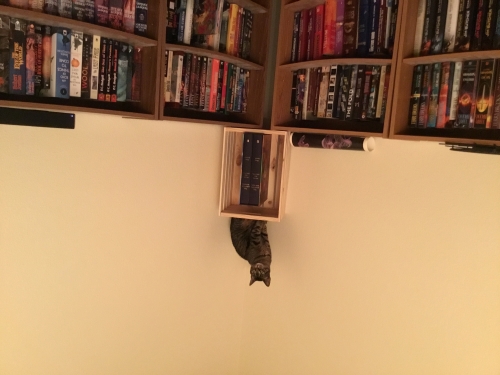
Jasmine was never the literary critic that Allie has turned out to be. However, she did spend a fair amount of time in my library. Here we can see her supervising my work while I transform one of my spare bedrooms into my library. Penny is perched on a similar wooden crate in the opposite corner. The tall books under Jasmine are Gary Larson's two-volume collection, The Complete Far Side (worth every penny!).
I do most of my reading in my office, sitting in front of my computer. That way I can keep up with AoSHQ. For the past several years Jasmine was my constant companion in my home office. She almost never left the room, though sometimes she'd join me in my bedroom or she'd hang out with Allie in the library.
She loved to sit quietly next to me while I read, a comforting presence. Now that she's gone, my office feels so empty and hollow, though Penny, Hexie, and Allie all spend a lot of time here.
I can say I'm truly blessed by the Moron Horde. The outpouring of love and support over the loss of my beloved kitty has been overwhelming. Thank you all for your kind words.
The Sunday Morning Book Thread was how I first joined the AoSHQ community as a commenter. If you are a regular lurker here, I encourage you to delurk, grab a nic, and start commenting. You'll soon discover that you have joined the most incredible family on the internet. It's even better once you meet them in person at a MOME. (Check the sidebar on the main page for details!)
Thank you, Jasmine, for being a beautiful part of my life for 13 years, my dear friend.
WHY READERS STOP READING
For the TL;DW crowd, Patrick points out that there are three main places within story where readers will generally tune out. I'll use Brandon Sanderson's nomenclature to explain what this means:
The Promise (first 30%)
Readers will tune out of the first part of a story if it doesn't grab their attention. I try to read at least 20% of a book before giving up on it, but that doesn't always happen. I recently gave up on reading Orson Scott Card's Treason because it was getting too weird too quickly. I didn't like the direction the story was going so I decided to put it down for another time, perhaps. I did the same thing with the Star Trek novel Killing Time. In that case, I felt the story was moving a bit too slowly and I wasn't in the mood for it. I will probably get back to it eventually. Some authors can have a "slow burn" in their stories, so I give them a bit of slack because I know that the end result is worth it. The Dragonbone Chair by Tad Williams spends 200 pages just establishing the world, and the pacing seems slow, but it's worth it because you feel yourself immersed in the history of Osten Ard and the day-to-day events of Simon's life.
The Progress (middle 40%)
Some books will start out really strong, but then grind to a halt somewhere in the middle because the author is taking their sweet time advancing the narrative. Maybe characters are developing a lot slower than you expect them to. Maybe the story is bogged down by stupid subplots, excessive dialog, or random events that seem to have no bearing on the story. Whatever the case, the reader decides that the story is no longer worth their time and decides to give up. Robert Jordan's Wheel of Time series suffers from this a bit. Books 7-10 are often called "the Slog" because not much seems to happen in those books to advance the overall plot. Instead, we get extensive character development, as Jordan has his main characters go in all different directions. It's worth reading them at least once, but if you want to focus on the main narrative, you can skip those books in later rereadings of the series and not miss out on too much.
The Payoff (last 30%)
If you've given up on a book by the time you've made it this far, then the author probably didn't do a very good job with the first 70% of a book. I've been known to finish a book that didn't interest me too much without remembering how it ended, mostly to say that I've read it. For example, I finished William Gibson's Neuromancer, supposedly one of the best science fiction books ever written about cyberspace, but I was bored to tears throughout most of it. I didn't care about the characters and the plot was barely interesting. I still don't remember how it ended. Nor do I care. Neal Stephenson's Snow Crash is vastly more entertaining, despite being hilariously dated. The characters are memorable, the plot is complex and intriguing, and I remember the ending distinctly, though it doesn't make a whole lot of sense. He has trouble properly finishind stories....
What are some reasons why YOU don't finish books?
++++++++++
++++++++++
PUBLIC DOMAIN CHARACTERS
OrangeEnt sent me a link to this article from Raconteur Press. They have put out a call for submissions for stories relating to the Buck Rogers universe because Buck Rogers is now a public domain character. However, the editors at Raconteur Press also made it very clear that there are still rules by which they must abide.
Just because a character or story is now available in the public domain doesn't give us the right to use any and all stories in which those characters appear. For instance, stories based on the Buck Rogers television show (1979-1981) will be rejected because THOSE stories are NOT in the public domain. The studio that produced the show purchased the rights to create their own material within the Buck Rogers universe and the studio owns the copyright on those stories.
If you choose to write stories using public domain characters, there's one rule above all others you should follow:
DO YOUR HOMEWORK!
In other words, do some basic research on the public domain characters and stories. Read as many of those stories as you can so that when you decide to incorporate them into your own stories, you understand who those characters are and how they will behave based on the spirit of the source material. It's OK to take risks, but your audience will notice when public domain characters are behaving differently than readers expect.
You also need to know WHICH stories are actually within the public domain. Until recently (2023), certain Sherlock Holmes stories were still not available within the public domain, thus no one could create derivative content based on those stories without the express permission of Sir Arthur Conan Doyle's estate (or whomemver owned the copyright on those stories). Now, though, all of the stories written by Sir Arthur Conan Doyle are freely available for public domain consumption and derivation. But you could NOT monetize stories based on the BBC Sherlock series starring Benedict Cumberbatch.
Public domain characters can be a good way to explore writing. You don't have the burden of creating your own characters and the world they inhabit. You can focus on plotting, exposition, dialog, and other elements of basic storytelling. You can also have a lot of fun putting characters in a zany situation and seeing how they might solve their current conflict.
MORON RECOMMENDATIONS
I read Dark Winter by William Dietrich. This is an engaging thriller set at the American basecamp at the South Pole. The last plane of the season has left and those wintering over are confronted with a murderer in their midst.
Posted by: Zoltan at April 26, 2026 09:16 AM (VOrDg)
Comment: This is a classic mystery set up, though in a location that presents its own unique challenges. Once the last plane has left for the season, there is very, very little hope of assistance from the outside world. For all intents and purposes, the scientists and support staff (if any) are cut off from the rest of the world until the weather allows for return transport, which could take months. Meanwhile, you have a murderer lurking among you. What do you do? Whom can you trust? You don't even have to bring a science fiction or horror element to the story. Simple human motivations are enough to make for an engaging story when told well.
++++++++++
Finished reading a graphic novel last week: The Winds of Numa Sera. While I could criticize parts of the story, it is fundamentally everything I've been searching for: a high-fantasy comic book! I read multiple chapters/issues in a sitting, and finished the whole thing in two days. So I was clearly enjoying myself.
Alas, there is one major problem with the book that cannot be overlooked. The book ends without a conclusion, with cliffhangers for multiple different characters. The book's spine says 'volume 1,' the copyright date says 2022, and four years later there is no sign of a volume 2. The back of the book has an advertisement for an 'Art or Numa Sera' and a table-top card came based on the story. All of this makes me think the book was created to be an IP farm, rather than for the sake of story. And I suspect the IP wasn't super-successful at launch, and thus may have been abandoned.
If so, that makes this yet another unfinished story littering my shelf...
Posted by: Castle Guy at April 26, 2026 09:39 AM (Lhaco)
Comment: Castle Guy brings up an interesting point...Nowadays, how many stories are published as a means to an end, rather than as an end unto itself? Based on his description, it sounds like the author(s) are looking for startup capital for other projects. Because of the various forms of entertainment we have access to nowadays, we have tons of IPs that have expanded into various media through computer games, role-playing games, movies, television, etc.
The Ice Limit by Douglas Preston and Lincoln Child -- This was a Moron Recommendation from a few years ago.
Mount Dragon by Douglas Preston and Lincoln Child -- Mad scientists...*sigh*...When will they ever learn?
Riptide by Douglas Preston and Lincoln Child -- Pirate treasure!
Sword of Ghosts by Richard A. Knaak -- Continuing the long-running saga of the Dragonrealm.
Dragon of the Depths by Richard A. Knaak -- Continuing the long-running saga of the Dragonrealm.
WHAT I'VE BEEN READING RECENTLY
Since I couldn't decide what to read after reading The Secret History of the World by F. Paul Wilson, I decided to play "Reading Roulette" and selected a few books at random from my TBR pile.
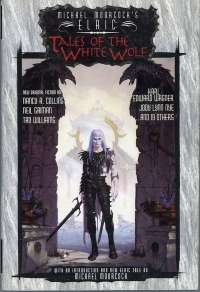
Michael Moorcock's Elric -- Tales of the White Wolf edited by Edward E. Kramer and Richard Gilliam
This is an anthology of short stories featuring everyone's favorite albino sorcerer king, the Dragon Emperor, the Eternal Champion, Elric of Melnibonë. Most of the contributors are successful fantasy authors in their own right, no doubt inspired by Michael Moorcock's creation to build their own worlds and characters. It's interesting when you read these stories how you can see Moorcock's influence on some of their own stories. It even features a short story by Gary "Advanced Dungeons and Dragons" Gygax! Unlike most of the stories, which tend to feature Elric as the main protagonist, Gygax instead tells a story from Moonglum's perspective. Moonglum is just one of many doomed companions of the White Wolf, eventually consumed by Elric's demonblade, Stormbringer.
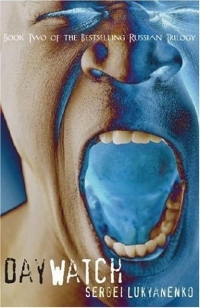
Day Watch by Sergei Lukyanenko
This is part of an urban fantasy series of novels set in Russia by Sergei Lukyanenko. For thousands of years, the Others have divided themselves into two main groups: the Night Watch, who serve the Light, and the Day Watch, who serve the forces of Darkness. It's actually a bit more complicated than that, as members of the Day Watch are really more libertarian/anarchist in their philosophy than explicitly worshipping demonic forces. Each book is a collection of three loosely-connected novellas that lead up to a climactic ending in the third part of the book.
It's not bad. I like the general worldbuilding that underlies the setting. The Others are beings with some form of access to the Twilight, additional layers of reality beyond our normal senses. Wizards and witches are the most powerful able to access deep levels of Twilight, while shapeshifters and vampires tend to be weaker overall, but still dangerous to mortals.
The Inquisition maintains the balance between the Day Watch and the Night Watch, ensuring that neither one gets too out of hand, as that tends to have rather unfortunate consequences for the world, like wars, famines, plagues, and the usual disasters that cause untold misery and destruction across the globe, which we mere mortals attribute to the folly of man or the capriciousness of Mother Nature.
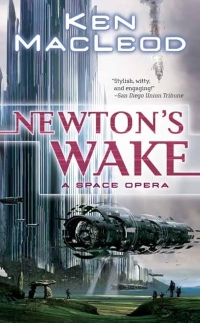
Newton's Wake: A Space Opera by Ken MacLeod
This story puts the "opera" in "space opera" by featuring a subplot with an actual opera performance. The main plot features a family of interstellar scavengers that use the monopoly of a portal network to loot worlds for lost technology. The Hard Rapture several centuries ago was the moment that the bulk of humanity transcended itself and became a hyperintelligent entity capable of godlike feats. For the survivors, they made do by leveraging some of the remnants of this technological feat to establish standard empires within the galaxy.
There are some interesting post-human effects explored within this story. For instance, because it's possible to backup and restore entire minds, death is no longer permanent with proper preparation and sufficient wealth. It means that people can almost treat life like a video game. This is exploited at one point when characters go to a world that's bombarded by neutron-star radiation, which is ultimately deadly, but the characters are able to survive long enough to fulfill their mission and "restore from backup."
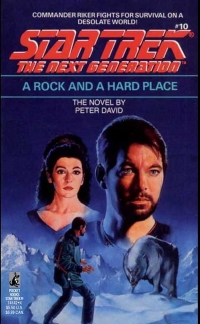
Star Trek: The Next Generation #10: A Rock and a Hard Place by Peter David
The Prime Directive in the Star Trek universe has always been idealistic twaddle. This story hammers that philosophy home hard as we see what happens when a young Starfleet Commander has to stand by and watch atrocities occur so that the Federation can gain yet one more world under its sway. Neither the Klingons nor the Romulans abide by any such Prime Directive, ruthlessly exploiting any technologically primitive world for their own gain.
Commander Stone is assigned to the Enterprise-D so that Picard and his crew can instill some proper Starfleet discipline in Stone. His behavior has become erratic and unpredictable, though he's also brilliant in taking a third option whenever he can. Meanwhile, Commander Riker has been reassigned to assist Federation terraformers on a world where a mad scientist experiment has run amok.
I was surprised by the quality of this story, as it really does show the perils of command and how events can shape our lives. Stone seems like a sociopath, and to some extent he probably is, but then you find out his backstory and it all makes sense. It's very dark for a Star Trek story.
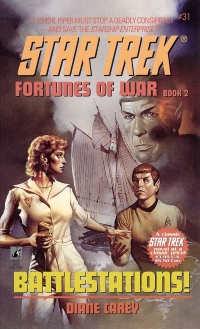
Star Trek #31: Battlestations! by Diane Carey
Unlike most Star Trek novels, this story is told in first person from the perspective of Lieutenant Commander Piper. She is recruited by Captain Kirk and Commander Spock to undertake a secret mission to uncover the truth about what happened to a group of scientists involved in the development of "transwarp" technology. Apparently there are a few different forms of this within the Star Trek Expanded Universe. In this story, it's a dimensional-warping device that will revolutionize space travel, but it's also highly unstable and dangerous. The scientist who developed the theory behind it wants to sell the technology to the highest bidder, which makes the Federation very unhappy.
It's a sequel to a previous Star Trek novel, Dreadnaught, but it's not necessary to read the previous story to understand what's going on in this story. LTC Piper is young and very unsure of herself, but find herself growing into her role as a capable leader and commander, which is why Captain Kirk assigned her to this mission, even though she didn't know about it until halfway through the story.
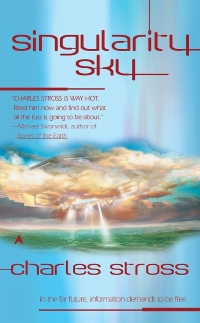
Singularity Sky by Charles Stross
I'm somewhat lukewarm on Charles Stross stories. He has a tendency towards over-exposition of his technology, as if he's trying to show off his knowledge. Still, he does have intriguing stories and this is one of them. The Festival, an alien "infovore" has arrived around a New Republic world, one based on a neo-feudalistic society modeled after late nineteenth-century Russia. The Festival provides unlimited goods for the local peasant population, in exchange for "entertainment" in the form of stories or just general knowledge. Meanwhile, the ruling aristocratic authorities are annoyed because they feel that control over their populace is threatened. Revolutionaries are spouting Marxist rhetoric that also threatens their rule.
Agents from the Echaton--the super-intelligence that actually rules humanity--have been dispatched to steer the New Republic from a disasterous course towards war against the Festival. The Festival is mostly harmless, but not defenseless and does respond to aggression with deadly retaliation. The Eschaton also wants to ensure that causality is absolutely preserved. Humans can travel at faster-than-light speeds only because of certain loopholes in causality. Attempting to circumvent those loopholes for strategic military gain is strictly forbidden as that would threaten the existence of the Echaton. It will ensure its own survival by making a sun go nova, so it's best to keep on their good side.
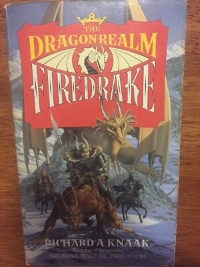
The Dragonrealm - Firedrake by Richard A. Knaak
After the passing of my cat Jasmine, I needed some "comfort" reading, so I opted to read a series of books that I've enjoyed for several decades. I remember picking up the first book, Firedrake, because it featured cover art by Larry Elmore and it was written by Richard A. Knaak, who had penned one of the best Dragonlance novels, The Legend of Huma.
On the surface, the Dragonrealm series seems like a generic fantasy series, but once you've read the first couple of books, you'll soon realize there's much more depth to it. The worldbuilding is amazing, with complex layers of reality the characters have to navigate along with intricate plots where you're not always sure who is in the right. The main characters such as Cabe Bedlam and Lady Gwen are decent, if a bit boring. The side characters, however, tend to be much more interesting. The Dragon Kings are not just generic villains. They operate in a complicated world and when we find out their origins, it explains a lot of their behaviors and ideology. The shadow steed Darkhorse is a unique entity in the multiverse, a sentient Void who just happens to enjoy taking the shape of a powerful horse. The Gryphon is a mysterious being originating from across the seas, ruler of the City of Knowledge. And Shade is a sorcerer supreme cursed with being immortal, but vacillating between good and evil in his incarnations.
I find it to be a very enjoyable series for the most part and I'm looking forward to reading through it again.
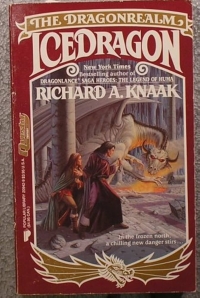
The Dragonrealm - Ice Dragon by Richard A. Knaak
In the sequel to Firedrake, the Gold Dragon Emperor has been defeated, but his brother the Ice Dragon now threatens the Dragonrealm. Cabe Bedlam and his wife, the beautiful Lady of the Amber Gwendolyn, must travel to the heart of the Ice Dragon's frozen domain before he can unleash a deadly spell that will cover the entire world in a new ice age, destroying not only all humans, but all life everywhere.
Meanwhile, Cabe's inhuman friend and ally the Gryphon is tracking down the source of the mysterious "wolf raiders" who furnished the Black Dragon with an inexhaustible supply of soldiers during the Black Dragon's siege of Penacles, the city the Gryphon is sworn to defend. He discovers that the answers to his questions lie in a continent across the seas...
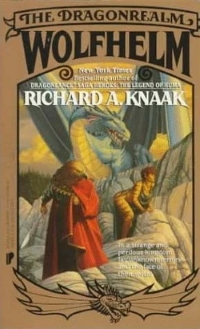
The Dragonrealm - Wolfhelm by Richard A. Knaak
Wolfhelm is the third book in the Dragonrealm series and focuses on the adventures of the humanoid lionbird known as the Gryphon. His origins are shrouded in mystery, but he knows he came from a distant land across the Eastern Seas. That continent is ruled by the Aramite Empire, who worships the Ravager, a god that takes the image of a wolf. The Aramites are at war with the Dream Lands, a coterminus reality that overlays the Aramite Empire and threatens their existence. The Gryphon finds himself caught up in a struggle between ancient powers he barely understands, as he also struggles to comprehend his own origins. Where did he come from? Why is he unique? Why does the godlike Ravager fear him?