« Daily Tech News 15 November 2026 |
Main
November 15, 2026
Sunday Morning Book Thread - 11-15-2026 ["Perfessor" Squirrel]
Welcome to the prestigious, internationally acclaimed, stately, and illustrious Sunday Morning Book Thread! The place where all readers are welcome, regardless of whatever guilty pleasure we feel like reading (a Dark Lord's worst nightmare). Here is where we can discuss, argue, bicker, quibble, consider, debate, confabulate, converse, and jaw about our latest fancy in reading material. As always, pants are required, unless you are wearing these pants*...
So relax, find yourself a warm kitty (or warm puppy--I won't judge) to curl up in your lap, and dive into a new book. What are YOU reading this fine morning?
PIC NOTE
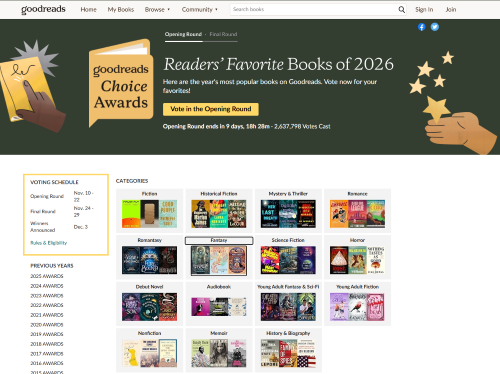
Any of y'all on Goodreads? I signed up for a Goodreads account a long time ago, but I hardly ever touch it. That doesn't stop Goodreads from sending me periodic emails about new releases and whatnot. Now they have a survey for "Readers Favorite Books of 2026." It's broken down by category or genre, so participants can vote for their favorite books in their preferred genres. Like most popularity contests, it's mostly meaningless in the grand scheme of things. I went to the Fantasy, Science Fiction, and Horror categories to see what choices are available, as those are my three preferred categories. Out of all three categories, I had only even heard of TWO books, both in the Fantasy category--Twelve Months by Jim Butcher and A Trade of Blood by Robert Jackson Bennett. I thought both books were very good, though, so I wouldn't have any issues with voting for them. In the Science Fiction category, I've heard of just a few of the authors (John Scalzi, Matt Dinniman, James Islington, and Adrian Tchaikovsky) but I have not read any of the books that are listed on the page. And of the authors I've heard of, I've read previous books by two of them (Islington and Tschaikovsky).
I guess I'm not "in tune" with what today's readers are reading. I seem to prefer stuff that was written before current year, unless it's written by an author whom I already read because I've enjoyed their previous works (like Jim Butcher or Robert Jackson Bennett).
Does anything on the Goodreads' "Favorite Books of 2026" appeal to you?
BEST *LAST LINES* IN A BOOK
That Clarke story was "The Nine Billion Names of God," and it's one of his best.
We often discuss books or stories with the best first lines. That story has one of the best last lines.
Posted by: Oddbob at November 01, 2026 12:30 PM (vTZFs
The first line of a book can be the line that hooks us and draws us in to a story. Some first lines become quite famous:
- "It was the best of times, it was the worst of times, it was the age of wisdom, it was the age of foolishness, it was the epoch of belief, it was the epoch of incredulity, it was the season of Light, it was the season of Darkness, it was the spring of hope, it was the winter of despair." (Charles Dickens, A Tale of Two Cities)
- "Call me Ishmael." (Herman Melville, Moby Dick)
- "It was a bright cold day in April, and the clocks were striking thirteen." (George Orwell, 1984)
- "It was a pleasure to burn." (Ray Bradbury, Fahrenheit 451)
- "In a hole in the ground there lived a hobbit." (J.R.R. Tolkien, The Hobbit)
But what about the LAST line(s) of a story? Those are the lines that should leave us satisfied about the conclusion of the story, sighing with pleasure, shuddering in horror, or simply reluctant to close the book after the events have been told. Of course, the challenge in discussing the last lines of a story is that we may unintentionally reveal a spoiler or two. I generally try to avoid reading the last line or page of a book (especially a mystery!) before I get to that point of the story. That is, I seldom, if ever, read ahead to see who lives at the end, as I don't like to ruin the surprise. I do like a story that has a good ending line, however.
Sometimes the last line of a story--particularly a short story--can be a "wham line" where the last line of the story completely changes how we perceive the story as an important twist is revealed in that last line. Robert Bloch's short story "Yours Truly, Jack the Ripper" has such a twist at the end. Harlan Ellison's "I Have No Mouth and I Must Scream" doesn't have a twist ending, per se, but it's one of the grimmest last lines of a story I've ever read. Ray Bradbury is quite good about coming up with a "last line" that leaves a mark on the reader in many of his short stories, often to chilling effect. As mentioned by Oddbob above, Arthur C. Clarke is no stranger to leaving the reader with an impactful last line. "The Nine Billion Names of God" is an amazing short story with a neat ending, one that shows just how much the universe really cares about us (spoiler--not much, as it turns out, once we've fulfilled our purpose). Isaac Asimov's "The Last Question" ends with a banger of a last line (literally!).
Another way in which the last line of a book can have an impact on the reader is if it's a reflection or callback to the first line of the story. In other words, the author uses both the last line and the first line as bookends to everything that happens in between. The twist is that the last line should have even MORE impact on the reader when we see the first line through the context of everything that happens throughout the story. Two examples spring immediately to mind:
Dying, in what seemed to be the first cold morning of the world, he groped for fire.
Fred Saberhagen, The Third Book of Swords
The wind blew southward, through knotted forests, over shimmering plains and towards lands unexplored. This wind, it was not the ending. There are no endings, and never will be endings, to the turning of the Wheel of Time.
But it was an ending.
Robert Jordan, A Memory of Light
(Yes, I know Brandon Sanderson co-wrote the book, but Jordan wrote the final ending before he passed away, so I'm giving Jordan sole credit here.)
One of my favorite last lines comes from Michael Ende's The Neverending Story because it encapsulates the entire theme of the book: "But that is another story, and shall be told another time."
++++++++++
 ++++++++++
TROPES WE HATE
This is a trope I've always hated: the far superior aliens who want to destroy earth/humans because we're so violent. What?!
Posted by: All Hail Eris, She-Wolf of the 'Ettes 'Ettes at September 27, 2026 10:49 AM (kpS4V)
Other tropes I've always hated
- The Magical Liberal who educates the lumpish conservative
- The deranged Vietnam veteran
- The conformism of suburban culture
- Dinner table arguments and accusations
- How damn hard life is for an urban gay
Posted by: Hadrian the Seventh at September 27, 2026 11:00 AM (eRlcH)
A trope, of course, is simply a storytelling convention or shortcut for describing situations that the audience will most likely recognize. For example, the hard-boiled detective or the chosen one. Some tropes work well for us, but sometimes we find ourselves HATING a story because of the way tropes are handled by the author. A common one, for instance, is when the author injects their own political ideology into a story that doesn't need it. Or the author is using a trope in such a way that it becomes just another tired cliche of an already overused trope, such as the endless romantasy books that all have the same basic plot structure. If that's your jam, go for it, but not everyone liks to read the same stories over and over again (and yes, the endless questing in fantasy books can get formulaic and boring at times.)
What are some of the tropes that will take YOU out of a story because they just rub you the wrong way? Do you grit your teeth and move on, if the story is otherwise engaging? Or do you throw the book into the nearest trashbin, vowing to never read another book by that author again?
MORON RECOMMENDATIONS
I got about 50 pages into MP4's new Ten Thousand Midnights Theda Bara book. I thoroughly enjoyed the first two and this is no different, maybe a tad better. It took only a few pages to feel transported back to the 1920s early Hollywood era. He does it with snappy dialog, a bit of period slang (think of William Powell in the Thin Man) and keeping the action to the technology of the period. Not everyone has a car or a phone and even radio was a fledgling industry. Newspapers and magazines were the common way to get, or reveal, information. It's an effective technique.
MP4 has the ability to bring characters to life quickly and completely without disrupting the flow of the story. It keeps everything moving and you don't want to put it down. A lot of telling yourself "Just one more chapter".
I'll have more to say when I finish. I will say if and when it comes out in hardcover (I have the paperback right now) I'll get it and pass along the paperback to my niece or nephew.
Really good job with the book, MP4.
Posted by: JTB at November 01, 2026 10:43 AM (yTvNw)
Comment: I have yet to purchase MP4's latest book (apologies!), but I did read the second Theda Bara story, The Stuff That Dreams Are Made Of: A Theda Bara Mystery and enjoyed it. I echo JTB's observation about MP4's ability to bring 1920s Hollywood to life. It's a masterclass in solid historical worldbuilding. I did think the mystery in Dreams was a bit on the thin side, but I didn't care because I was enjoying the rest of the story as we see the interactions between Toby, Theda, and the other characters. Good stuff if you are looking for something to keep you entertained and engaged for a few hours.
In The Puppet Masters the female lead is ultimately the key to beating the alien slugs. YMMV but for my money this is the best alien invasion novel ever, and it's the book that kicked off my decade-plus-long period of reading almost nothing but sf for pleasure.
Posted by: Just Some Guy at September 20, 2026 09:17 AM (q3u5l)
Comment: I'll admit that The Puppet Masters is a really good alien invasion story. I have not read this book in a long, long time, though, so I don't know how much I would enjoy it today. I shall have to give it a rea-read soon. It does feature flying cars, which is cool. And everyone is walking around in their skivvies, as that's one of the few ways to ensure people aren't under the control of the alien parasites (it makes sense in context). I honestly don't remember how it ends.
MORE MORON RECOMMENDATIONS CAN BE FOUND HERE: AoSHQ - Book Thread Recommendations
WHAT I'VE ACQUIRED RECENTLY
- The Bloodsworn Book 1 - The Shadow of the Gods by John Gwynne
- The Bloodsworn Book 2 - The Hunger of the Gods by John Gwynne
- The Bloodsworn Book 3 - The Fury of the Gods by John Gwynne
- The Wolfheart Chronicles Book 1 - The Wolves of War by John Gwynne
WHAT I'VE BEEN READING RECENTLY
Realm of the Elderlings - Liveship Traders Book 3 - Ship of Destiny by Robin Hobb
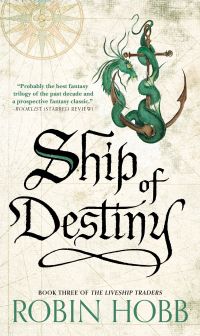
This is the third and final volume of Robin Hobb's Liveship Traders series. Although it was pretty good and the action kept moving, it did seem to drag a bit in parts as the characters seemed to be endlessly searching for each other. We do get to see the central mystery resolved (no spoilers!) and there's a fair amount of character development that takes place over the story. Not only among the human characters, but the liveships themselves (sentient beings) also change, which has dramatic effects on the story. The ending did seem a bit rushed, as a major plotline was resolved off-page. We only see the aftermath of that in correspondence that the main characters receive during the extended epilogue chapters. Overall it's a pretty decent fantasy series. Hobb is very much concerned with character development over plot, which is OK because she makes it work.
Hobb does have a tendency to put her characters through the wringer, though, which can be emotionally draining on the reader as we see characters put into very challenging situations that often have a gruesome end. In the first book, for instance, Wintrow, a young fourteen-year-old boy, damages one of the fingers on his hand to the point where it has to be amputated. Hobb doesn't spare us the gory details about the amputation process.
Dragonships Book 1 - Bones of the Dragon by Margaret Weis and Tracy Hickman
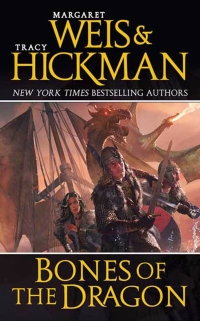
I decided to take a break from Robin Hobb's series about living ships to read another series of books about ships (which also become "alive" in some sense): Dragonships by Margaret Weis and Tracy Hickman. It's been a long time since I've read any of their books.
This series is inspired by Norse mythology and follows the adventures of a young man from a small village. The gods of his society have been killed off by the New Gods, and now he's on a quest to find them and see how their power can be restored.
Skylan Ivorson, supposedly the main hero, is one of the dumbest characters I've ever seen. He's functionally retarded in many ways. If Weis and Hickman rolled up the stats for this character in Dungeons and Dragons he'd have a combined Intelligence and Wisdom score of no more than 8. For context, an average character in D&D has individual Intelligence and Wisdom scores of 10-11, with a maximum of 18 for each ability for exceptional characters. So a combined score of 8 or less is pretty danged stupid. Groo the Wanderer is Isaac Newton compared to Skylan, and has better impulse control.
We'll have to wait and see if he improves any over the course of the next few books. Weis and Hickman are pretty good at character development and growth, so there is at least some precedent that Skylan will learn some valuable lessons and improve his behavior. Otherwise, his story may be over soon and another character will take his place. Plot twist?
Tips, suggestions, recommendations, etc., can all be directed to perfessor -dot- squirrel -at- gmail -dot- com.
The world was doomed, but it kept running anyway.
Disclaimer: Always read the fine print of any Trial by Combat.
* I'm now contractually obligated to inform you that rickb223 is the sole recipient of a lifetime exemption from the pants rule on the Sunday Morning Book Thread. May God have mercy on us all...

posted by Open Blogger at
09:00 AM
|
Access Comments