
Intermarkets' Privacy Policy
Donate to Ace of Spades HQ!
aceofspadeshq at gee mail.com
Buck:
buck.throckmorton at protonmail.com
CBD:
cbd at cutjibnewsletter.com
Doof:
doof2112 at proton.me
joe mannix:
mannix2024 at proton.me
MisHum:
petmorons at gee mail.com
J.J. Sefton:
sefton at cutjibnewsletter.com
The Mystery of the Talarico Disappearance
The Morning Rant
Mid-Morning Art Thread
The Morning Report — 10/13 /26
Daily Tech News 13 October 2026
Monday Overnight Open Thread (10/12/26) Happy Columbus Day Edition
Columbus Day Cafe
Llama Seduction Open Thread
Some Kind of Weasel Open Thread
Jon Ekdahl 2026
Jay Guevara 2025
Jim Sunk New Dawn 2025
Jewells45 2025
Bandersnatch 2024
GnuBreed 2024
Captain Hate 2023
moon_over_vermont 2023
westminsterdogshow 2023
Ann Wilson(Empire1) 2022
Dave In Texas 2022
Jesse in D.C. 2022
OregonMuse 2022
redc1c4 2021
Tami 2021
Chavez the Hugo 2020
Ibguy 2020
Rickl 2019
Joffen 2014
maildrop62 at proton dot me
Mid-Morning Art Thread [Kris]
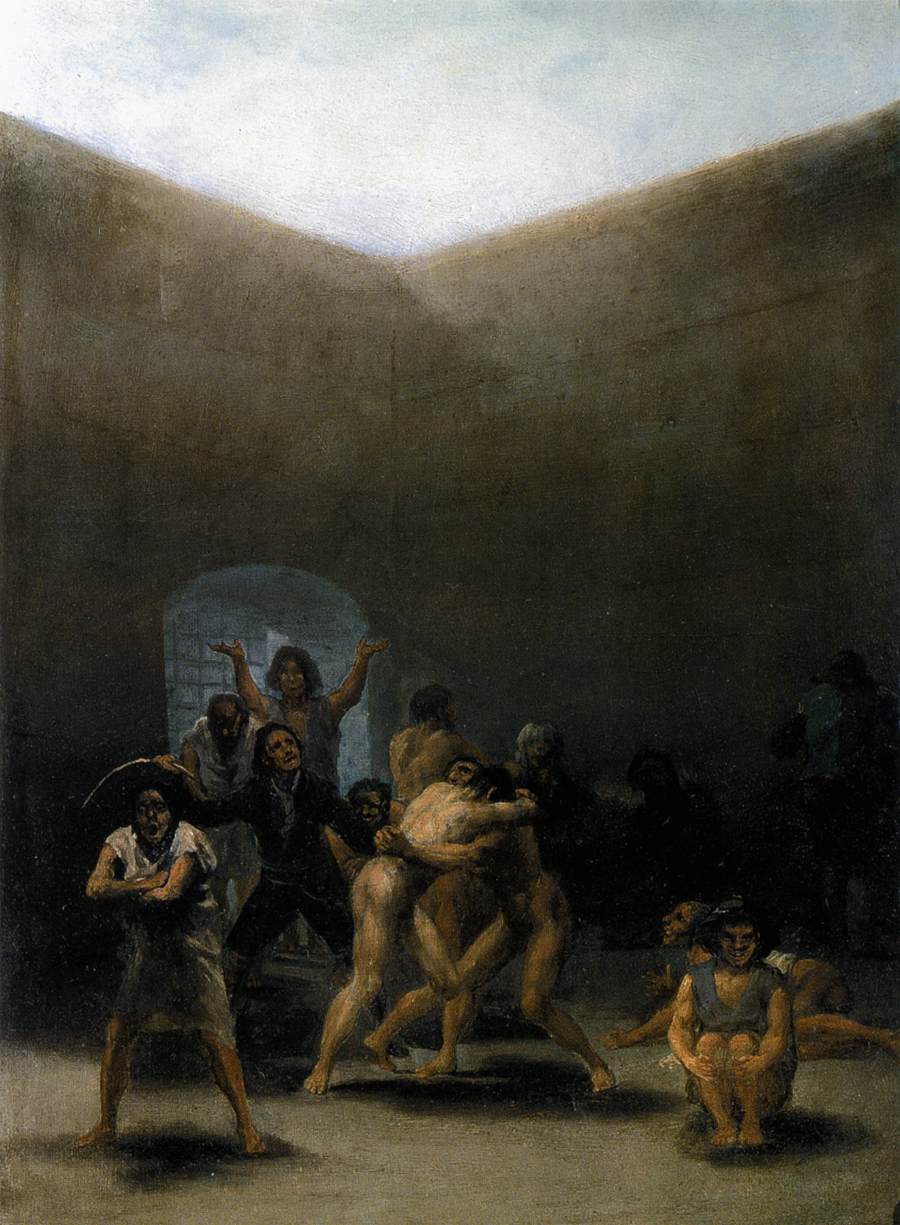
The Yard Of A Madhouse
Francisco José de Goya y Lucientes
Goya’s career was slow in taking off until he married the sister of a member of the Royal Academy of Fine Arts. His new brother-in-law got him a job and commissions, including some that would decorate the royal palaces. These works eventually got him noticed by the king and would lead to his rise as a court painter in 1789, and as First Court Painter to Charles IV in 1799.
Around 1794, Goya’s suffered an illness that left him completely deaf. His work became moody and introspective as a result. Among these was “Yard of the Madhouse.” He describes it in a letter as something he witnessed personally that affected him. He was acutely aware of the painting’s disturbing imagery and that people might not like it. He didn’t seem to care if anyone ever saw it or not.
“Yard of the Madhouse” is a dark work and probably my favorite Goya. It is a long, thin, vertical work with almost nothing going on in the top half. The top of the arch in the background is about the half-way point of the composition. Above this is quiet, but ominous. There’s a large wedge of empty blue sky and then two large, brown/grey walls that come together at a corner. This effect creates a bright blue arrow that drives my eye down to the lower half of the work and keeps it there, but its moody stillness does nothing to ready us for the chaos at the bottom.
The bottom of the painting is a mass of writhing, yelling forms. In the center are two grappling figures. Their muscles ripple with effort as they try to thrash the other. Meanwhile, a hospital staff member whips them. The violence of the whipping can be seen in the arc of the rod, but the two do not feel it. This scene reminds me of a dog fight I once witnessed. The viciousness of the fight was terrifying to watch and very difficult to break up. Nothing seemed to work. Only brute strength finally tore the dogs apart, but some of us were seriously hurt doing so.
In this painting, I think Goya may be using the classical nude against itself. The Classical Era was believed to be the absolute Golden Age of human civilization. Its ideals became one of the foundations of Western culture, and art would adopt the older era’s themes and motifs. By making the central lunatics nude, Goya may be criticizing the contemporary idealization of Man and Human Reason, instead showing humanity as he saw it. I don’t think it’s a coincidence that the central figures are the only nudes, and that they are the most violent figures in the work. Physically, these figures are ideal male specimens, but their mind, what made them human, is gone. The ideal is shattered like their minds.
In the painting, the rest of the inmates react to the fight. They panic, scream, hoot, run around and flip out — it’s bedlam… except for one figure.
The figure in the lower right foreground, for me, lifts this painting to greatness. I cannot stop looking at him. He just sits there. Smiling. At me. The smile is a big, toothy grin. He’s probably giggling too. Everyone else is immersed in the fight; he, alone, is not. He is reacting to my presence. Now go back to the walls in the upper half of the painting. There are only two. The other two are behind me… meaning I am in the yard of the madhouse with the lunatics, and there is no barrier between me and them. Back in the day, asylums were tourist attractions, like zoos for crazy people. Goya may have went on such a tour to have witnessed this scene and this figure watched the tourist go by, and just smiled.
Goya had a fear of going insane and like many other Romantics of his era, explored the relationship between sanity and insanity. In a society that celebrated the achievements of human reason, ability, and ingenuity, the Romantics were fascinated by the deception of human ability and the dark areas of the mind and human nature. Goya would go back to this theme several times during his career. After the fallout of the Napoleonic Wars, he would withdraw from court and society all-together, create his “Black Paintings” that were intended for his eyes only, and die a near-recluse just outside Madrid.

[/i][/s][/b][/u]Oddbob: "[i]Texas women swooned over Beto O'Rourke. That go ..."
wth: "I guess he left the flying carpet in the car. ..."
Elric The Blade: "I guess that could happen. I mean, though, haven't ..."
Alberta Oil Peon: "He was a black dude. Sometimes these poor bastards ..."
ChristyBlinkyTheGreat: "331 327 It does occur to me that the whole Talafre ..."
Don Black: "HERE'S what happened: A scientist in New Mexico ..."
Black Orchid (j+aD2): "[I]I guess that could happen. I mean, though, have ..."
bonhomme[/i][/i][/i][/b][/b][/b][/s][/s][/s][/u][/u][/u]: "[i]the dude was enormous that said, don't the w ..."
[/i][/b][/s]Biden's Dog sniffs a whole lotta malarkey,: "Mrs. BD and I took a flu shot for the first time d ..."
ChristyBlinkyTheGreat: "298 289 281 No flu shot for me, thanks. Posted by ..."
SMH at God's mercy: "Thinks of the 13 shot & killed by Hassan including ..."
The Mystery of the Talarico Disappearance
The Morning Rant
Mid-Morning Art Thread
The Morning Report — 10/13 /26
Daily Tech News 13 October 2026
Monday Overnight Open Thread (10/12/26) Happy Columbus Day Edition
Columbus Day Cafe
Llama Seduction Open Thread
Some Kind of Weasel Open Thread
Paul Anka Haiku Contest Announcement
Integrity SAT's: Entrance Exam for Paul Anka's Band
AllahPundit's Paul Anka 45's Collection
AnkaPundit: Paul Anka Takes Over the Site for a Weekend (Continues through to Monday's postings)
George Bush Slices Don Rumsfeld Like an F*ckin' Hammer
Democratic Forays into Erotica
New Shows On Gore's DNC/MTV Network
Nicknames for Potatoes, By People Who Really Hate Potatoes
Star Wars Euphemisms for Self-Abuse
Signs You're at an Iraqi "Wedding Party"
Signs Your Clown Has Gone Bad
Signs That You, Geroge Michael, Should Probably Just Give It Up
Signs of Hip-Hop Influence on John Kerry
NYT Headlines Spinning Bush's Jobs Boom
Things People Are More Likely to Say Than "Did You Hear What Al Franken Said Yesterday?"
Signs that Paul Krugman Has Lost His Frickin' Mind
All-Time Best NBA Players, According to Senator Robert Byrd
Other Bad Things About the Jews, According to the Koran
Signs That David Letterman Just Doesn't Care Anymore
Examples of Bob Kerrey's Insufferable Racial Jackassery
Signs Andy Rooney Is Going Senile
Other Judgments Dick Clarke Made About Condi Rice Based on Her Appearance
Collective Names for Groups of People
John Kerry's Other Vietnam Super-Pets
Cool Things About the XM8 Assault Rifle
Media-Approved Facts About the Democrat Spy
Changes to Make Christianity More "Inclusive"
Secret John Kerry Senatorial Accomplishments
John Edwards Campaign Excuses
John Kerry Pick-Up Lines
Changes Liberal Senator George Michell Will Make at Disney
Torments in Dog-Hell
The Ace of Spades HQ Sex-for-Money Skankathon
A D&D Guide to the Democratic Candidates
Margaret Cho: Just Not Funny
More Margaret Cho Abuse
Margaret Cho: Still Not Funny
Iraqi Prisoner Claims He Was Raped... By Woman
Wonkette Announces "Morning Zoo" Format
John Kerry's "Plan" Causes Surrender of Moqtada al-Sadr's Militia
World Muslim Leaders Apologize for Nick Berg's Beheading
Michael Moore Goes on Lunchtime Manhattan Death-Spree
Milestone: Oliver Willis Posts 400th "Fake News Article" Referencing Britney Spears
Liberal Economists Rue a "New Decade of Greed"
Artificial Insouciance: Maureen Dowd's Word Processor Revolts Against Her Numbing Imbecility
Intelligence Officials Eye Blogs for Tips
They Done Found Us Out, Cletus: Intrepid Internet Detective Figures Out Our Master Plan
Shock: Josh Marshall Almost Mentions Sarin Discovery in Iraq
Leather-Clad Biker Freaks Terrorize Australian Town
When Clinton Was President, Torture Was Cool
What Wonkette Means When She Explains What Tina Brown Means
Wonkette's Stand-Up Act
Wankette HQ Gay-Rumors Du Jour
Here's What's Bugging Me: Goose and Slider
My Own Micah Wright Style Confession of Dishonesty
Outraged "Conservatives" React to the FMA
An On-Line Impression of Dennis Miller Having Sex with a Kodiak Bear
The Story the Rightwing Media Refuses to Report!
Our Lunch with David "Glengarry Glen Ross" Mamet
The House of Love: Paul Krugman
A Michael Moore Mystery (TM)
The Dowd-O-Matic!
Liberal Consistency and Other Myths
Kepler's Laws of Liberal Media Bias
John Kerry-- The Splunge! Candidate
"Divisive" Politics & "Attacks on Patriotism" (very long)
The Donkey ("The Raven" parody)