Ace: aceofspadeshq at gee mail.com
Buck: buck.throckmorton at protonmail.com
CBD: cbd at cutjibnewsletter.com
Doof: doof2112 at proton.me
joe mannix: mannix2024 at proton.me
MisHum: petmorons at gee mail.com
J.J. Sefton: sefton at cutjibnewsletter.com
A site for members of the Horde to post their stories seeking beta readers, editing help, brainstorming, and story ideas. Also to share links to potential publishing outlets, writing help sites, and videos posting tips to get published.
Contact OrangeEnt for info: maildrop62 at proton dot me
Sunday Morning Book Thread - 8-9-2026 ["Perfessor" Squirrel]
Welcome to the prestigious, internationally acclaimed, stately, and illustrious Sunday Morning Book Thread! The place where all readers are welcome, regardless of whatever guilty pleasure we feel like reading (party's over, pal!). Here is where we can discuss, argue, bicker, quibble, consider, debate, confabulate, converse, and jaw about our latest fancy in reading material. As always, pants are required, unless you are wearing these pants...
So relax, find yourself a warm kitty (or warm puppy--I won't judge) to curl up in your lap, and dive into a new book. What are YOU reading this fine morning?
VIDEO NOTE
The House of Commons of the British Parliament tends to grab most of the headlines, but it's worth remembering that the British Parliament is a bicameral system. The House of Lords is the "upper chamber" of Parliament, consisting of around 770 members. Like the House of Commons, it plays an important role in legislative affairs, even if that role is largely behind the scenes in government. Unsurprising for an organization that has been around for many centuries, its procedures and traditions are arcane to outsiders. The House of Lords has its own dedicated library in which they can look up previous laws and statutes that may be relevant to current legislation. I suppose they tend to serve more in an advisory role to the King and the House of Commons in that respect, rather than a hands-on legislative body that gets things done--that seems to be the role of the House of Commons.
FEATURED MORON REVIEW
Biden's Dog sent in the following review:
The Curtain Falls: Last Days of the Third Reich (1945) is a short firsthand memoir by Count Folke Bernadotte*, the well-known Swedish diplomat and vice-chairman of the Swedish Red Cross.
Bernadotte recounts his negotiations from mid-February to late April 1945 with the highest ranking Nazis in Germany, including Himmler. His initial humanitarian mission was to secure the release and transport of Scandinavian (mainly Danish and Norwegian) prisoners from Nazi concentration camps to neutral Sweden for internment until the war's end.
The book details his repeated missions and meetings amid the collapsing Third Reich. It vividly describes the chaotic, surreal atmosphere in the final weeks before Germany's surrender. What began as a rescue effort took on political weight when Himmler, acting without Hitler's knowledge, used Bernadotte to convey a late, desperate offer of partial surrender to the Allies.
The account is based on Bernadotte's own notes and reports. Such rescues ultimately saved thousands, including Scandinavians, Poles, and others. It was published shortly after the war and remains a notable primary source on this period.
The book is an easy read, small in size and 155 pages long. It is a straightforward wartime memoir rather than a broad history. The book is illustrated with 10 black and white photos of most of the characters involved.
----
* On September 17, 1948, Count Bernadotte was assassinated in Jerusalem by Israel's LEHI (the Stern Gang) group. LEHI viewed Bernadotte as biased toward the Arabs and a threat due to his mediation proposals on Jerusalem and territorial limits for the Jews. At the time, future Israeli Prime Minister Yitzchak Shamir was one of the LEHI's leaders and approved of the assassination plan.
The Israeli provisional government, under David Ben-Gurion, strongly condemned the act as a "low, dastardly crime." So, too, did Menachem Begin, leader of the Irgun/ETZEL. Begin publicly called for those responsible to be found and brought to justice.
++++++++++
++++++++++
READING ON PAPER REWIRES YOUR BRAIN
I thought the video above was an excellent overview of how reading paper-based materials affects our brains. Apparently we are hard-wired to show marked improvement in retention and comprehension by reading paper books rather than digital books. This makes a lot of sense. As a species we've been reading paper-based materials for millennia. We've only been reading digital materials for a few decades at most. No doubt our brains have evolved or been shaped by our environment to prioritize gathering information from paper-based materials.
I thought the "one book effect" was very interesting because it demonstrates the power that just ONE BOOK in a home can have on a child's education and upbringing. Most of you reading this blog no doubt grew up in a home filled with books. I know I sure did. So I can't even conceive of a home that doesn't have at least one book in it. It's an alien concept to me.
As someone who works in the education industry, I was also struck by the point that reading complex material in printed format was better for you than reading it in digital format. I know that whenever I'm tasked with reading an academic journal article, I prefer to print it out and THEN go through it with a fine-toothed comb to understand it. I do find that I retain the information better and can spend time wrestling with the complicated materials until I understand it more fully. It also helps me whenever I'm writing a paper because I can spread out journal articles around me and sort them into piles that are "relevant" and "irrelevant." It's easy to tell at a glance which articles are most important to supporting the thesis of my paper.
The "dimensionality" aspect of reading printed materials also seems to have a direct impact on how much we retain and comprehend. Again, the fact that I can pick up a weighty tome of knowledge and tell at a glance how much I have left to read is immensely helpful to me. Even when reading for pleasure (which is most of my reading), I absolutely LOVE to have the physical book over a digital version. I engage most of my senses -- sight, hearing (turning the pages), touch, and even smell -- to enjoy the story. I can go back and forth within the book, easily holding my place with a bookmark or finger, while I look up a term in the glossary or flip back to a map/illustration that's relevant to what I'm reading at the moment. I have a much harder time with that experience when reading digital versions. I've noticed that digital books do attempt to replicate the physical book reading experience with digital pages that simulate physical paper, "page turning" animations that simulates a real book, and even adding a "page turning" noise.
I know a lot of you folks enjoy reading on a digital device, which does have a lot of advantages, especially for older folks who may struggle to read physical books these days. Audiobooks are also a very common alternative these days. Maybe someday the data will show a different story as future generations adapt to reading/comprehending in digital media. Of course, there's also the problem of long-term storage of digital media over time. Physical books can last for hundreds or even thousands of years. Will we still be able to read a digital copy of The Odyssey a thousand years from now?
+-----+-----+-----+-----+
WHAT I'VE BEEN READING RECENTLY
I'm continuing my trek through the Dune Expanded Universe books written by Brian Herbert and Kevin J. Anderson. They're better than I'd been led to believe, but then some folks tend to be "purists" when it comes to canon. I can understand that. That might be a topic for future Sunday Morning Book Thread.
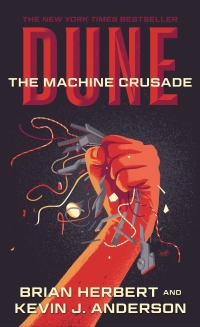
Legends of Dune: The Machine Crusade Brian Herbert and Kevin J. Anderson
Humanity is finally striking back at the overmind Omnius, who has ruled over a significant portion of humanity for millennia. Unfortunately, they are unable to establish a decisive victory over their AI overlords. Vorian Atreides, the son of the cymek Agamemnon, has defected to the side of humanity and now fights for their freedom, using his knowledge of the Titans to undermine their authority.
Herbert and Anderson are clearly using this war as a backdrop to establish the various factions that play a key role in the original Dune series. We see the seeds of the Mentats, human computers who use their mental abilities to calculate probabilities of events. Norma Cenva immerses herself within "spice gas," which is essential for creating the Navigators that allow ships to travel safely through folded spacetime.
This series is a bit odd in that the "foldspace" drive is essential to the Dune universe, being the main faster-than-light travel mechanism. However, before the foldspace drive is perfected, humans clearly had some alternate form of faster-than-light travel because it only takes weeks or months to travel from planet to planet. Herbert and Anderson are deliberately vague about how this older FTL drive works, which I think undercuts the story a bit.
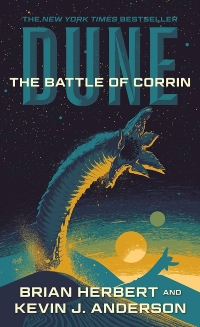
Legends of Dune: The Battle of Corrin by Brian Herbert and Kevin J. Anderson
Humanity has driven Omnius back to a single planet after humans have bombarded all of the overmind's other world with "atomics," turning them into radioactive cinders. But once again they are at a stalemate as humanity is unable to penetrate Corrin's planetary defenses. Omnius conspires with a human traitor to unleash a virulent plague on the human worlds, which threatens to wipe out humanity.
Once again we see the seeds of the future Dune universe being sown here. This time the women who will one day be known as the Bene Gesserit unlock the keys to the future, which will one day result in the Kwisatz Haderach that will save humanity from itself.
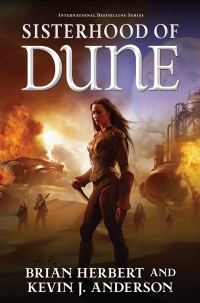
Sisterhood of Dune by Brian Herbert and Kevin J. Anderson
Sisterhood of Dune picks up about eighty years after the conclusion of The Battle of Corrin. The overmind Omnius has been defeated once and for all, but the universe is still turbulent. The Butlerian Jihad is still gathering strength and their leader Manford Torondo is determined to wipe out technology, even benign technology such as advences in medical science, because reliance on technology is what led humans to being dominated by artificial intelligence for millennia. Emperor Salvador Corrino is a weak ruler, under the thrall of Manford's Butlerian Jihad, and unable to stand up to the mobs who are tearing his Empire apart. The Sisterhood (which will one day become the Bene Gesserit) have discovered a terrible secret about the Corrino bloodline. But they are also being torn apart by the sisters who have fallen under the sway of the Butlerian Jihad.
This book was better than I thought it would be. Manford Torondo is a zealous fanatic that you love to hate because he's such an insufferable prick. I can't hardly wait to see how he finally gets his comeuppance in later books. This series is meant to show the divide between those who embrace technology and want to see civilization advance and those who prefer to tear it down because they believe that technology/science is the cause of all mankind's woes. It's explicitly mentioned that Manford's group may not be satisfied until they've outlawed fire of all things.
Tips, suggestions, recommendations, etc., can all be directed to perfessor -dot- squirrel -at- gmail -dot- com.
Disclaimer: The Earth is neither flat nor round. It's shaped like a burrito.