
Intermarkets' Privacy Policy
Donate to Ace of Spades HQ!
aceofspadeshq at gee mail.com
Buck:
buck.throckmorton at protonmail.com
CBD:
cbd at cutjibnewsletter.com
Doof:
doof2112 at proton.me
joe mannix:
mannix2024 at proton.me
MisHum:
petmorons at gee mail.com
J.J. Sefton:
sefton at cutjibnewsletter.com
The Morning Report — 10/26 /26
Daily Tech News 26 October 2026
Sunday Overnight Open Thread - October 25, 2026
Gun Thread: TXMoMe Withdrawal Edition!
Food Thread: What A Lame Post!
First World Problems...
Modern Immigration Is A Far Cry From That Of Our Ancestors
The Book Thread: October 25th, 2026 [MP4]
Daily Tech News 25 October 2026
Jon Ekdahl 2026
Jay Guevara 2025
Jim Sunk New Dawn 2025
Jewells45 2025
Bandersnatch 2024
GnuBreed 2024
Captain Hate 2023
moon_over_vermont 2023
westminsterdogshow 2023
Ann Wilson(Empire1) 2022
Dave In Texas 2022
Jesse in D.C. 2022
OregonMuse 2022
redc1c4 2021
Tami 2021
Chavez the Hugo 2020
Ibguy 2020
Rickl 2019
Joffen 2014
maildrop62 at proton dot me
Lawnmunchers Cafe
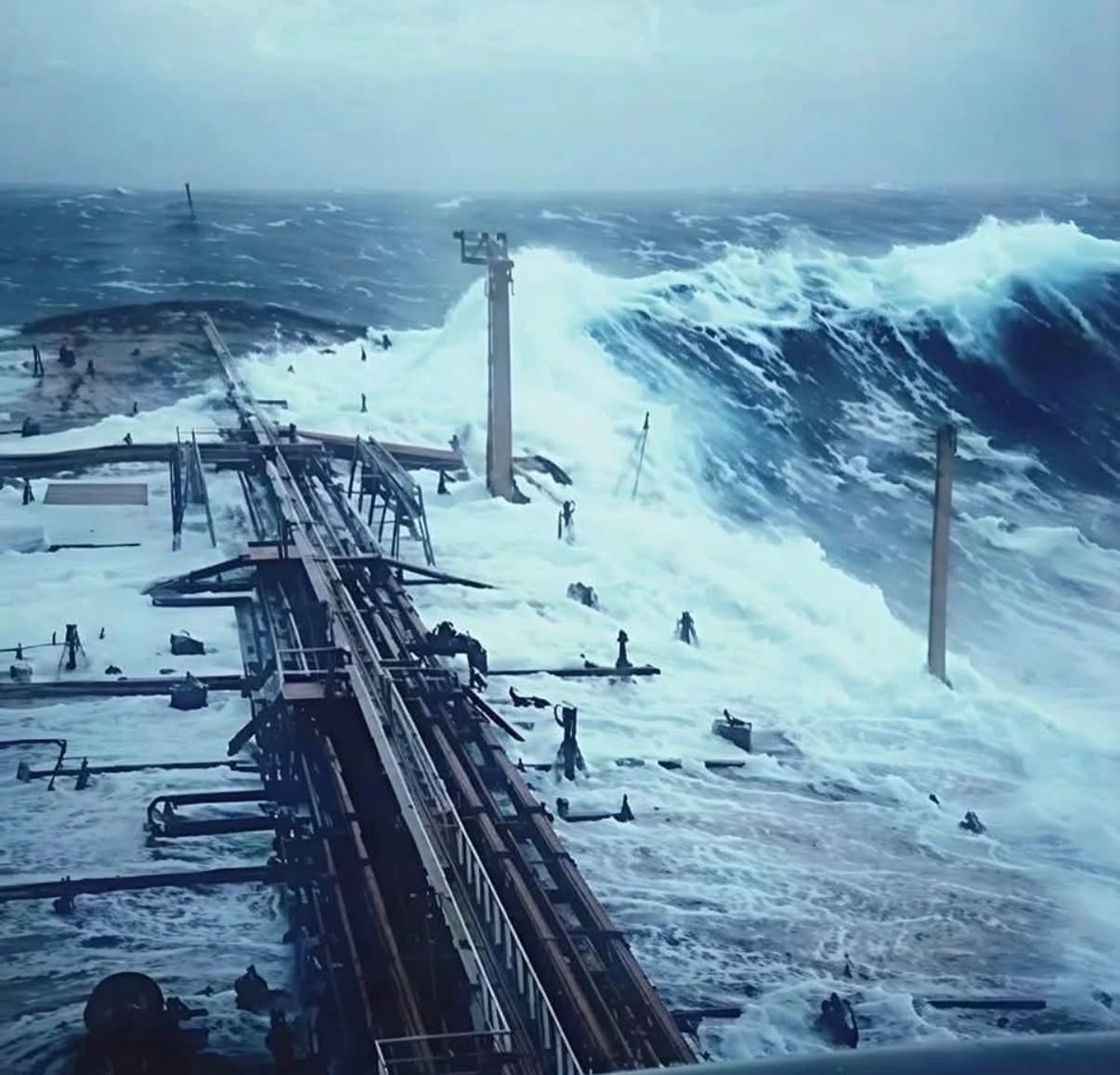
Historic Vids @historyinmemes
A genuine 1980 photograph shows the supertanker Esso Languedoc being struck by a massive rogue wave off Durban, South Africa. Captured by the ship's chief officer, the image remains one of the most famous examples of extreme ocean conditions.The photograph captured what many scientists once considered nearly impossible: a rogue wave. Taken in 1980 as the oil supertanker Esso Languedoc sailed off Durban, South Africa, it shows a towering wall of water rising far above the ship's bow. The crew estimated the wave reached around 25--30 meters (82--98 feet) high.
For much of the 20th century, rogue waves were often treated as sailor's tales because traditional wave models suggested such extreme events were almost impossible. Images like this, combined with eyewitness accounts, helped change scientific understanding. Later advances in satellite monitoring, ocean buoys, and modeling confirmed that rogue waves are real and can form when multiple wave systems combine their energy into a single massive crest.
The waters off South Africa are especially dangerous because powerful Southern Ocean swells can collide with the strong Agulhas Current, creating unpredictable sea conditions. In 1995, the Draupner oil platform in the North Sea recorded the first scientifically measured rogue wave, a 25.6-meter (84-foot) wave that provided definitive proof these extreme events exist.
Cat adopts orphaned monkey.
Little kitten already understand there is no "I" in team.
This chicken has seen Roadhouse too many times.
Rescue dogs are extra-devoted.
Hero dog chases off bear menacing little boy.
Old but fun: Boys play ball with a playful elk.
Dog really wants to turn a kiddie pool into a boat but it's not big enough to support him.
Lion misses his Emotional Support Dachshund.
He's a regular Snake Plisskin.
This kid had 25 seconds to hit 4 shots for $10K… And he delivered. pic.twitter.com/5Elg0tIdMP
— Massimo (@Rainmaker1973) July 13, 2026
Beautiful moment when, 2-yr-old Nicolly, who was blind since birth, sees for the first time. pic.twitter.com/ZodwVWWJYh
— Massimo (@Rainmaker1973) July 13, 2026
This vulture waits for the dog to die to eat it, but the dog is just enjoying some sun.
— Massimo (@Rainmaker1973) July 14, 2026
[📹 tombirchy]pic.twitter.com/p4CDXgIU7M
When you have to landscape an overgrown lawn that hasn't been tended for years, it's time to bring in the heavy machinery.
And that heavy machinery is thirty-five goats.

Ripley: ""anyway, behold! https://tinyurl.com/2febwaj8 ..."
NaCly Dog: "Thomas Bender All future dystopian movies can b ..."
Any better, I'd be twins: "The Packers and Ravens are both 4-3 and sitting la ..."
expiration date: "You won't see the blue wave troll after November 3 ..."
Thomas Bender: "The only thing I'm confident about for the electio ..."
Anna Puma: "Steelers? May have to reread John Grisham's [i] ..."
Mr Aspirin Factory: "find the Browns record extremely disorienting, but ..."
Angzarr the Cromulent: "@252 -- Sponge, I can't believe anybody falls for ..."
LinusVanPelt: "The Jalen Hurts story still blows my mind. Especia ..."
Anna Puma: "Dear Amazon seller, I will NOT pay you $36 for ..."
naturalfake: " If you haven't seen Talafreako's pre and post pl ..."
The Morning Report — 10/26 /26
Daily Tech News 26 October 2026
Sunday Overnight Open Thread - October 25, 2026
Gun Thread: TXMoMe Withdrawal Edition!
Food Thread: What A Lame Post!
First World Problems...
Modern Immigration Is A Far Cry From That Of Our Ancestors
The Book Thread: October 25th, 2026 [MP4]
Daily Tech News 25 October 2026
Paul Anka Haiku Contest Announcement
Integrity SAT's: Entrance Exam for Paul Anka's Band
AllahPundit's Paul Anka 45's Collection
AnkaPundit: Paul Anka Takes Over the Site for a Weekend (Continues through to Monday's postings)
George Bush Slices Don Rumsfeld Like an F*ckin' Hammer
Democratic Forays into Erotica
New Shows On Gore's DNC/MTV Network
Nicknames for Potatoes, By People Who Really Hate Potatoes
Star Wars Euphemisms for Self-Abuse
Signs You're at an Iraqi "Wedding Party"
Signs Your Clown Has Gone Bad
Signs That You, Geroge Michael, Should Probably Just Give It Up
Signs of Hip-Hop Influence on John Kerry
NYT Headlines Spinning Bush's Jobs Boom
Things People Are More Likely to Say Than "Did You Hear What Al Franken Said Yesterday?"
Signs that Paul Krugman Has Lost His Frickin' Mind
All-Time Best NBA Players, According to Senator Robert Byrd
Other Bad Things About the Jews, According to the Koran
Signs That David Letterman Just Doesn't Care Anymore
Examples of Bob Kerrey's Insufferable Racial Jackassery
Signs Andy Rooney Is Going Senile
Other Judgments Dick Clarke Made About Condi Rice Based on Her Appearance
Collective Names for Groups of People
John Kerry's Other Vietnam Super-Pets
Cool Things About the XM8 Assault Rifle
Media-Approved Facts About the Democrat Spy
Changes to Make Christianity More "Inclusive"
Secret John Kerry Senatorial Accomplishments
John Edwards Campaign Excuses
John Kerry Pick-Up Lines
Changes Liberal Senator George Michell Will Make at Disney
Torments in Dog-Hell
The Ace of Spades HQ Sex-for-Money Skankathon
A D&D Guide to the Democratic Candidates
Margaret Cho: Just Not Funny
More Margaret Cho Abuse
Margaret Cho: Still Not Funny
Iraqi Prisoner Claims He Was Raped... By Woman
Wonkette Announces "Morning Zoo" Format
John Kerry's "Plan" Causes Surrender of Moqtada al-Sadr's Militia
World Muslim Leaders Apologize for Nick Berg's Beheading
Michael Moore Goes on Lunchtime Manhattan Death-Spree
Milestone: Oliver Willis Posts 400th "Fake News Article" Referencing Britney Spears
Liberal Economists Rue a "New Decade of Greed"
Artificial Insouciance: Maureen Dowd's Word Processor Revolts Against Her Numbing Imbecility
Intelligence Officials Eye Blogs for Tips
They Done Found Us Out, Cletus: Intrepid Internet Detective Figures Out Our Master Plan
Shock: Josh Marshall Almost Mentions Sarin Discovery in Iraq
Leather-Clad Biker Freaks Terrorize Australian Town
When Clinton Was President, Torture Was Cool
What Wonkette Means When She Explains What Tina Brown Means
Wonkette's Stand-Up Act
Wankette HQ Gay-Rumors Du Jour
Here's What's Bugging Me: Goose and Slider
My Own Micah Wright Style Confession of Dishonesty
Outraged "Conservatives" React to the FMA
An On-Line Impression of Dennis Miller Having Sex with a Kodiak Bear
The Story the Rightwing Media Refuses to Report!
Our Lunch with David "Glengarry Glen Ross" Mamet
The House of Love: Paul Krugman
A Michael Moore Mystery (TM)
The Dowd-O-Matic!
Liberal Consistency and Other Myths
Kepler's Laws of Liberal Media Bias
John Kerry-- The Splunge! Candidate
"Divisive" Politics & "Attacks on Patriotism" (very long)
The Donkey ("The Raven" parody)