« Daily News Stuff 12 July 2026 |
Main
|
Lindsey Graham Dies; Neo-Cons Across The Country Are In Mourning »
July 12, 2026
Sunday Morning Book Thread - 7-12-2026 ["Perfessor" Squirrel]
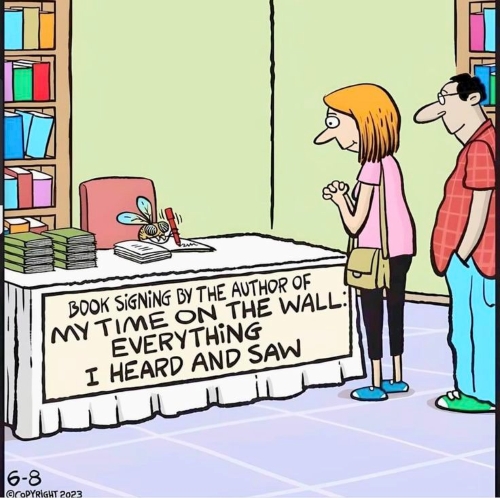
Welcome to the prestigious, internationally acclaimed, stately, and illustrious Sunday Morning Book Thread! The place where all readers are welcome, regardless of whatever guilty pleasure we feel like reading (party's over, pal! Zombie moose out front shoulda told ya!). Here is where we can discuss, argue, bicker, quibble, consider, debate, confabulate, converse, and jaw about our latest fancy in reading material. As always, pants are required, unless you are wearing these pants...
So relax, find yourself a warm kitty (or warm puppy--I won't judge) to curl up in your lap, and dive into a new book. What are YOU reading this fine morning?
GOTHIC LITERATURE
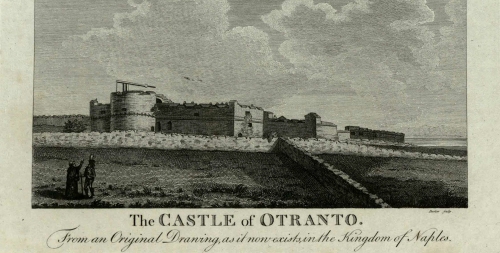
Gothic literature is widely considered to have originated with Horace Walpole's The Castle of Otranto (1764), which is subtitled "A Gothic Story" in its second edition. It established the core tropes that are still used to this day: haunted architecture, hidden identities, dark secrets, ancestral curses, and implications of a supernatural world involving itself in human affairs. Like most powerful influencers, it sparked its share of critics who thought many of the elements were absurd. Since it's in the public domain, you can read The Castle of Otranto for yourself on Project Gutenberg.
Due to its popularity The Castle of Otranto spawned a next generation of Gothic literature authors, such as Ann Radcliffe's The Mysteries of Udolpho (1794) and The Italian (1787), as well as Matthew Lewis's The Monk (1796). It's notable that Radcliffe tended towards "explained supernatural" elements in her storytelling, where the events have a rational cause, while Lewis included explicitly demonic elements in his own story. This contrast will continue down through the ages, where its not uncommon for a reader to be uncertain if the story has a supernatural component or not. That uncertainty just adds to the sense of unease within the story.
Victorian and lat 19th century authors such as Bram Stoker, Robert Louis Stevenson, and Oscar Wilde embraced the Gothic traditions in their stories, resulting in timeless classics such as Dracula(1897), Strange Case of Dr Jekyll and Mr Hyde (1890), and The Picture of Dorian Gray (1890), respectively. (All of these are available on Project Gutenberg, of course!)
So what defines gothic literature? As near as I can tell, there are a few characteristics that when combined will create a gothic story.
Atmosphere - Above all, a gothic story has a very well-defined and distinctive atmosphere or mood that is interlaced all throughout the story. At all times, the reader and the characters in story should feel a sense of unease with the events in the story. Nothing is quite as it seems. Reality itself seems to be twisted in some way, leading to events that could be influenced by supernatural forces, or maybe it's simply the nature of the story to present the ordinary in an extraordinary dark fashion. Shadows are deeper, clouds are gloomier, and whatever light is present is wan, sickly, and fails to illuminate as much as it should. A sense of dread permeates the story, impacting the decisions of the characters, and often leading them to make poor choices. In a way, the atmosphere of a gothic story is itself a character, both influencing the characters and reacting to their choices. There's often a sense of oppression layering their world as they struggle to rise above the challenges they face, which seem to be insurmountable and might very well be beyond their capabilities to face, leading to madness and death for some.
Secrets - At the heart of every gothic story, you will find a secret that's been buried deep. Part of the challenge for the characters (and the reader) is to ferret out those secrets and bring them into the light, though that can often lead to tragic circumstances. For instance, in Robert Bloch's excellent short story "Yours Truly, Jack the Ripper" one of the characters uncovers the truth behind the legend of the dreaded serial killer, but it's too late for him. Many dark secrets may be layered on top of one another, burying multiple shames and betrayals that when uncovered result in unforeseen circumstances, such as madness or suicide. In P.C. Hodgell's gothic fantasy novels Seeker's Mask and To Ride a Rathorn, the protagonist Jame is forced to delve deep into her family's history, which is thousands of years old. Going back just a few decades, she finds out the truth of the origins of one her kinsmen (Seeker's Mask) and she discovers the Shame of Tentir (To Ride a Rathorn), which has dramatic ripples in Jame's destiny in future novels.
Characters - Gothic stories are equally character and plot driven. Characters are often interconnected in suprising and complex ways. Many of the characters will have a tragic backstory that leads them to their current circumstances. Some are devils, others are fallen angels, struggling to do the right thing but weighed down by the burdens of family history. Expect a lot of brooding over past regrets. Some characters might struggle against their destiny, while others will embrace it and go with the flow, eventually leading to their own damnation. This often shows up in H.P. Lovecraft's short stories when a character discovers their origins, such as in "The Shadow over Innsmouth."
Although we often link gothic and horror together, gothic elements can be woven into any other genre. I've already mentioned P.C. Hodgell's gothic fantasies. You can also find gothic elements in science fiction (particularly in the Warhammer 40K Expanded Universe), mysteries, and suspense, as well as romance. "Gothic" is as much a layer added onto a genre as it is a genre by itself.
What are some of YOUR favorite gothic stories? Does "Gothic" hold up in the modern era?
++++++++++
++++++++++
BOOKS BY MORONS
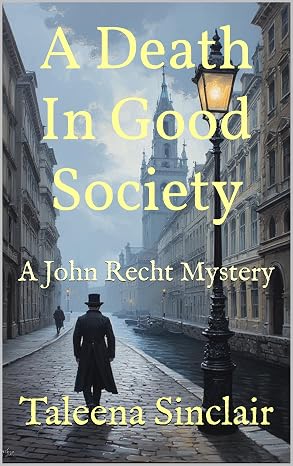
Although not explicitly Gothic, I can tell from the cover of this book that there does seem to be a hint of Gothicness in this story. The description also lends itself to supporting that idea. CBD himself said this book looks like fun and I agree!
 Hello!
I know y'all don't do promos in the book thread anymore, but I was wondering if there might be some help for a long time, mostly lurking moron-ette (lurking since 2002!). Sarah Hoyt just promo-d my new book over at her site and I was hoping for some love from the Moron Horde. My daughter says I need to shill myself some more, so here I am.
I read all the time about how conservatives need to contribute to the arts, and there is also the recurring conversation of "modern perspectives" being jammed into period pieces. I set out to write more of what I want to read: Men being men, women being women and both being clever and heroic while still being real-ish people and not cartoons.
If the fine folks at the HQ decide against it, no hard feelings and the lurking will continue.
God Bless, Taleena
A Death In Good Society
+++++
When the body of Maire Beaufort, society's adored "Angel of Waldfeld," is found propped against a canal wall in the city's most fashionable quarter, her death is more than just a tragedy; it threatens to ignite a diplomatic crisis.
Captain John Recht, former intelligence officer, is summoned from retirement to investigate on the heels of burying his wife. What begins as a straightforward murder quickly unravels into a labyrinth of deception, ambition, and betrayal. Powerful families are at odds, the palace whispers of scandal, and the Angel is at the center of it all.
As John and his trusted allies pursue truth through the salons and alleyways of a city built on secrets, they discover that the crime is only the first move in a much larger game—one that could topple governments and destroy the beginnings of John's new life.
+-----+-----+-----+-----+
WHAT I'VE ACQUIRED RECENTLY
I was pleasantly surprised by Dune: House Atreides by Brian Herbert and Kevin J. Anderson (see below), so I bought the sequels in the prequel trilogy:
- Dune: House Harkonnen
- Dune: House Corinno
WHAT I'VE BEEN READING RECENTLY
Galactic Empires: Volume 2 edited by Brian Aldiss
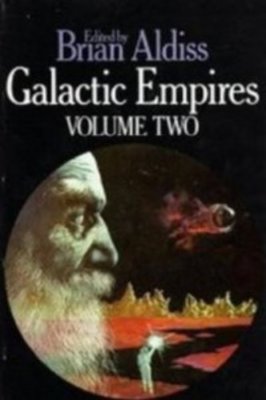
I'll probably due a Sunday Morning Book Thread focusing on "imperial" stories. I find it to be a fascinating subject as I read a lot of books that are set within a vast galactic empire. Brian Aldiss collected a number of short stories that all explore ideas of where humanity might go as a species as we advance out among the stars. Is a galactic empire even possible?
Saucer: Savage Planet by Stephen Coonts
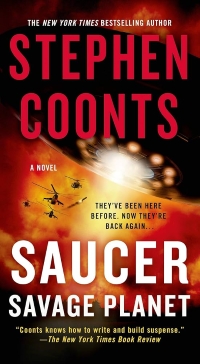
This is very much a tongue-in-cheek look at an alien first-contact story. It's not meant to be taken seriously at all, though Coonts does pose some interesting questions about how humanity would react as a species if we believed that someone on Earth had access to an alien anti-aging drug that could potentially lead to immortality. Would the drug companies want to mass market it? Or would the suppress it? Or would they deliberately limit supply so only the wealthy elite would benefit? How far will humans go in pursuit of this miraculous substance?
The Lost World by Sir Arthur Conan Doyle
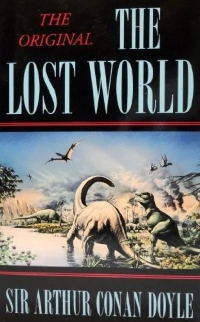
This the classic adventure story by the author of Sherlock Holmes.
Like all great adventure tales, it starts with a young man who wants to get laid. The woman he's courting insists that she can only be with someone of heroic stature.
Edward Malone, a young reporter for a third-rate London publication, decides that in order to win over her heart he will have to embark on a grand adventure. He finds a scientist who had returned from an expedition to South America with outlandish tales of giant monsters never seen before. The scientific society to which Professor Challenger belongs is highly skeptical. But in order to settle the issue, they agree to send him and a couple of observers to verify his claims. Malone is sent along by his newspaper to document the journey.
This is a classic story for a reason and it has inspired countless pulp fiction tales since it was published in 1912. Michael Crichton's Jurassic Park, for instance, is clearly an homage to Doyle's story.
Philip Jose Farmer's The Dungeon is also heavily, heavily inspired by The Lost World, particularly in how the story is framed as an expedition funded by a newspaper to search for a missing noble heir in an explored region of the world (Africa instead of South America).
I definitely recommend The Lost World if you want to read a gripping adventure story. It seems cliche at times, but that's because this is where the cliches *began*.
Willful Child by Steven Erikson
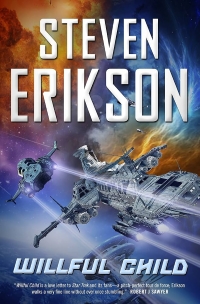
THE TRANSCREDIBLE ADVENTURES OF CAPTAIN ZAPP BRANNIGAN! HADRIAN SAWBACK!
This is a satire and parody of Star Trek featuring a captain who is approximately 3 parts Captain James T. Kirk, 1 part Captain Zapp Brannigan from Futurama, and 1 part Captain Chode from Tripping the Rift.
He's not quite as cowardly as Brannigan, but he's also not very bright. Mostly Captain Sawback succeeds through a lot of stupendous luck and a towering sense of his own infinite superiority over the Affiliation of Civilized Planets, which is run like most large bureaucracies everywhere.
Dune: House Atreides by Brian Herbert and Kevin J. Anderson
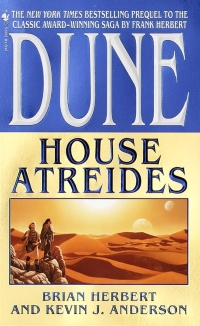
I had heard mixed reviews of the stories written by Brian Herbert (Frank Herbert's son) and Kevin J. Anderson that are set in the Dune universe. However, I got this cheap at a library book sale recently and decided to give it go.
Prequel novels have one fatal weakness: the characters have plot armor that prevents them from dying if they show up in the main storyline later. However, we do get to see the events that lead up to the main storyline, which can be engaging and interesting when done well. I was pleasently surprised in how Brian and Kevin expanded the lore of the Dune universe. It's not perfect, but they do seem to try to adhere to Frank Herbert's original intent as best they could. In the afterword, Brian and Kevin both share how they came to collaborate on this novel. According to Brian, it would not have happened if somone hadn't discovered Frank Herbert's notes on the unwritten seventh Dune novel, which was supposed to wrap the plot threads from Chapterhouse: Dune, but was never finished due to Frank's untimely death in 1986.
I had some misgivings at first about reading this book, but I wanted to give the story a fair shake and I'm glad I did. I enjoyed it enough that I immediately ordered the next two books in the series. I don't know if I'll read them all, but I may go ahead and read Frank Herbert's last three books in the series.
It's a weird, weird universe that Frank Herbert created and Brian/Kevin have added considerably to that weirdness. It's not for everyone, though. One of the more unusual aspects of this world is that there do not appear to be any alien intelligences on the million worlds of the Galactic Empire. Plenty of alien lifeforms, but none of them have sentience. Humanity has dispersed itself to conquer the galaxy, though some branches have mutated to the point where they've become alien to their original species (looking at you Spacing Guild Navigators).
By the Light of the Moon by Dean Koontz
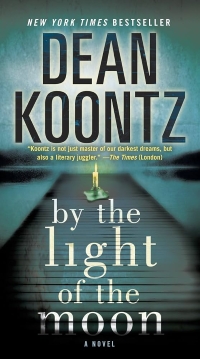
This is one of Dean Koontz's lighter and wackier horror stories. Two random strangers are injected with "stuff" that's promised to enhance them in some unspecified way. Now Dylan and Jilly must join together, along with Dylan's autistic younger brother Shepherd, to unravel the mystery of the "stuff," understand how it's changed them, and also dodge government operatives who presumably want to capture them and the "stuff" that's inside their veins.
It's not all fun and games, though, as Dylan and Jilly are drawn towards truly monstrous people engaged in horrific activities and it's up to the two of them to use their unique gifts to stop these monsters at any cost.
Tips, suggestions, recommendations, etc., can all be directed to perfessor -dot- squirrel -at- gmail -dot- com.
Disclaimer: The nuts must flow!

posted by Open Blogger at
09:00 AM
|
Access Comments