Ace: aceofspadeshq at gee mail.com
Buck: buck.throckmorton at protonmail.com
CBD: cbd at cutjibnewsletter.com
Doof: doof2112 at proton.me
joe mannix: mannix2024 at proton.me
MisHum: petmorons at gee mail.com
J.J. Sefton: sefton at cutjibnewsletter.com
A site for members of the Horde to post their stories seeking beta readers, editing help, brainstorming, and story ideas. Also to share links to potential publishing outlets, writing help sites, and videos posting tips to get published.
Contact OrangeEnt for info: maildrop62 at proton dot me
Sunday Morning Book Thread - 12-28-2025 ["Perfessor" Squirrel]
Welcome to the prestigious, internationally acclaimed, stately, and illustrious Sunday Morning Book Thread! The place where all readers are welcome, regardless of whatever guilty pleasure we feel like reading. Here is where we can discuss, argue, bicker, quibble, consider, debate, confabulate, converse, and jaw about our latest fancy in reading material. As always, pants are required, unless you are wearing these pants...
So relax, find yourself a warm kitty (or warm puppy--I won't judge) to curl up in your lap, enjoy a freshly-made batch of Chex Mix, and dive into a new book. What are YOU reading this fine morning?
VIDEO NOTE
This is a great example of how to build a proper library. I love the dome that simulates a skylight. Very nicely done. As everyone knows, a library needs a secret door so that the lord of the manor can escape when the peasants are storming the castle.
2025 READING RETROSPECTIVE
Welcome to the last Sunday Morning Book Thread of 2025! We'll fire up a whole new series of Sunday Morning Book Threads starting next week, though the format will most likely remain similar to the current format. If it ain't broke, I ain't fixing it.
Let's take a look back at 2025 and review some of my more notable reads...
Path to Ascendancy by Ian C. Esslemont -- Since I started 2024 reading Steven Erickson's Malazan Books of the Fallen, I thought it would be fun to start off with this series, which provides the backstory of how the Malazan Empire came to be. It turns out it was the greatest heist of all time, as Kellanved and his partner Dancer decided to forge an Empire from nothing using only their wits and chutzpah to make it happen. Not as good as Malazan but still a very fun read.
Watership Down by Richard Adams -- This has been recommend numerous times here, so I felt I had an obligation to give it a shot. Definitely worth it. Adams explores the life of bunny rabbits in an ordinary field in England, but he brings their whole society to life in a cool and interesting way. You can see how Adams has influenced many other authors who have used animals in their stories, such as Brian Jacques and Tad Williams.
Star Wars - New Jedi Order by various authors -- This was the initial launch of Star Wars Expanded Universe after Del Rey took it over from Bantam Spectra. It's a good thing they did, as they created a very cool space opera. It's a darned shame that the woke lunatics at Disney discarded all of this because they had a near-perfect blueprint of how they could have relaunched the Star Wars Cinematic Universe if they had adapted New Jedi Order material.
Hercule' Poirot's Casebook by Agatha Christie and The Complete Sherlock Holmes by Arthur Conan Doyle -- I'm lumping these together because they both epitomize the best of British mystery stories. Both authors have inspired countless other authors and television shows over the past hundred years or so. Absolutely well worth your time and effort to read these!
The Once and Future King by T.H. White -- One of the great classic retellings of the Arthurian legend. It's both humorous and quite dark at times. Very much a tragedy at the end. White's story has served as inspiration for numerous fantasy authors that followed in his wake.
Dracula and Other Stories by Bram Stoker -- This is one of my all-time favorite reads for 2025. I had no idea that Stoker's original telling of the vampire myth would be so compelling. I had a hard time putting it down. I now understand why it's been retold so many, many times over the past hundred years or so since it was originally published. Just an amazing story and well worth your time.
What are some of YOUR most memorable reads of 2025?
What do you have planned for 2026?
In my case, I can think of a few anticipated reads: Dragonriders of Pern by Anne McCaffrey; The Conan stories by Robert E. Howard and the later ones written by Robert Jordan; a re-read of The Dresden Files prior to reading the most recent book that comes out in early January; some more Michael Moorcock, etc.
GK CHESTERTON ON FATHER CHRISTMAS
++++++++++
++++++++++
5 PHASES OF READING FANTASY
At this point in my life, I'd definitely say I'm at stage (or phase) 5 of reading fantasy. That doesn't mean that I exclusively read that type of fantasy novel, but I can say that I've expanded my fantasy interests considerably over the past several decades.
One point that I think is lost a bit in the video above is that he's talking about CURRENT fantasy, meaning there is an enormous catalog of fantasy stories that simply didn't exist when I was growing up.
When I was a wee little squirrel, the landscape of fantasy literature was not the cultural juggernaut that it is today, thanks to the popularity of Harry Potter, The Hunger Games, and other contemporary works. It was much more of a niche field of literature. It was still easy to find and quite popular among a certain subset of readers, but it didn't dominate book sales like it does today. So Viking's comments in his video are applicable to a reader getting started in TODAY'S fantasy literature environment, but it would have looked a lot different 30-40 years ago, when I first started out on my own fantasy literature journey.
For example, in my personal experience, my journey looked something like this:
PHASE 1 - Chronicles of Narnia by C.S. Lewis; Chronicles of Prydain by Lloyd Alexander; Fairy Books by Andrew Lang, etc. Books I read when I was a child.
PHASE 2 - During my teenage years and into my adolescence, I was reading LOTS of books based on Dungeons and Dragons, such as the Dragonlance books, Forgotten Realms stories, and Ravenloft novels. I also started reading Terry Brooks' Shannara series, Tad Williams' Memory, Sorrow, and Thorn, Raymond E. Feist's Riftwar Saga, and Robert Jordan's Wheel of Time.
PHASE 3 - In my twenties and thirties, I would have moved on to other fantasy series. In fact, I didn't even get around reading Harry Potter until this stage of my life as it didn't come out until then. I also started reading The Dresden Files and The Codex Alera, both by Jim Butcher, around this time. I also loved reading Margaret Weis and Tracy Hickman (pick a series) as well.
PHASE 4 - I'm not quite sure what I'd put into this category, but it would have been stuff I've read in the last decade or so, I think. This is when "grimdark" fantasy started becoming really popular, so I read some of that, such as A Song of Ice and Fire by George R.R. Martin, The Lightbringer by Brent Weeks, and Of Blood and Bone by John Gwynne.
PHASE 5 - Finally, at the end of my journey, in the current phase, I'm going back and attempting to read a lot of the classics of the genre that have influenced the genre from the beginning. Books like Watership Down by Richard Adams, Ursula K. LeGuin's Earthsea stories, or Anne McCaffrey's Dragonriders of Pern (still in my TBR pile). I've also read the Malazan books by Steven Erickson and Ian C. Esslemont, which I would not have read when I was much younger. Very complicated plot, but awesome characters and a fun ride.
Overall, I'd say I'm a fairly well-rounded fantasy reader, though I have my preferred tastes. Now that I'm entering my twilight years, I don't know that I'll branch out as much as I might have in the past, simply because the market is so over-saturated with content. I wouldn't even know where to start with a new author unless I have a really good recommendation from someone I trust.
Have you gone through phases like this in your life?
+-----+-----+-----+-----+
MORON RECOMMENDATIONS
How does one clear the name of an accused murderer if he refuses to cooperate, is also a duke, and your brother? This is the quandary facing Lord Peter Wimsey in Dorothy Sayers' Clouds of Witness. In the story, the fiancé of their sister is found dying of a gunshot wound in the middle of the night, in the Duke of Denver's lodge with the Duke standing over him.
Peter Wimsey immediately races to the scene to try and clear his brother, but the Duke refuses to discuss the case, relying on the House of Lords to clear him. Wimsey must trace the clues of fiancé Cathcart's life and death to find out the truth. He must travel to Paris and then eventually New York to ferret out the answers, and then make a risky transatlantic flight to produce his evidence before the House.
The story involves several twists, including a member of the socialist party who is an additional suitor for his sister, a nearly fatal encounter in a bog near the manor, and dissembling by both his brother and sister. With a twist at the end, Wimsey wraps up the case with a shocking testimony in the House of Lords. This is another clever novel from one of the titans of the golden age of British mysteries.
Posted by: Thomas Paine at December 21, 2025 09:18 AM (0U5gm)
Comment: An American author, Edgar Allan Poe, might have created the detective mystery genre, but I think the British may have perfected it. Seems like a lot of early detective mystery authors came from the British Isles. That's not to say there aren't excellent American mystery authors, of course. However, I suspect a lot of them were influenced by British authors like Sir Arthur Conan Doyle, Dame Agatha Christie, and Dorothy Sayers, among others.
++++++++++
Reading Piano Man by Charles Beauclerk, a biography of British pianist John Ogdon.
Winner of the 1962 Tchaikovsky Competition. Ogdon was a prodigiously talented pianist with a huge repertoire and extraordinary technique. But he had lifelong mental problems. He was the child of a tyrannical lunatic father and an unloving stage mother. His success at the keyboard led his agency to overwork and underpay him.
In 1973, he had a severe breakdown due to bipolar disorder. He never truly recovered and was in and out of mental institutions before dying in 1989 of undiagnosed diabetes. Even through all this, he continued to perform at an astonishing level, including a complete performance of Sorabji's 4 1/2 hour Opus Clavicembalisticum.
Posted by: Hadrian the Seventh at December 21, 2025 11:00 AM (tgvbd)
Comment: What is it about genius-level talent that it seems to come with a lot of drawbacks? Geniuses often seem to have terrible backgrounds in their lives, or suffer from other mental or physical disorders that hinder their abiliy to interact with normal people. They can be supremely competent in one or two areas, but may have extreme difficulties in leading a normal life. And yet, without them, human progress as a species might not be possible.
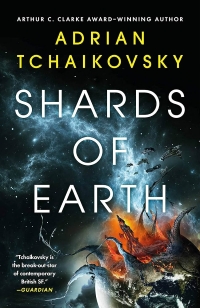
The Final Architecture Book 1 - Shards of Earth by Adrian Tchaikovsky
As I mentioned last week, I purchased this series with gift cards from my bosses at work. It's not a bad series at all, though I don't think Tchaikovsky lives up to the hype I've seen elsewhere.
The Architects--inscrutable, invulnerable, inevitable. They came from the the depths of unspace to remake inhabited planets, twisting them into bizarre, otherwordly, yet also beautiful artworks. Earth was only one of their most recent victims--ten billion souls wiped out in just a few hours as an Architect turned our beautiful blue jewel of a planet inside out. Nothing could stop them. Until one woman was able to form a psychic connection with an Architect to ask it one simple question: "Why?" Then they disappeared for over fifty years, while the rest of the galaxy recovered from the onslaught.
Now they are back and only one man, a broken remnant from the Intermediary program that stopped the Architects in their tracks, may hold the key to stopping them again. Unfortunately, every faction in the galaxy--both human and alien--now wants Idris on their side, as they know he's one of the very few people in history to survive an attack from an Architect. His mysterious gifts within unspace allow him deep insight into the Architects' mad schemes for reforming the galaxy on their terms.
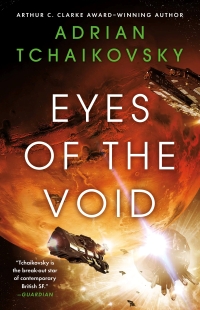
The Final Architecture Book 2 - Eyes of the Void by Adrian Tchaikovsky
Idris and his companion Solace have stopped an Architect once again, at the same distant planet where they destroyed an Architect before. The Architects haven't forgotten. The Essiel Hegemony, once thought to be the only race capable of guarding planets against an Architect's attack have been proven to be as impotent as the rest of the galaxy. The Architects have also revealed a tiny weakness, a chink in their near-invincible armor that Idris and his companions hope to exploit to understand the Architects' overall goal and perhaps save the remaining human colonies. Unfortunately, galaxy has devolved into a bickering shooting war over trivial nonsense, instead of uniting to face the new threats.